
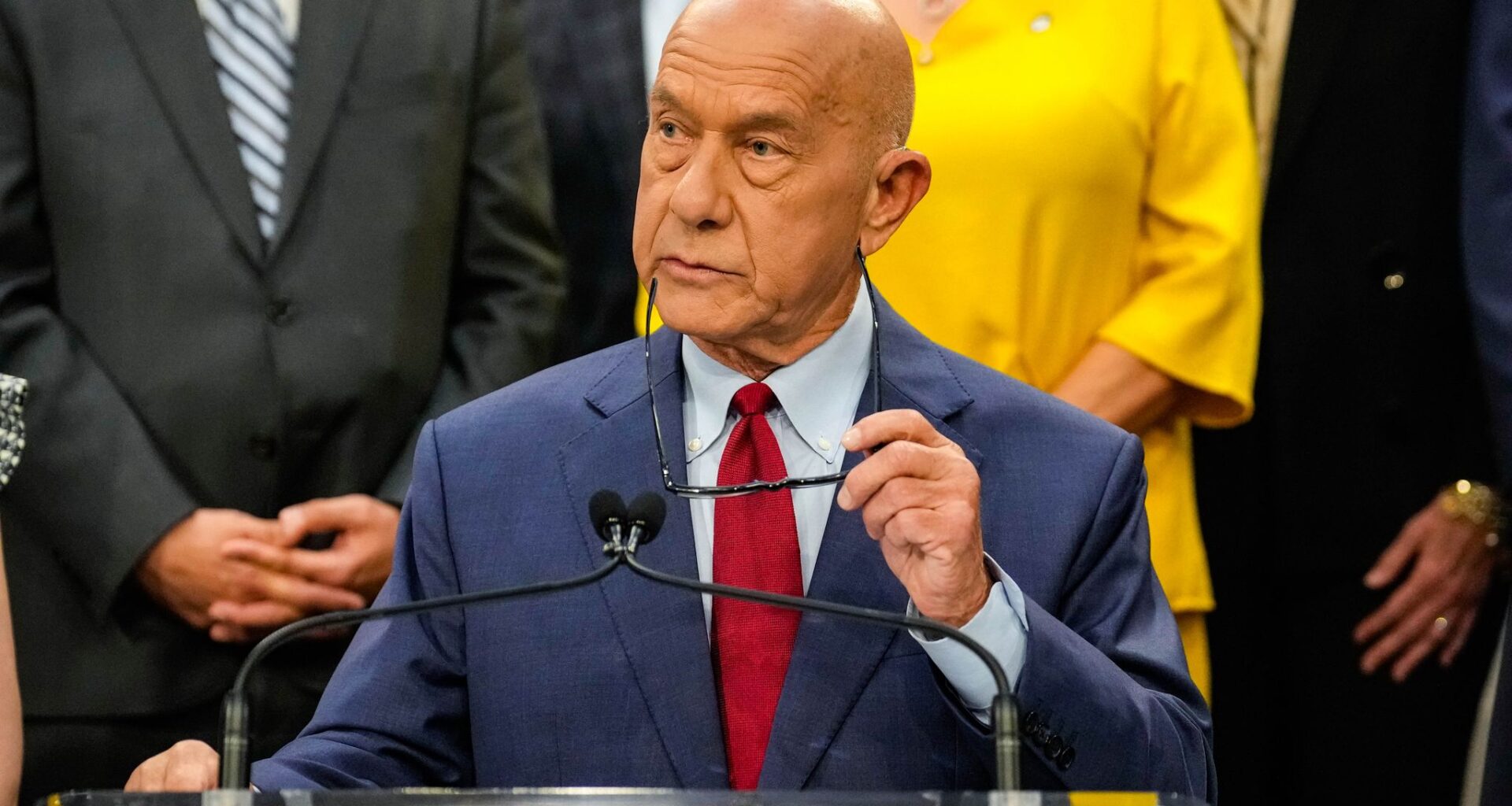
Houston Mayor John Whitmire speaks about his proposed 2027 budget and a new trash fee proposal during a presentation at City Hall in Houston, Tuesday, May 5, 2026.
Raquel Natalicchio/Houston Chronicle
Mayor John Whitmire campaigned on rooting out waste, corruption and conflicts of interest in city government, but has not reformed Houston’s ethics policies despite pressure from council members and recent incidents revealing gaps in how the city investigates allegations of wrongdoing.
The city’s main investigative office lacks transparency and independence from the mayor’s office, the council members seeking reform say, while the Houston Ethics Commission can operate openly but has no teeth – and hasn’t met in perhaps a decade.
Two recent cases have highlighted some of these weaknesses.
Article continues below this ad
RELATED: Mayor Whitmire accused Chris Hollins of ‘pay to play.’ Investigators quietly closed the case.
Whitmire’s office last year referred a “pay-to-play” allegation against Controller Chris Hollins to the city’s main investigative arm, the Office of Inspector General, which is housed inside the city legal department.
The OIG quietly closed the case last fall. As most of the office’s work is confidential, the only publicly available information on the case was a label stating the complaint was “not sustained” in a document the Houston Chronicle obtained through an open records request.
Though the city Ethics Commission can handle allegations against office holders and other city officials, the Hollins matter was not referred to the commission.
Article continues below this ad
Neither was a case that became public last summer in which Council Member Tarsha Jackson requested favors from a city contractor via text message. Records show the matter was not referred to the commission or the OIG, which also can investigate elected officials, along with most other city employees.
DEVELOPER FAVORS: Houston council member sought favors like personal home repairs from city contractor, records show
Andrew Cates, a lawyer and expert on Texas ethics laws, said Houston’s ethics commission, like others across the state, lacks the staff and expertise to be effective. The inspector general has broader investigative authority, he added, but is less transparent.
“These systems only work if you keep up with them, and you keep them evolving and you keep them funded,” Cates said, adding that failing to do so means, “You did the job for all the bad actors on their behalf.”
City Attorney Arturo Michel and council members have said the Whitmire administration is working on OIG reforms but have not described what changes might occur. Whitmire’s office did not respond to requests for comment.
Article continues below this ad
Several council members have proposed making the OIG more transparent and more independent from the mayor’s office.
Council Member Joaquin Martinez has proposed letting city council appoint the inspector general to a four-year term. The role currently is selected by the mayor for an unlimited term. The city attorney, who runs the legal department in which the OIG is housed, also is chosen by the mayor.
Council Member Julian Ramirez has also pitched proposals that would outline the information the inspector general could make public as the office investigates misconduct.
“The way it’s set up now allows wrongdoing, I think, to skirt under the radar,” Ramirez said. “And I’m not saying this is what the mayor wants to have happen. This is independent of who holds the office.”
Looking at ‘a big change’
Another reform proposal would give the ethics commission more teeth – but council members seemed surprised at how limited its role has become in a recent hearing on the idea.
Article continues below this ad
Martinez and Council Members Amy Peck and Twila Carter have proposed letting the commission sanction officials who are found guilty of impropriety through mandatory public disclosures, restitution, ethics trainings and other measures.
But the commission largely operates in an “advisory” fashion, making recommendations to the mayoral administration about what complaints to investigate yet unable to exercise investigatory power, said Rashaad Gambrell of the city attorney’s office. Asked when the commission last met, Gambrell said it was likely at least a decade ago.
Partly this is because the commission has voted over time to relinquish its powers, he said, such as by making city attorneys responsible for reviewing campaign finance filings and making the OIG its main investigatory body.
“If the ethics commission isn’t meeting, but the legal department is doing work and the OIG is doing work, is there even a need for the ethics commission?” Peck said at the July 7 council hearing. “Do we give them more to do? Or do we disband that and make sure that the work the legal department is doing is more transparent to this committee and to this body?”
She continued: “Maybe we just need to look at making a big change here.”
Article continues below this ad
Whether changes occur comes down to priorities, said Martinez, who proposed his OIG reforms in June. He said he is in talks with the mayor’s team but said the mayor wants to retain the power to appoint the inspector general.
“What does become difficult is as you’re running a city, how do you prioritize all the priorities?” said Martinez, an ally of the mayor. “There’s a lot of priorities right now.”
Ramirez, who has been in talks with the administration about potential ethics reforms for more than a year, agreed.
“It’s a process,” Ramirez said. “In a strong-mayor form of government, you’ve got to make progress where you can and when you can.”