
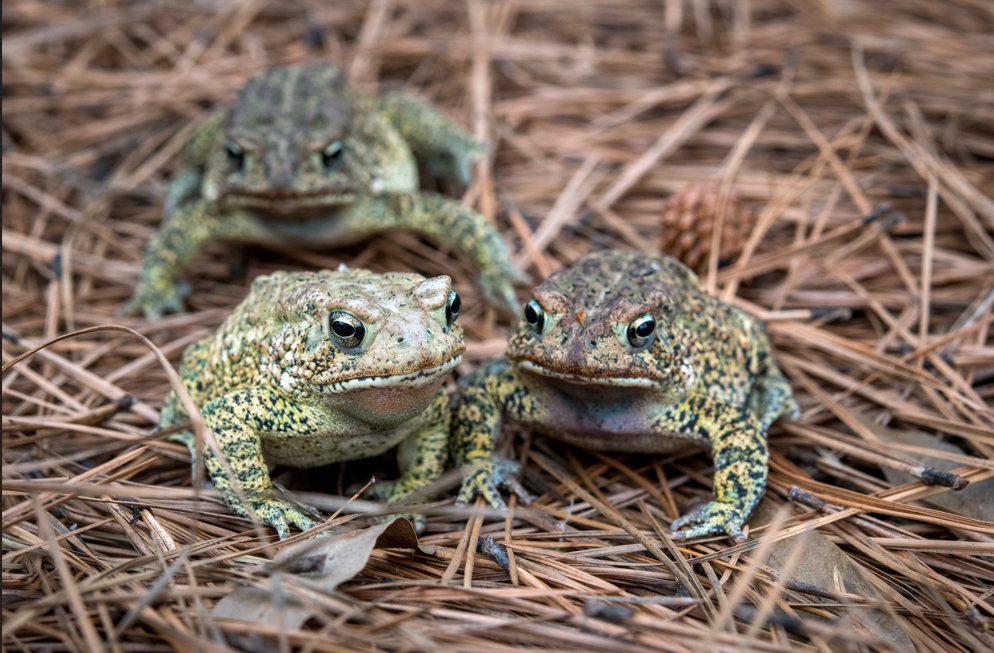
The endangered Houston toad has disappeared from most of its historic range, but decades of captive breeding, egg releases and habitat restoration are helping the species rebound in parts of Central Texas. Houston toads seen in 2019.
Houston Zoo
The Houston toad may no longer live in the city it’s named for.
Urban growth pushed the small, warty amphibian out of most of the region decades ago. Today, it survives in only a few Texas counties.
But in Central Texas, the toad is showing signs of a comeback.
Article continues below this ad
This spring, wildlife officials and conservation groups released 1.6 million Houston toad eggs into protected habitats in Bastrop County. The massive release was part of a decades-long effort involving the Texas Parks and Wildlife Department, the Houston Zoo, the Amphibian and Reptile Conservancy, the U.S. Fish and Wildlife Service and other Texas zoos.
Now researchers are finding breeding adults at sites where the species had nearly disappeared.
ALSO READ: Private money is shifting Texas oyster reef conservation. Will it be enough?
The effort is testing whether decades of captive breeding, egg releases and habitat restoration can rebuild a self-sustaining population of a species nearly wiped out by development, drought and wildfire. Scientists still don’t know whether those populations can sustain themselves without millions of additional eggs.
Article continues below this ad
That uncertainty makes the early results more striking.
A comeback takes shape
When Michael Forstner began studying the Houston toad in 1991, no amphibian species had ever recovered through population supplementation.
For the first time in nearly a decade, researchers have documented resident populations at Bastrop State Park and Griffith League Ranch, a nearly 5,000-acre conservation property owned by Scouting America, formerly the Boy Scouts of America.
Houston toad populations, already low, dwindled at both sites after the 2011 Bastrop County Complex Fire.
Article continues below this ad
The endangered Houston toad has disappeared from most of its historic range, but decades of captive breeding, egg releases and habitat restoration are helping the species rebound in parts of Central Texas. Researchers with Texas State University, the U.S. Fish and Wildlife Service and the Houston Zoo toad conservation program released Houston toad eggs in Bastrop State Park in March 2019.
Michael Minasi/Reporting Texas, Austin American-Statesman
“There’s nothing easy about fixing a problem like this,” said Forstner, a Texas State University professor. “But a bunch of people are now trying. We have tools we didn’t have, and it feels like we’re actually making some progress, which is pretty kick-ass.”
The Houston toad once lived in as many as 14 Texas counties. Today, it remains in only a few counties.
The federal government listed it as endangered in 1970, making it one of the first amphibians protected under a law that preceded the Endangered Species Act, according to Texas Parks and Wildlife.
By then, development had erased much of its habitat in the Houston area. Prolonged drought reduced populations elsewhere, and the 2011 fire drove them down further, Forstner said.
Article continues below this ad
Breeding a lifeline
Scientists concluded in 2006 that the species needed a captive population as insurance against extinction. The Houston Zoo joined the recovery effort and began breeding toads.
The strategy shifted in 2014. Instead of focusing mainly on captive toads, the program began producing eggs for release into wild habitats. Conservationists also built and restored ponds where the toads could breed.
“The idea behind that was just to get as much biomass out into the wild as possible,” said Matt Lammers, the zoo’s Houston toad recovery coordinator.
The endangered Houston toad has disappeared from most of its historic range, but decades of captive breeding, egg releases and habitat restoration are helping the species rebound in parts of Central Texas. More than one million Houston toad eggs have been released at Bastrop State Park over Spring 2026.
Courtesy of Texas Parks and Wildlife
The season begins in winter or early spring and lasts about 11 weeks, Lammers said.
Article continues below this ad
The Houston Zoo keeps about 800 Houston toads. Roughly 12,000 live across all participating facilities, including other Texas zoos and a U.S. Fish and Wildlife Service hatchery in San Marcos.
The Houston Zoo splits its breeding population among three rooms to guard against disease or another disaster and to preserve genetic diversity. About 99% of the eggs go into the field, Lammers said.
The program first released 1 million eggs in 2018. The Fort Worth Zoo joined the effort in 2016, followed by the Dallas Zoo and the federal hatchery in 2020.
The land behind the recovery
Many of the eggs went to Griffith League Ranch, one of the program’s main recovery sites.
The ranch, now owned by Scouting America, is one of the few remaining land grants from the Republic of Texas. It became federally designated Houston toad habitat in 2006 and has participated in the recovery effort since the early 2000s.
ALSO READ: Goat Island’s 1,483 acres of marsh will be preserved in Galveston Bay. Here’s why it matters.
Volunteers help clear vegetation on the property, said Charles Mead, director of marketing and public relations for Scouting America’s Capitol Area Council.
“You don’t often get the chance to truly have the values that you speak about come to life, and this is a chance for us to do that,” Mead said.
Forstner said successful conservation requires three tenets: landowners willing to protect habitat, government agencies willing to work with them and scientists who can guide the recovery.
“You need the nerds — the full-on, oh my God, horn-rimmed glasses nerds,” he said.
Texas had as many as 2,000 adult Houston toads as of July 2025, Forstner said.
Conservationists have released a total of 15 million eggs since 2013.
The program has expanded into Milam and Austin counties, and Forstner hopes it will reach more sites.
Can the toad ever come home?
Houston, however, is likely another matter.
Returning the toad to Harris County would require years of habitat restoration and protection, Forstner said. Lammers doubts the species could overcome the region’s development and environmental pressures.
But the gains in Bastrop County have given researchers something they lacked for years: enough toads to study.
“You can’t study toads if you don’t have any toads,” Forstner said.