
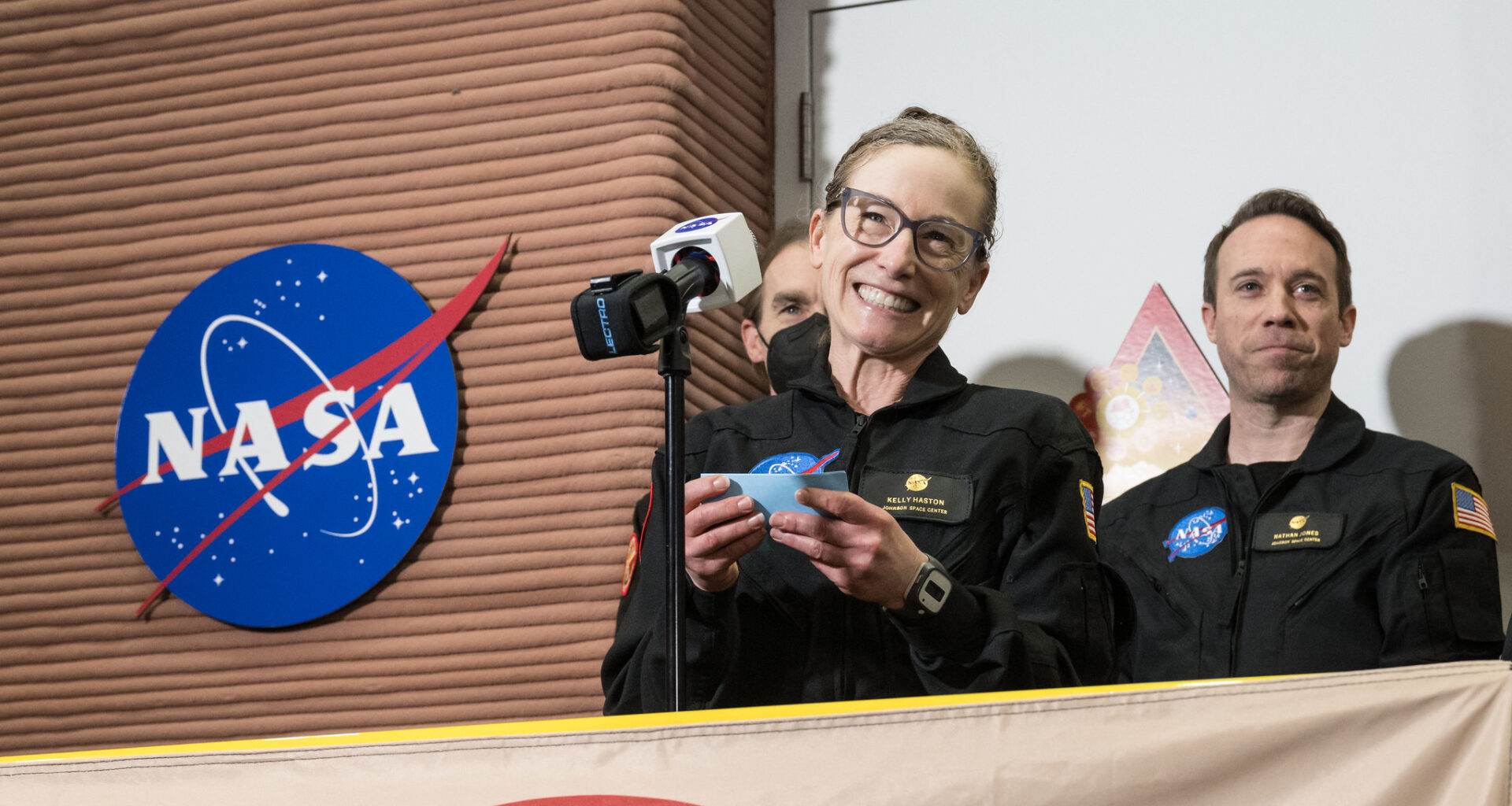
Kelly Haston speaks on July 6, 2024, after completing 378 days inside a Mars analog at NASA’s Johnson Space Center in Houston.
Josh Valcarcel NASA John/NASA/Josh Valcarel
Kelly Haston was beaming as she returned to the 1,700-square-foot habitat she shared with three others on “Mars.”
“I was looking up at the sun today, and it was just so nice to be outside,” Haston recalled telling her crewmates.
Article continues below this ad
Haston had not actually gone outside. She’d worn a fake spacesuit and walked on a treadmill. A virtual reality headset gave the illusion of sunlight.
FAKE MARS: Meet the 4 strangers who will live on ‘Mars’ for a year in NASA’s Johnson Space Center in Houston
Treadmills are shown at NASA’s Johnson Space Center on Tuesday, April 11, 2023, in Houston before four people began their one-year mission pretending to live on Mars. The crew wore virtual reality headsets and walked on these treadmills to simulate a “Marswalk.”
Melissa Phillip/Staff Photographer
A CHAPEA crew member participates in a simulated “Marswalk” inside the 1,200-square-foot sandbox, which is filled with red sand to mimic the Martian landscape, at NASA’s Johnson Space Center in Houston.
NASA/CHAPEA crew
Machines are shown in a Mars sandbox at NASA’s Johnson Space Center on Tuesday, April 11, 2023, in Houston before four people began their one-year mission pretending to live on Mars.
Melissa Phillip/Staff Photographer
Boots coated from the Mars sandbox are shown at NASA’s Johnson Space Center on Tuesday, April 11, 2023, in Houston before four people began their one-year mission pretending to live on Mars.
Melissa Phillip/Staff Photographer
From left, Kelly Haston, Dr. Nathan Jones, Anca Selariu and Ross Brockwell pose for a picture on July 6, 2024, after completing 378 days living inside a Mars analog at NASA’s Johnson Space Center in Houston.
Josh Valcarcel NASA John/NASA/Josh Valcarel
A bedroom is shown in the Mars Dune Alpha habitat at NASA’s Johnson Space Center on Tuesday, April 11, 2023, in Houston before four people began their one-year mission pretending to live on Mars.
Melissa Phillip/Staff Photographer
The crew grew vegetables during their one-year Mars analog at NASA’s Johnson Space Center.
NASA/CHAPEA crew
This photo shows food used to celebrate Christmas during a one-year Mars analog at NASA’s Johnson Space Center.
NASA/CHAPEA crew
The crew grew vegetables during their one-year Mars analog at NASA’s Johnson Space Center.
NASA/CHAPEA crew
The crew grew vegetables during their one-year Mars analog at NASA’s Johnson Space Center.
NASA/CHAPEA crew
A dessert is used to celebrate Ross Brockwell’s birthday during the one-year Mars analog at NASA’s Johnson Space Center in Houston.
NASA/CHAPEA crew
Kelly Haston speaks on July 6, 2024, after completing 378 days inside a Mars analog at NASA’s Johnson Space Center in Houston.
Josh Valcarcel NASA John/NASA/Josh Valcarel
A sandbox is shown at NASA’s Johnson Space Center on Tuesday, April 11, 2023, in Houston before four people began their one-year mission pretending to live on Mars. This sandbox simulated the Martian surface where the crew conducted science and maintained their habitat.
Melissa Phillip/Staff Photographer
From June 2023 to July 2024, Haston and her crewmates spent 378 days inside a warehouse at NASA’s Johnson Space Center. They pretended to be astronauts living on Mars. They ate shelf-stable food, restricted their water and suffered through communication delays with family.
NASA has used the mission – along with a second one-year mission that began last October – to study the physical, mental and social challenges that could affect future explorers on the Red Planet.
Article continues below this ad
The agency is now accepting applications for a third mission slated to start in August 2027, though this crew should be prepared for even tighter quarters. Most of the mission will be spent inside a 650-square-foot spacecraft.
“We’re just evolving into the next step,” said Renita Fincke, manager for spaceflight analogs in NASA’s Human Research Program. “We’ve done these analogs for surface missions. How can we also simulate some of these long journeys – very, very long journeys – that it’s going to take to get to Mars?”
The upcoming crew will spend five months pretending to fly to Mars, two months living on the Red Planet and another five months returning to Earth.
NASA is seeking four people between 30 and 55 years old with a technical background – preferably an advanced STEM degree. They must be a U.S. citizen or green card holder and cannot be taller than 6-foot-2.
The selected crew will be paid hourly wages, though NASA would not say how much.
Article continues below this ad
“We are looking for as close to an astronaut-like population as possible,” Fincke said. “A lot of it is knowing that you can handle being in a yearlong confined environment.”
Life on Mars
Haston, now 55, is a research scientist. Her crew included Ross Brockwell, a structural engineer and public works administrator; Anca Selariu, a microbiologist in the U.S. Navy; and Dr. Nathan Jones, an emergency medicine physician.
Before embarking on their mission, they created spreadsheets to ensure they wouldn’t bring the same personal items. Only one person needed to bring the small tinsel Christmas tree that they decorated with handmade items, Haston said. They spent the year in a nondescript warehouse on NASA’s sprawling campus that workers would drive past during their daily commutes.
Her favorite days were spent on the treadmill virtually exploring Mars. The hard days were learning something went wrong with friends and family. She recalled one friend crying in an audio message after her pet had died.
Article continues below this ad
HABITAT: See inside NASA’s ‘Mars’ habitat, where four people will simulate life on the Red Planet for a year
The crew celebrated holidays, including Christmas and New Year’s, inside their Mars habitat. Pictured, from left, are Ross Brockwell, Anca Selariu, Dr. Nathan Jones and Kelly Haston.
NASA/CHAPEA crew
The crew celebrated holidays, including Christmas and New Year’s, inside their Mars habitat. Pictured, from left, are Ross Brockwell, Anca Selariu, Dr. Nathan Jones and Kelly Haston.
NASA/CHAPEA crew
“In your normal life, you would go spend time with them,” she said. “You would find ways to alleviate their pain or their sadness if you could. I found it really tough because I’m a problem solver, and so I really like to help when things are bad.”
Eating the shelf-stable food was less of a challenge, though Haston did miss crunchy items. She used freeze-dried food that she didn’t rehydrate as a garnish for her meals.
The crew got every Sunday off, and she often used her free time to embroider. She made a Mars plaque for each of her crewmates, and she treasured the hand-drawn pictures or special meals they made for her, too.
Article continues below this ad
They were intentional about handling squabbles, she said, and grew attuned to each other’s needs and communication styles.
“We were a crew that did not want to have big blowups,” Haston said.
The journey
But Haston felt something was missing from their experience, especially the challenges of long periods spent in transit to and from Mars. On the way home, in particular, there would be fewer tasks and the crew would be in a smaller area. They’d probably be irking one another by this point, “even if you love them,” she said.
NASA’s next simulated mission will start in a 650-square-foot pretend spacecraft, which is 60% smaller than the living area of Mars Dune Alpha where Haston spent most of her time.
The spacecraft will have three levels. The first has a workspace and bathroom. The second has the kitchen, exercise equipment and storage. The third has four private crew quarters – essentially bunks with privacy curtains.
The crew will spend five months in this spacecraft before moving to the Mars habitat.
EXPERIENCE: Participants reflect on life on ‘Mars’ as yearlong NASA simulation mission prepares to end
Nathan Jones participates in a simulated “Marswalk” inside the 1,200-square-foot sandbox, which is connected to the habitat through an airlock, at NASA’s Johnson Space Center in Houston.
NASA/CHAPEA crew
At roughly 900 square feet, this reconfigured habitat will be about half as large as it was on previous missions. Another first could be the addition of a rover module with two beds and a non-flushable toilet to simulate long-distance driving expeditions on the Red Planet.
NASA will study how the crew is affected by the mission’s isolation, confinement and communication delays, Fincke said. It could take up to 22 minutes for a message to reach Mars.
This new yearlong mission could help shape NASA’s Artemis Program that seeks to return humans to the lunar surface in 2028 and then build a moon base to create a long-term presence. For instance, participants could test wearable devices or portable medical equipment that might be used on the moon, Fincke said.
“We can test some of these technologies quicker, faster and more effectively,” Fincke said, “and also check things like reliability and safety and all that before we take it into an actual mission.”
Coming home
Haston initially felt overwhelmed when she emerged from Mars Dune Alpha. “We’d go into a supermarket,” Haston recalled, “and I’d be like, ‘Wow, so much to look at.’”
She spent six months traveling, visiting family and teaching part time at San Francisco State University. She’d left her job before beginning the mission and has since joined a biotech firm.
Haston said the experience gave her three lifelong friends and a deeper appreciation for the various ways people express themselves. And she’s proud to have supported the science that will help keep people safe as NASA pushes toward the moon and Mars.
“Coming out and seeing what we contributed to in a small way,” Haston said, ” … that was really, in the end, what I took away from it.”