
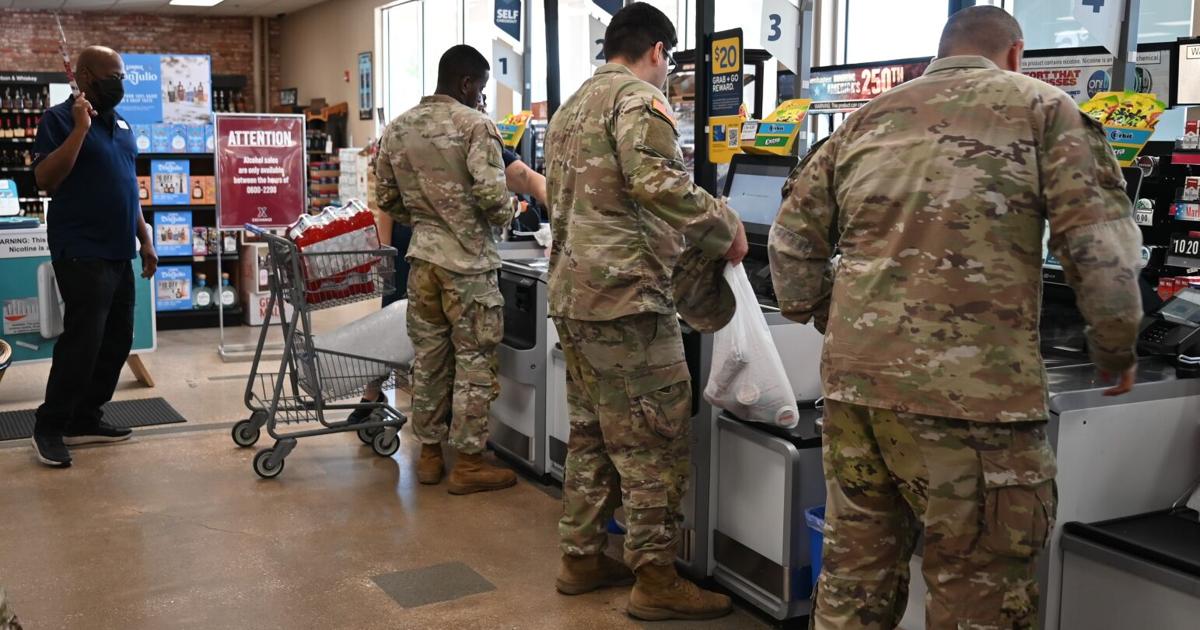

Soldiers shop at the III Corps Express Tuesday at Fort Hood. The Texas Comptroller’s impact analysis states a large percentage of the installation’s economic impact stems from disposable income from Soldiers, families and civilians.
Photo by Janecze Wright, Fort Hood Public Affairs
Fort Hood has a long-standing reputation as a community cornerstone, but a recent report issued by the Texas Comptroller detailing the installation’s nearly $38 billion contribution to the Texas economy in 2025, magnifies the extent of The Great Place’s impact beyond installation gates.
The staggering amount was highlighted in the recent impact analysis developed in collaboration with the Texas Military Preparedness Commission, which “measures the direct and indirect economic contributions of military installations in Texas through employment, economic output, gross domestic product and disposable personal income,” as reported by comptroller.texas.gov.
Contractors pave the road in front of III Armored Corp Headquarters Tuesday at Fort Hood. Continuous construction and upkeep not only supports the installation’s commitment to quality of life, but creates employment opportunities for contractors and civilians who contribute to the economic stability of the state.
Photo by Janecze Wright, Fort Hood Public Affairs
“The Texas Comptroller’s 2025 Economic Impact Analysis of Texas Military Installations reinforces what we have long known — Fort Hood’s value extends far beyond our role in defending the nation,” Col. Mark McClellan, U.S. Army Garrison-Fort Hood commander, expressed. “The report highlights nearly $38 billion in economic stimulus and the support of almost 160,000 jobs, but behind those numbers are Soldiers, civilians and military families at the heart of our connection to the Central Texas community and we are proud to give back to the communities that so strongly support us.”
From its start in 1942 to its current standing as the premier installation for global deployment and training, Fort Hood represents one of 14 Texas military installations that support the nation’s defense and drive the economic momentum for communities throughout the state with a combined $148.8 billion, a quarter of which Fort Hood generated.
The report estimates as of 2025, Fort Hood was home to nearly 160,000 direct and indirect employees, including more than 34,000 active-duty military personnel, and over 126,000 military retirees who use installation resources. Additionally, the report estimated Texas military installations generated nearly $44 billion in disposable personal income, with Fort Hood contributing approximately a quarter of that amount.
“Fort Hood’s mission requires a large, permanent workforce of active-duty Soldiers, civilian employees and contractors,” explained Donna Tomsic, management analyst, Fort Hood Plans, Analysis and Integration Office. “This creates stable, long-term employment that anchors the regional economy. Military pay is reliable and consistent, providing economic predictability. Their stable income, predictable spending patterns and community engagement contribute to economic growth.”
The Great Place’s revenue also stems from intergovernmental support agreements, or IGSAs, and integral community partnerships.
Tomsic noted Fort Hood has 28 Memorandums of Agreement and 16 Mutual Aid Agreements with local cities, police departments, fire departments, school districts and other community partners to serve the population of Fort Hood, highlighting one partnership that led to a historic moment for the installation.
“In a landmark community partnership, the City of Harker Heights, Fort Hood and the Texas Military Preparedness Commission have commissioned the U.S. Army’s first 100% battery-powered electric locomotive at Fort Hood, Texas,” Tomsic said. “This project was made possible through a Defense Economic Adjustment Assistance Grant (DEAAG) and is also part of an energy-resiliency project in collaboration with Dominion Energy, Fort Hood’s utility privatization partner for electric and natural gas systems.”
The initiative directly enhances mission readiness and establishes a vital new capability — a 2.4-megawatt mobile power source that guarantees continuity of operations for the power projection platform, Tomsic added.
Other major collaborations include the Energy Resiliency Storage System, which provides electric grid stability and continued operation to the substation serving 25 facilities including Robert Gray Army Airfield; the Fort Hood premier Power Projection Platform and five installation family housing communities through a partnership with the city of Copperas Cove and a $5 million DEAAG; the Mass-Transit IGSA, a partnership with the Hill Country Transit District that launched the Cavazos Connector, the first of its kind, free, on-post, mass-transit system, in 2023; and the North Fort Hood Recreation Services IGSA that provides a recreation center operated by the Gatesville Parks and Recreation Services Division.
“Fort Hood and our community are partners in prosperity,” Tomsic said. “The post brings jobs, spending and growth that ripple throughout Central Texas. When Fort Hood is strong, our neighborhoods are stronger. Better employment, more local business, improved services — these benefits reach every corner of our area. It’s simple: Fort Hood’s success is the community’s success.”
The numbers and economics tell a powerful story, but true wealth comes from a bond money cannot buy, McClellan conveyed.
“Readiness does not begin and end at our installation gates; it is sustained by the trust, strong partnerships and shared economic commitments we build with our
neighbors,” he expressed. “As a major economic driver in the region, we are proud to serve here, invest here and remain an enduring partner in the continued growth and success of Texas.”