
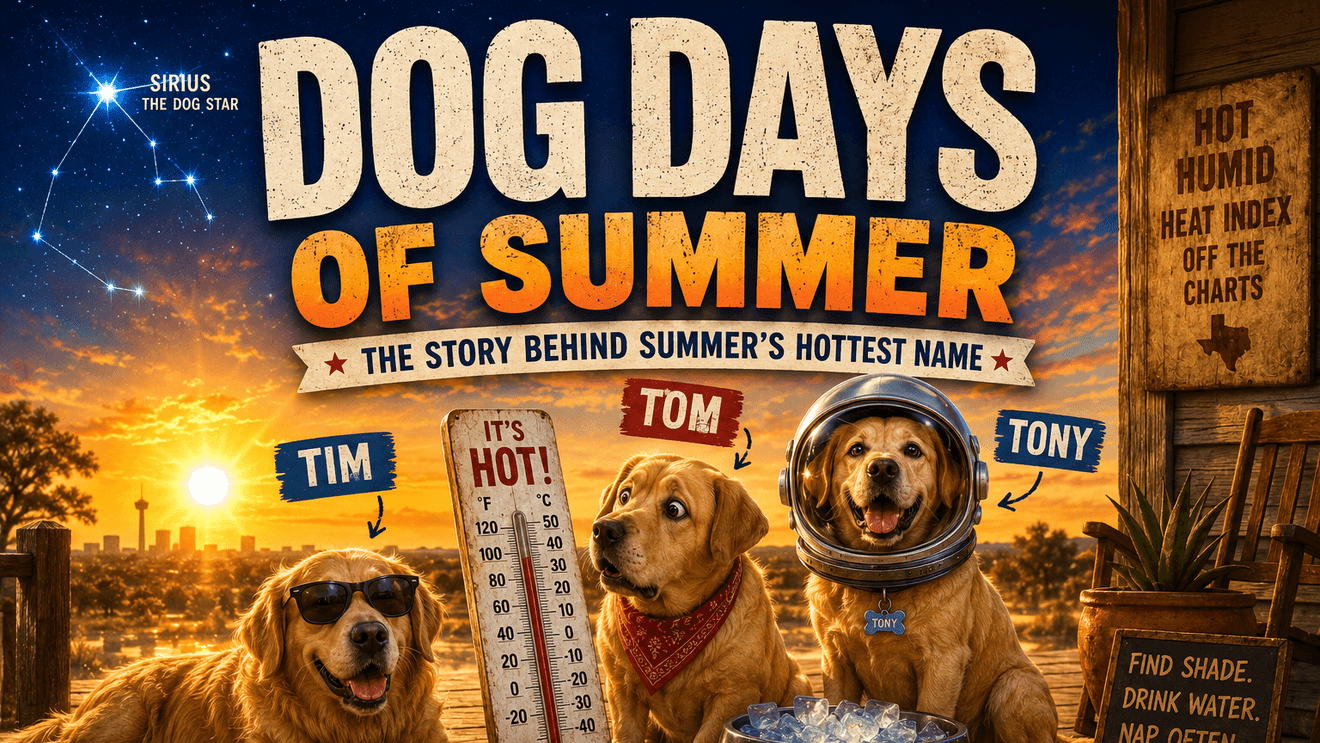
SAN ANTONIO – Every summer about this time, someone asks us the same question…
“Why do they call it the Dog Days of Summer?”
And every year, I give the scientific answer. But today… I thought we’d let three experts handle it instead.
Meet Tim, Tom and Tony. Three dogs. Zero meteorology degrees. Unlimited opinions.
Tim: “Obviously, it’s because we refuse to go outside.”
Tim is the oldest of the group. He’s wise, experienced, and believes that any temperature above 80 degrees should require written permission before leaving the air conditioning.
“You people keep talking about Heat Index values. We just call it… Tuesday.”
Tim has a point. Late July into early August is often the hottest stretch of the year across South Texas. The sun has been beating down for months, the ground is hotter than blue blazes, humidity is hanging around, and nights just don’t cool off much anymore.
Everything simply adds up.
Tom: “I blame the cats.”
Tom is not much for science. He’s more of a “somebody did it” enthusiast.
“Somewhere… a cat started this.”
Unfortunately for Tom, history says otherwise. The phrase Dog Days of Summer actually dates back thousands of years. Long before any cats had thoughts of stirring up dog trouble. Ancient Greeks and Romans noticed that during the hottest part of summer, the bright star Sirius – known as the Dog Star because it’s part of the constellation Canis Major (the Greater Dog) – rose in the eastern sky just before sunrise.
They believed Sirius added its own heat to the sun. Now we know that’s not true.
Sirius is about 8.6 light-years away, so while it’s one of the brightest stars in the night sky, it not doing much to warm your backyard barbecue.
Still, the name stuck. More than two thousand years later, we’re still talking about the Dog Days.
Tony: “I’m just here for snacks.”
Tony represents what most of us are feeling this week.
“If I can see the mailbox from the porch… that’s close enough.”
Honestly? Same.
This time of year isn’t just about hot afternoons. It’s about relentless heat. The pavement is hot. Cars become ovens. Playgrounds turn into frying pans. Even the wind feels like someone pointed a giant hair dryer at your face.
It’s the time of year when you’re trying to figure out exactly when you can safely mow the lawn or just go out for a walk.
The Real Science
Contrary to popular belief, the Dog Days aren’t caused by Sirius. They’re caused by something much closer. The atmosphere has been storing heat since late spring.
Day after day, the sun keeps adding energy faster than the Earth can release it overnight. Temperatures continue to build until they finally peak in late July and early August.
Think of it like preheating a cast-iron skillet. It doesn’t get hot instantly. But after sitting on the burner long enough…
Don’t touch it.
The Dogs’ Summer Survival Guide
Tim says:
“Find shade. Stay hydrated. Nap often.”
Tom adds:
“If the pavement is too hot for my paws… it’s probably too hot for your flip-flops.”
Tony keeps it simple:
“Ice cream.”
Hard to argue with that one.
Final Thoughts
Weather has always been wrapped in stories. Long before satellites, Doppler radar, and computer models, people looked to the stars to explain what they were experiencing.
The Dog Days of Summer are one of those traditions that survived because they painted a picture everyone understood.
Today, we know the science behind the heat. But that doesn’t make the phrase any less fun. So the next time someone asks where the name came from…
You can tell them about Sirius.
Or…
You can simply smile and say,
“Tim, Tom, and Tony told me it’s because sensible dogs know better than to chase tennis balls when it’s 103 degrees outside.”
And honestly…
I think they’d all agree with that.