
GEORGETOWN, Texas (KXAN) — Brett Lagrone can imagine the smell of sunscreen and the sound of his two young daughters laughing and splashing.
“The community pool was my stomping ground,” Lagrone said of his own childhood.

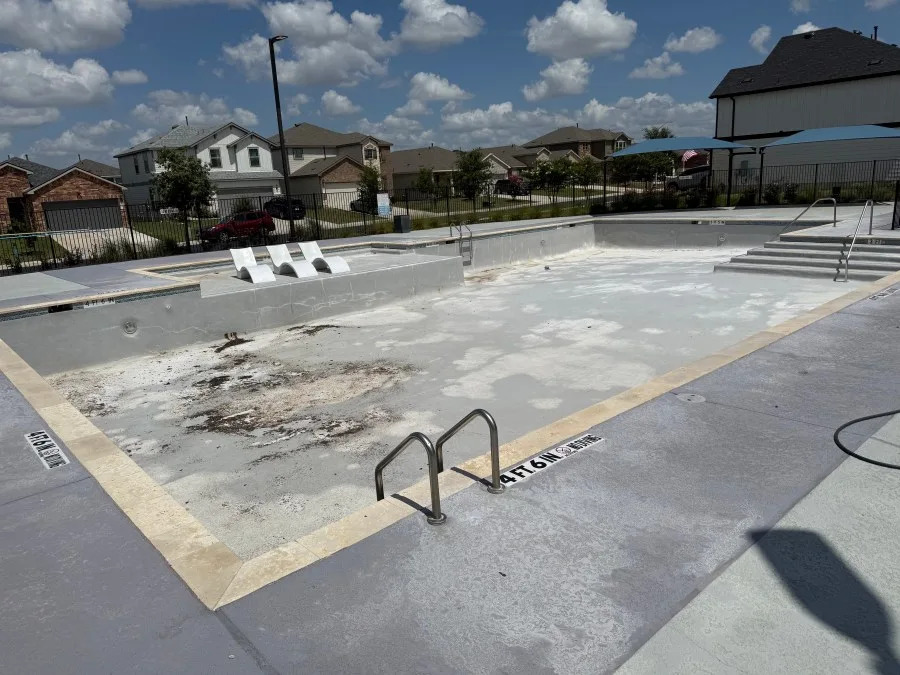
Homeowners said the Carlson Place community pool was drained last winter and never refilled. (KXAN Photo/Arezow Doost)
He was hoping it would be the same for his girls as they made friends and cooled off this summer. Lagrone explained that the Carlson Place community pool was drained last winter and never refilled.
Texans file thousands of complaints over solar panel deals; state oversight promised
The neighborhood in eastern Georgetown is near State Highway 130 and a community Lagrone said has many young families just like his.
“This place in the summer would be hopping,” Lagrone added. “Today, we can hear the birds chirping.”
Lagrone explained the homeowners association, managed by Goodwin & Company, told residents the pool has a defect known as “concrete cancer,” or alkali-silica reaction (ASR). The chemical reaction happens when minerals in rocks and sand react with the cement, forming a gel that swells as it absorbs water, causing the concrete to crack from the inside out.
Industry experts said the defect causes spiderweb-like cracking on the surface of Central Texas pools built since 2017, making it hard to hold water.
“You got major cracks along this far wall right here,” Lagrone showed the cracks to KXAN investigators, adding, “it’s disappointing.”
Central Texas is a hot spot for ASR
Lagrone shared an update on the community’s management app from the board of directors in June, which said they’re exploring financial options including securing a loan to fund the reconstruction of the pool but will continue taking legal steps to potentially recover damages from Pulte, a developer of the community, and other responsible parties. If the board proceeds with the loan, homeowners are told to expect dues to increase starting in January 2027.
“They’ve told me they can either get a loan to fix it and costs would be passed down to us $10 a month maybe, or they can continue fighting it, whatever litigation is currently ongoing,” he said.
The HOA and its management company wouldn’t speak to KXAN investigators about the pool, saying it had no comment.

Homeowners said the HOA notified the community that the pool tested positive for concrete cancer after spiderweb-like cracks appeared on the surface. (Courtesy: Brett Lagrone)
A spokesperson with Pulte said in an email that the pool and responsibility for its maintenance were turned over to the HOA in 2024 and that Pulte recently received information from the HOA regarding the pool and is reviewing it.
The Central Texas Pool & Hot Tub Alliance (PHTA), which is comprised of pool industry professionals, believes the Austin area is a national hot spot for ASR problems found in pools.
John McIntyre, a licensed engineer and ASR educator, said that as many as 30,000 pools in Central Texas may be affected. He added there is no fix for concrete cancer, and the only solution is to rip out the pool and replace it with a new one, which McIntyre explained could cost anywhere from $150,000 to $500,000.
McIntyre said the pools with the defect may have lacked a key ingredient in the concrete mixture called fly ash — a cement-like material produced by burning coal. He explained, in 2016, the Environmental Protection Agency moved toward a measure that caused many coal-fired electric power plants to convert from coal to natural gas as a fuel source. He said fly ash was a byproduct of coal burning and the switch eliminated much of the fly ash from the market. He added that the lack of fly ash and increased pool construction across the area made the material harder for suppliers to get.

Georgetown community pool closed for the summer as HOA explores options after residents told about “concrete cancer.” (KXAN Photo/Arezow Doost)

Georgetown community pool closed for the summer as HOA explores options after residents told about “concrete cancer.” (KXAN Photo/Arezow Doost)

Georgetown community pool closed for the summer as HOA explores options after residents told about “concrete cancer.” (KXAN Photo/Arezow Doost)

Georgetown community pool closed for the summer as HOA explores options after residents told about “concrete cancer.” (KXAN Photo/Arezow Doost)

Georgetown community pool closed for the summer as HOA explores options after residents told about “concrete cancer.” (KXAN Photo/Arezow Doost)
“Right now, there’s only one class of fly ash producer in the state. There were several dozens, and now it’s down to one. And so, the cost of fly ash is very expensive,” said Juanjose Armenta-Aguirre, president of the Central Texas PHTA.
Armenta-Aguirre works closely with McIntyre, who is also on the board of directors of the Central Texas PHTA chapter, and is pushing for ASR education. His family also owns Texan Gunite in the Williamson County area, specializing in residential and commercial gunite, which is a dry-process concrete.
“Call it a blessing, call it good luck, as far as we know, our company has not had any ASR cases because at the time we were buying our non-reactive sand, not where everyone else was buying it,” Armenta-Aguirre said. “We’re pretty transparent; here’s our testing; we do it once a year for our sand.”
Armeta-Aguirre said several cement suppliers are now testing regularly. He said pool owners can also send a piece of concrete to a lab to be tested, but it can cost upwards of $3,500 per sample. KXAN reached out to WJE’s Austin lab, which provides concrete materials analysis, but a spokesperson said questions about ASR couldn’t be answered due to a conflict of interest.
‘We can prevent this kind of thing’
Besides ongoing lawsuits against several companies alleging concrete defects, Texans have started filing complaints with the Office of the Texas Attorney General.
Since March 2024, records obtained by KXAN investigators show there have been more than a dozen complaints filed against pool companies and concrete suppliers — all mentioning ASR.
Some families have even turned to the Texas Department of Insurance for help, hoping homeowners’ insurance would cover the cost of damages. TDI said it has received three complaints since March about the issue. Records KXAN investigators obtained show TDI didn’t find any violations of state insurance law or regulation.

Georgetown homeowners are pushing for a solution after the community pool was drained due to a defect. (Courtesy: Brett Lagrone)
Texas did explore regulation last legislative session.
“We can prevent this kind of thing from happening,” said State Representative Vikki Goodwin, D-Austin.
Goodwin is the author of two bills that would have directed the Texas Commission on Environmental Quality to establish concrete quality standards and required companies selling those materials to list ingredients.
The bills didn’t make it far after being filed, but Goodwin, who is running for Texas lieutenant governor, hopes another lawmaker will pick it up next session starting in January 2027.
“It is consumer protection, and we need to make sure that we’re regulating well to protect people when they’re investing so much money in their homes,” she said.
KXAN reached out to Republican Lt. Gov. Dan Patrick, who is running against Goodwin for perspective, but he has not provided a comment.
Ask questions
McIntyre said it can take two to five years for concrete cancer to show up, and it normally appears in the spa due to temperature changes. He said many pools built between 2017 and 2021 are the ones with the ASR problems.
Texans are encouraged to ask builders about their material suppliers and to get a list of ingredients being used and whether they have had any ASR problems. If a house is on the market and already has a pool, ask when it was built and by which company.

Carlson Place Amenity Center in Georgetown. (KXAN Photo/Arezow Doost)
McIntyre explained ASR in one spot doesn’t mean every inch of the pool is affected. He added there are some temporary measures that can help, including spraying a rubberized coating onto the pools.
Lagrone said his community pool is just a big hole in the ground, and he’s worried about the impact of rain and sitting water. He’s hoping there’s a solution soon and a path forward.
“It definitely is concerning for home values if we wanted to sell our home,” he explained. “We just want our pool back, and we just want our kids to have a fun summer, and we don’t want to be that community that’s got an empty pool.”
Director of Investigations & Innovation Josh Hinkle, Investigative Producer and Reporter Dalton Huey, and Investigative Photojournalist Chris Nelson contributed to this report.
Copyright 2026 Nexstar Media, Inc. All rights reserved. This material may not be published, broadcast, rewritten, or redistributed.
For the latest news, weather, sports, and streaming video, head to KXAN Austin.