
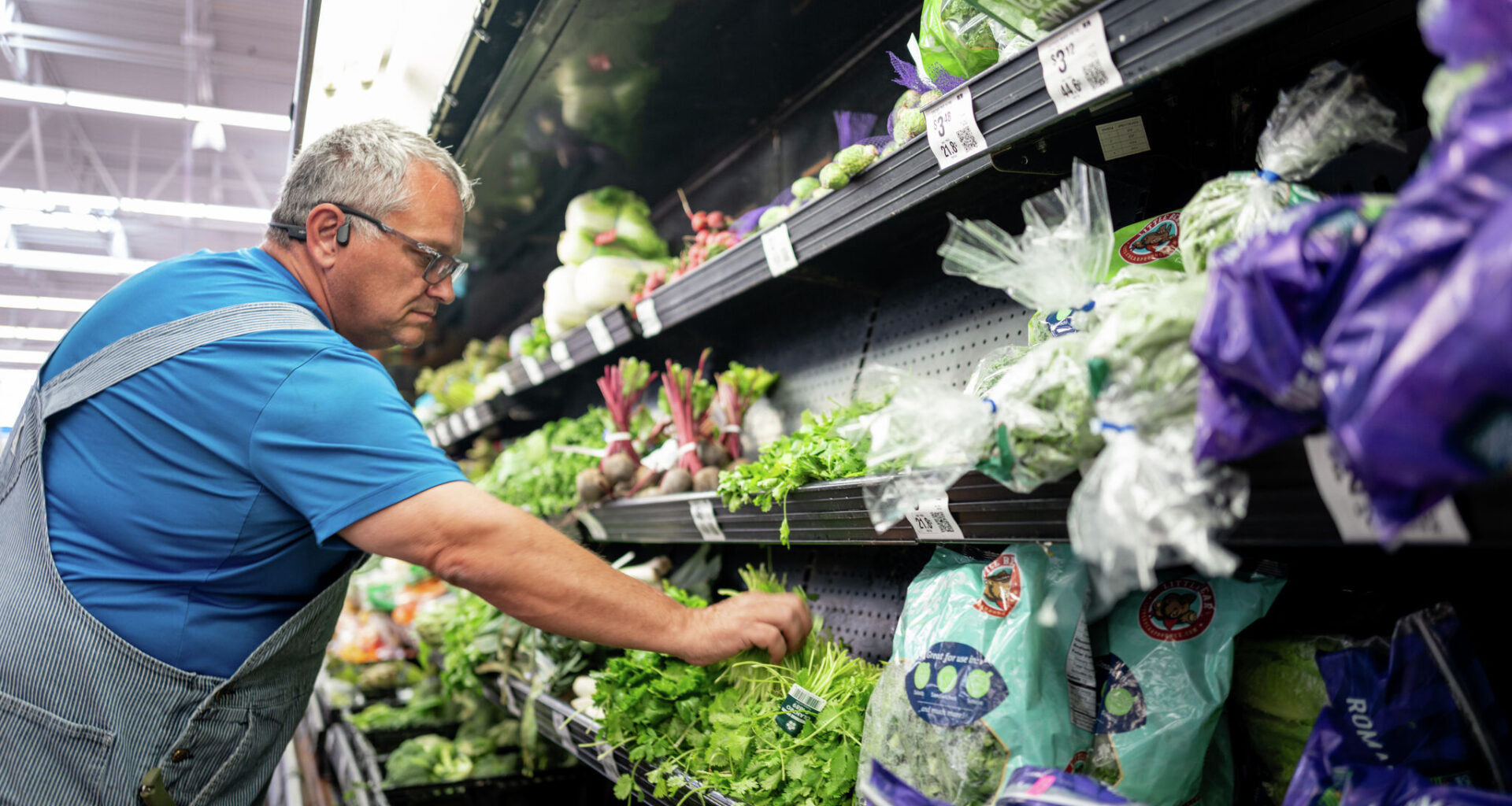
AUSTIN, TEXAS – JULY 23: A customer shops for cilantro at a Walmart Supercenter on July 23, 2026 in Austin, Texas. The cyclosporiasis outbreak, an intestinal illness caused by the microscopic parasite Cyclospora cayetanensis, has spread across multiple states and remains under investigation by federal health officials after the first known illness onset was reported in early May. (Photo by Brandon Bell/Getty Images)
Brandon Bell/Getty Images
A growing cyclosporiasis outbreak in Texas has left shoppers staring at salad aisles, questioning restaurant menus and asking the same question: What food is actually safe to eat?

Health officials have confirmed more than 100 cases of cyclosporiasis across Texas, including a large cluster in the Houston area, but investigators have not identified a single source assuredly responsible for the illnesses. That uncertainty has fueled anxiety among consumers, with some Texans saying they are avoiding lettuce, bagged salads and fresh produce altogether until they know more.
Article continues below this ad
Online discussions have exploded as residents try to piece together conflicting information—from reports of a possible lettuce connection to reassurances from grocery chains that recalled products never reached their shelves. But infectious disease experts say the confusing reality is that outbreak investigations can take time—sometimes weeks or months—and consumers may not get a definitive answer.
“It’s really difficult for people because they want to know, ‘Tell me exactly what I should avoid,'” said Dr. Stacey Rose, associate professor of infectious diseases at Baylor College of Medicine. “But sometimes the science does not allow us to give that immediate answer.”
State health officials have confirmed 123 cases of cyclospora in Texas, with 90 of those being reported in the Houston area.
Here is a breakdown of the Houston area cases:
38 in unincorporated Harris County
21 in the City of Houston
16 in Montgomery County
14 in Galveston County
2 in Brazoria County
Source: Texas Department of State Health Services
Why don’t we know what caused the outbreak yet?
Cyclospora is a parasite that infects the intestinal tract and can cause prolonged diarrhea, stomach cramps, nausea, fatigue and other symptoms. One of the biggest challenges for investigators is the illness’ long delay between exposure and symptoms. Rose said someone can consume contaminated food and not become sick for days or even weeks, making it much harder to determine exactly what made them ill.
Article continues below this ad
“Once someone presents with symptoms, there’s additional lag time because you may not go see a doctor right away,” Rose said. “Then there’s time needed for diagnostic testing.”
These data include case data reported directly to the CDC Cyclospora program. Case counts may not match exactly with what is listed in the Nationally Notifiable Diseases Surveillance System tables.
CDC
After a case is confirmed, investigators must then interview patients about everything they ate in the weeks before they became sick.
“And you can imagine how hard it is to remember what you ate for breakfast yesterday, much less what you ate two or three weeks ago,” Rose said.
Article continues below this ad
Investigators then search for patterns—restaurants, grocery stores or ingredients shared among patients.
Is lettuce the problem?
That is the question causing the most concern among shoppers. Federal investigators previously looked into a possible connection involving Taylor Farms lettuce. But officials later said testing did not confirm the lettuce sample as the source, and investigations remain ongoing. This has left many consumers confused about whether lettuce, bagged salads or other produce should be avoided.
Rose said the lack of a confirmed source does not mean people should stop eating fresh fruits and vegetables.
Article continues below this ad
“I really don’t think so,” she said. “What the FDA and CDC are continuing to advise is to be a little bit extra cautious when you are purchasing and consuming produce.”
That means washing fruits and vegetables thoroughly under clean running water, peeling produce when possible and removing outer leaves from items such as lettuce before eating.
WASHINGTON, DC – JULY 22: Packaged salad mixes are displayed in the refrigerated produce section of a Target store on July 22, 2026 in Washington, DC. (Photo by Kevin Carter/Getty Images)
Kevin Carter/Getty Images
For people who are especially concerned, cooking produce can eliminate Cyclospora risk because the parasite cannot survive high cooking temperatures.
Article continues below this ad
What about eating at restaurants?
Many Texans are wondering whether ordering a salad at a restaurant is risky. Rose said consumers should understand restaurants and grocery stores also have food safety procedures designed to reduce risk.
“I think the hope is that the retail industries and the food service industries are paying attention to this and are doing everything that they can,” she said.
That includes removing potentially affected products, reviewing suppliers and reinforcing hygiene practices among employees.
Article continues below this ad
But, she added, no food system can eliminate every risk.
“Nothing is ever a guarantee in life,” Rose said. “Cyclospora is not the only risk that’s out there. We get outbreaks of E. coli. We’ve had outbreaks of salmonella.”
Packages of Taylor Farms salad greens are displayed at a Safeway store on July 16, 2026, in Kings Beach, California. Federal health officials are investigating whether shredded iceberg lettuce supplied by California-based Taylor Farms was the source of a nationwide Cyclospora outbreak that has sickened more than 1,600 people in 34 states, though no definitive link has been confirmed. (Justin Sullivan/Getty Images/TNS)
Justin Sullivan/TNS
Why outbreaks sometimes never get solved
One of the most frustrating realities for consumers: investigators may never find the exact source. The FDA’s foodborne illness investigation database includes outbreaks where officials ultimately could not identify the contaminated product.
Article continues below this ad
Rose said that can happen because of the complexity of tracking food through a national supply chain.
“If I became sick while I was traveling in Ohio, is that because of something I ate in Ohio, or something I ate two weeks ago when I was visiting family in Alabama?” she said. “You can only imagine how complicated it is.”
What should Texans do right now?
Health officials recommend:
Article continues below this ad

Smart, funny and sometimes unhinged look at the week that was.
By signing up, you agree to our Terms Of Use and acknowledge that your information will be used as described in our Privacy Policy.
Wash fresh produce thoroughly under running water.
Wash hands before preparing food and after using the restroom.
Peel produce when possible.
Remove outer leaves from leafy greens.
Seek medical care if diarrhea persists or symptoms become severe.
Rose said most healthy people who become infected recover, and treatment is available for those who need it. Her advice for consumers: don’t panic—but do pay attention.
“Control what you can,” Rose said. “Clean the products that you’re bringing home from the store well and talk to your healthcare provider if you have particular risk factors.”
Article continues below this ad