
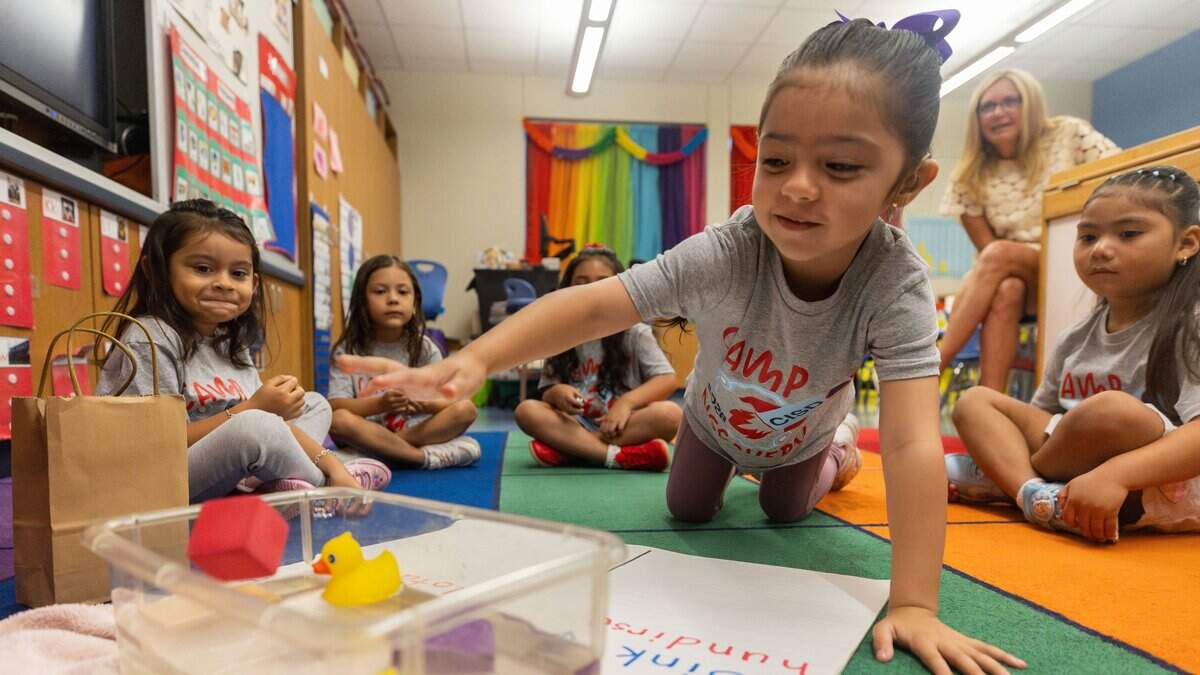
Yamileth Escalera, 4, tosses a red foam cube into a container full of water during a pre-K prep program at Castleberry Elementary School in Fort Worth on June 29, 2026. The students had to guess whether their chosen object would float or sink when dropped in water.
Elvis Martinez-Cartagena
FORT WORTH STAR-TELEGRAM
As Texas’ public-school enrollment experiences its first non-pandemic enrollment decline in decades, Tarrant County’s pre-K enrollment is also losing its youngest students. And although some communities are seeing rapid growth, early education leaders are struggling to fully understand the nuances of what’s shaping the learning environment for 3- and 4-year-olds.
Public pre-K enrollment in Tarrant County has fluctuated over the past five school years, with the latest data showing a 2.7% decrease from 2024-25 to 2025-26 — the first substantial decline the county has seen since the COVID-19 pandemic. Some factors outside of districts’ control, such as the declining birth rate and competition with the private sector, could be contributing to this trend, according to local and state education leaders. And the loss of these students could impact district performance as cohorts move up in their educational careers; students who attend a pre-K program typically perform better in school compared to their peers who didn’t attend.
“Much of this is driven by the decline in pre-K enrollment in the two largest districts, Fort Worth and Arlington ISD. Forty-six percent of all pre-K enrollment in county districts is represented by those two districts, both of which saw declines in their ‘25-’26 pre-K cohorts,” said Leila Santillán, chief operating officer of the Fort Worth Education Partnership.
An analysis of the countywide data by the nonprofit also shows Tarrant’s pre-K enrollment has grown 12.5% from 2021-22 to 2025-26, a change of 14,597 to 16,422 enrolled students. Over this same period, the total enrollment of Tarrant districts across all grades has fallen. As a result, the share of pre-K students has accounted for a larger percentage of total district enrollment in recent years.
Despite the fluctuations seen year-to-year for Tarrant pre-K enrollment, certain pockets of the county are experiencing such strong pre-K growth that some districts are building schools to exclusively serve pre-K students, including Northwest and Mansfield ISDs.

Northwest ISD is among the fastest-growing school districts in Texas, with thousands of new homes built in the district’s boundaries annually. The area has also grown to be a regional economic engine with the nearby Alliance development generating billions of dollars in impact.
The district’s first of four incoming early learning centers opens this school year, funded by a 2023 voter-approved bond worth $2 billion.
The first center, the Dr. David Hicks Early Childhood Center, will serve about 275 students, district officials said. The second center is slated to tentatively open in 2028 to students on the district’s central campus.
“We know that early intervention is key. So we want to get as many pre-K students in as soon as possible, and students that qualify for pre-K typically need intervention early because of the factors for why they qualify for pre-K,” said Executive Director of Teaching and Learning Stephanie Espinosa, referring to state requirements to qualify for pre-K that are based on income, English language proficiency and more.
 Brynley Cowan, 17, a senior at Ben Barber Innovation Academy, helps pre-K students interact at their stations while interning at Jandrucko Early Learners Academy on Nov. 6, 2025. Amanda McCoy amccoy@star-telegram.com
“Our students that are with us in pre-K outperform students that go to kindergarten that are not with us in pre-K,” she added. “We know that it’s crucial for them to be with us because we know that sets a really strong foundation for them. So the more we can get in, the better.”
Mansfield ISD opened its Dr. Sarah Jandrucko Early Learners Academy in 2019 and is currently constructing its second early learners academy, which is set to open in the 2027-28 school year. The Jandrucko campus serves about 300 preschoolers, and the incoming campus is expected to serve almost 800.
Ashton Oliver, the district’s director of early childhood, says several factors are driving this growth, including construction of new homes in the community, engagement with young families and district investment in early learning.
Additionally, the Jandrucko campus has been locally and nationally recognized for its unique, immersive curriculum, receiving an H-E-B Excellence in Education Award last year as the state’s top pre-K campus. This has sowed pride from community members, Oliver said.
“We were the first in the country to do this model, and we’ve had over 10,000 visitors come. That has grown our reputation,” Oliver said. “Word-of-mouth to the community — they really are proud of our program. They want their students to come here.”
 Harper Hargrove, 17, a senior at Mansfield High School, helps pre-K students sound out words while interning at Jandrucko Early Learners Academy on Nov. 6, 2025. Amanda McCoy amccoy@star-telegram.com
Other districts, including Lake Worth ISD and Keller ISD, have experienced an opposite trend of losing pre-K students in recent years. The districts have respectively lost 38% and 13% of these students over the past five school years.
Keller ISD officials cite three notable variables.
“Our demographer has cited declines in birthrates, declines in mobility of district residents, and expansion of school choice as factors in our declining enrollment,” district officials said.
Lake Worth ISD didn’t respond to requests for comment by the Star-Telegram.
Tarrant disproportionately represents statewide enrollment loss in pre-K
Statewide pre-K enrollment was 249,072, as of the 2025-26 school year — a loss of about 800 students compared to the previous year. Across all grades, Texas public school enrollment saw its first enrollment drop, aside from the COVID-19 pandemic, in almost four decades.
When looking at pre-K enrollment, Tarrant County notably accounts for more than half of this decline: Out of the drop of 800 statewide students, 456 of them were from Tarrant.
Texas Education Agency officials say it’s unclear why Tarrant makes up the bulk of the loss. When looking at the statewide decline, state education leaders theorize it could be tied to the decline in the birth rate.
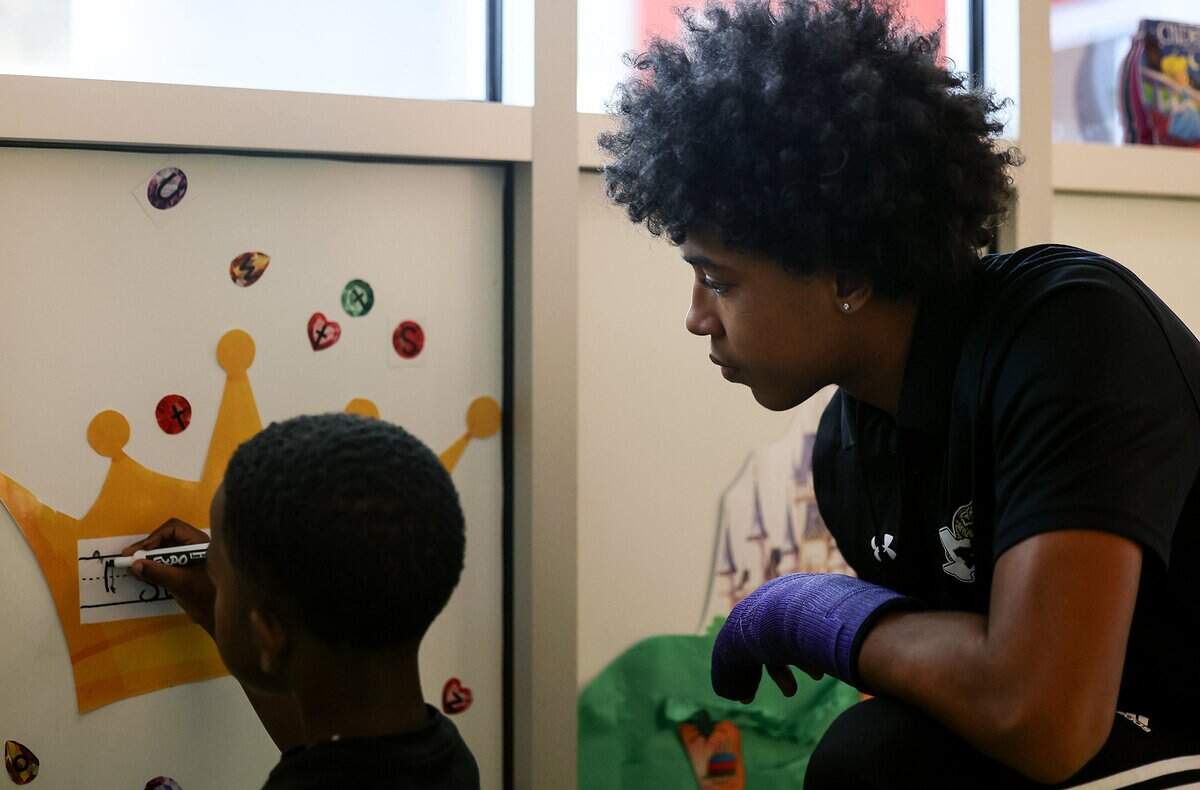 Josiah Hall, 16, a junior at Ben Barber Innovation Academy, helps pre-K student Saint Bishop write his name while interning at Jandrucko Early Learners Academy on Nov. 6, 2025. Amanda McCoy amccoy@star-telegram.com
Kym Shaw, executive director of the Early Learning Alliance, said leaders in Tarrant’s early learning environment are also uncertain about what’s driving the data point.
“No one can figure out why the concentration is in Tarrant County. No one understands that at all,” Shaw said.
Although the county has experienced a significant decrease in its birth rate over the past decade, its 2024 rate was notably higher compared to the United States, according to the most recent data from Tarrant County Public Health. Tarrant’s birth rate was 12.3 births per 1,000 women compared to the nationwide rate of 10.7 births.
Shaw also noted tensions with immigration enforcement crackdowns happening near school campuses. Tarrant County’s pre-K population is predominantly Hispanic.
“With the political climate and the tension with ICE and all of those things, some people feel that that could be why enrollment is low,” she said.
Shaw also mentioned conversations about Texas’ new school voucher program, which includes providing pre-K families with public money to access private or homeschool options; however, the program doesn’t go into effect until the 2026-27 school year.
Related Stories from Fort Worth Star-Telegram

Fort Worth Star-Telegram
Lina Ruiz covers early childhood education in Tarrant County and North Texas for the Fort Worth Star-Telegram. A University of Florida graduate, she previously wrote about local government in South Florida for TCPalm and Treasure Coast Newspapers.