
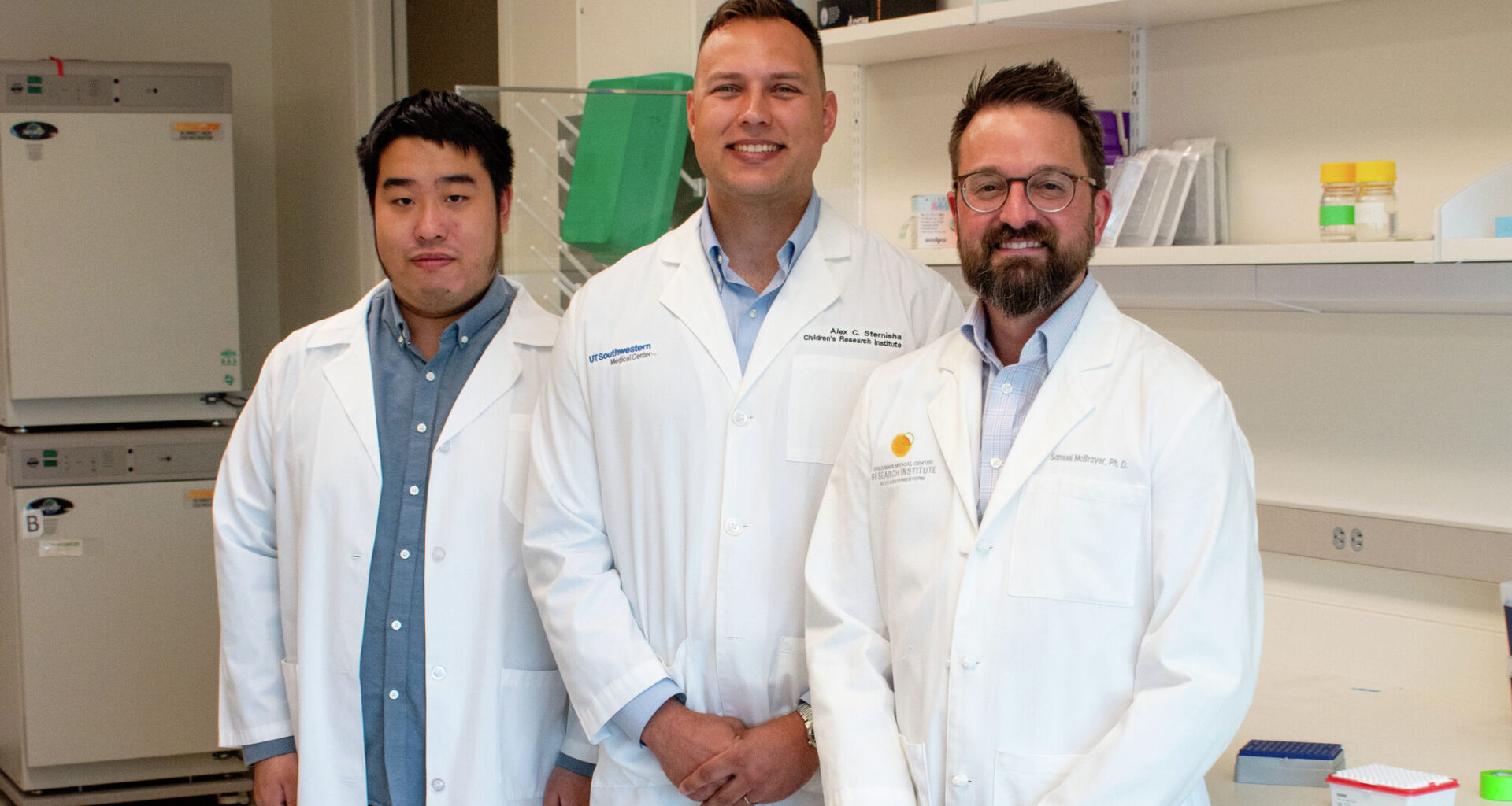
From left, Sam McBrayer, assistant professor in Children’s Medical Center Research Institute at UT Southwestern (CRI), with Haocheng Li and Dr. Alex Sternisha, in the CRI Moody Flow Cytometry Shared Facility.
CRI
More than 800 different genes have been linked to intellectual and developmental disabilities in humans, which are estimated to affect 1 to 2% of the population.

Before now, scientists had only a partial understanding of why a deficiency in one of those genes leads to issues in brain development. Dallas researchers may have found the answer.
In a study published in Science in July, scientists at Children’s Medical Center Research Institute at UT Southwestern (CRI) explained why babies born with the deficiency suffer from severe neurological impairment, and they have identified a potential strategy to intervene.
Article continues below this ad
Developing a biosensor
Sam McBrayer’s interest in metabolism, or chemical changes in the human body, began during his training in biochemistry, when he realized he wanted to pursue questions related to human physiology and disease. This fascination became the basis of his lab’s research, which looks at the development of brain tumors and symptoms associated with metabolic disorders.
Eventually, that interest guided him to Alpha-ketogluterate (αKG), a type of small molecule capable that plays an important role in controlling which genes are turned on or off, explained McBrayer, an assistant professor at CRI and the study leader.
Researchers didn’t understand how αKG is transported to the nucleus, a cell’s DNA-containing control center. Alex Sternisha, a former graduate student of McBrayer and lead author on the study, built a tool to find out.
Sternisha took a protein from a bacteria that could recognize αKG and modified it to work in human cells. He also linked it to a glowing green protein, so that the more αKG was within a cell, the brighter it would glow.
Article continues below this ad
“It’s been kind of a holy grail in the field to have a way to measure alpha ketoglutarate in the nucleus,” McBrayer said. “No one’s been able to do that.”
GPT2’s role in gene expression
Using the newly developed tool, researchers discovered that an enzyme known as GPT2 is responsible for producing αKG.
Artist’s rendering of the production and transfer of αKG from the mitochondria to the nucleus by sequential activities of GPT2 and SLC25A11.
Melissa Logies for CRI
“We’ve known about this enzyme for probably 80 years,” said Dr. Ralph DeBerardinis, the director of UT Southwestern Medical Center’s Eugene McDermott Center for Human Growth and Development, and a co-author on the study. Nobody would have ever guessed that it helped regulate gene activation by producing αKG, he said.
Article continues below this ad
Mutations in the gene for GPT2 can deactivate it, McBrayer said, leading to less αKG being produced. This results in many genes important for brain development to remain unactivated.
“When that gene is mutated, patients are afflicted with a broad spectrum of different neurological symptoms,” McBrayer said. These include severe intellectual disabilities, issues with movement and failure or delays in developing speech and language.
As there is no treatment for the disease, there’s a strong incentive to develop strategies that can help alleviate patients’ symptoms, McBrayer said.
A potential treatment
The new research suggests αKG supplementation at birth might help diminish disease progression.
Article continues below this ad
To test their theory, McBrayer and Dr. Eric Morrow, the Mencoff Family professor of biology at Brown University, tested the treatment on mice without the GPT2 protein. They found that by supplementing these mice with αKG from birth, newborn mice were able to maintain their body weight. This indicated the treatment was effective in addressing one of the disease’s characteristics.
From left, Haocheng Li, Dr. Alex Sternisha and Sam McBrayer, assistant professor in Children’s Medical Center Research Institute at UT Southwestern (CRI).
CRI
DeBerardinis said αKG is a promising candidate for treatment, but he said a chemically modified version would likely be needed to prevent it from being broken down by the body before it reaches the brain.
“I think the key gap that we need to address now is how you can give this chemically modified version of αKG very early in life and continuously to try and alleviate some of the damaging effects that depletion of this molecule has in the developing brain,” said McBrayer. “This includes simple questions related to formulation, frequency of dosing, and route of administration.”
Researchers also have yet to identify the time window in which supplementation needs to occur for it to work.
Article continues below this ad
In a press release, Morrow expressed his excitement regarding the development of potential treatments to help patients with GPT2 deficiencies. The researchers will continue to test their treatment in animal studies, and McBrayer said they intend to advance it to clinical trials.
“It’s a rare disorder,” said McBrayer, explaining how it was discovered within the past decade. But their research, he said, “has directed increased attention towards diagnosis of the disorder that will ultimately lead to appreciation of the broader prevalence of this disease.”
Niamh Ordner is a science reporting fellow at The Dallas Morning News. Her fellowship is supported by the University of Texas at Dallas. The News makes all editorial decisions.