
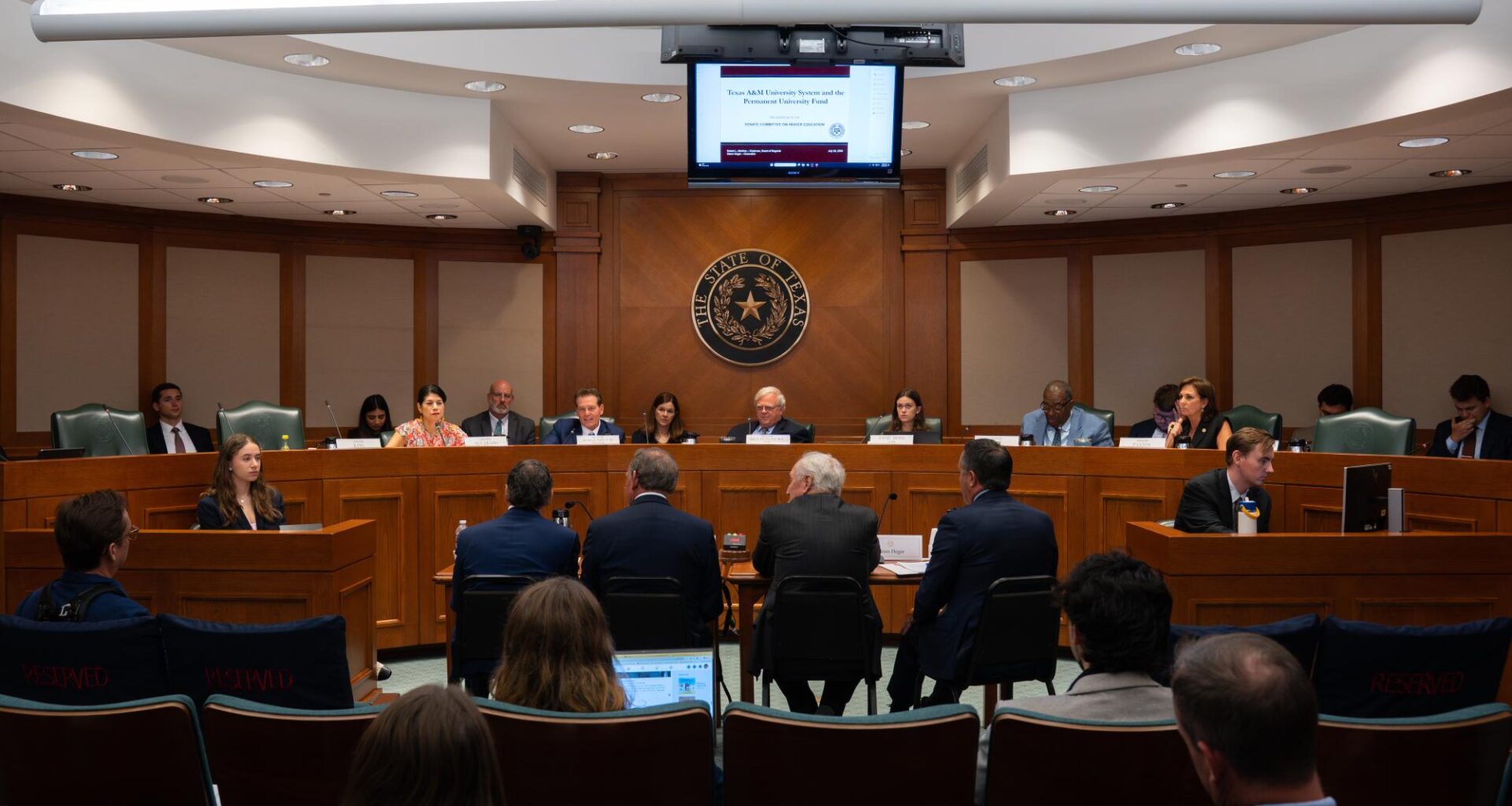
The Texas Senate Committee on Higher Education reviewed how public universities are implementing legislation and how the UT System is using state funding to support students during its hearings on Tuesday and Wednesday.
The committee’s Tuesday hearing focused on the implementation of Texas Senate Bill 37, a law passed in 2025 that expanded the authority of governing boards, like the UT System Board of Regents, over curriculum and made faculty senates advisory. In the Wednesday hearing, state senators examined the Permanent University Fund, the UT and Texas A&M systems’ endowment system, and questioned UT System officials about affordability initiatives funded through it.
The meetings were held as part of the committee’s interim charges, which directed lawmakers to review implementation of recent higher education laws and examine university funding before the Texas Legislature reconvenes in January 2027.
Brandon Creighton, the Texas Tech University System chancellor, authored SB 37 while serving in the Texas Senate. Creighton said during the Tuesday hearing that the Texas Tech System has reviewed more than 14,000 courses to comply with the law’s curriculum review requirements. Of these courses, 92 received formal review by the Texas Tech System’s Board of Regents, and 60 were modified.
According to the bill, every Texas public university, including UT, must complete its own curriculum review by Jan. 1, 2027.
“We welcome the feedback,” Creighton said at the Tuesday hearing. “Students should leave our institutions with real skills, real opportunity and real preparation.”
Brandon Simmons leads the Office of the Ombudsman for the Texas Higher Education Coordinating Board. The office was created by SB 37 to handle complaints relating to Senate Bill 17, which prohibits diversity, equity and inclusion practices at public universities.
Simmons, director of institutional policy and oversight for the THECB, said during the Tuesday hearing that since launching, the office has received 73 complaints, opened two formal investigations involving alleged SB 17 violations and established procedures for reviewing future complaints.
The committee shifted its focus Wednesday to university funding, reviewing how the Permanent University Fund supports institutions within the UT and Texas A&M Systems and discussing how these resources are used to improve affordability for students.
“To (whom) much is given, much is expected,” said Paul Bettencourt, chair of the Higher Education Committee, during the Wednesday hearing, referencing a Bible verse. “You all have the greatest ‘given’ of any group that I am aware of in the United States.”
During the Wednesday hearing, UT System Chairman Kevin Eltife said the Board of Regents voted in May 2025 to increase the annual distribution from the Permanent University Fund to the constitutional maximum of 7%, allowing the system to invest more in capital projects and student financial aid while preserving the fund’s long-term value.
One of these financial aid initiatives is the Promise Plus program, which covers tuition and mandatory fees for Texas resident undergraduates in financial need at any UT System institution. The Board raised the eligibility from families making up to $65,000 to $100,000 annually in 2024, using funds from the Permanent University Fund through the Available University Fund.
“Our goal is to continue to expand these endowments to increase the number of students we touch with this program,” Eltife said. “To date, we’ve already touched over 41,000 students with this program.”
Eltife said housing remains one of the largest financial barriers for students in Austin. He said UT Austin is working to establish a privately-funded endowment to support housing assistance.