
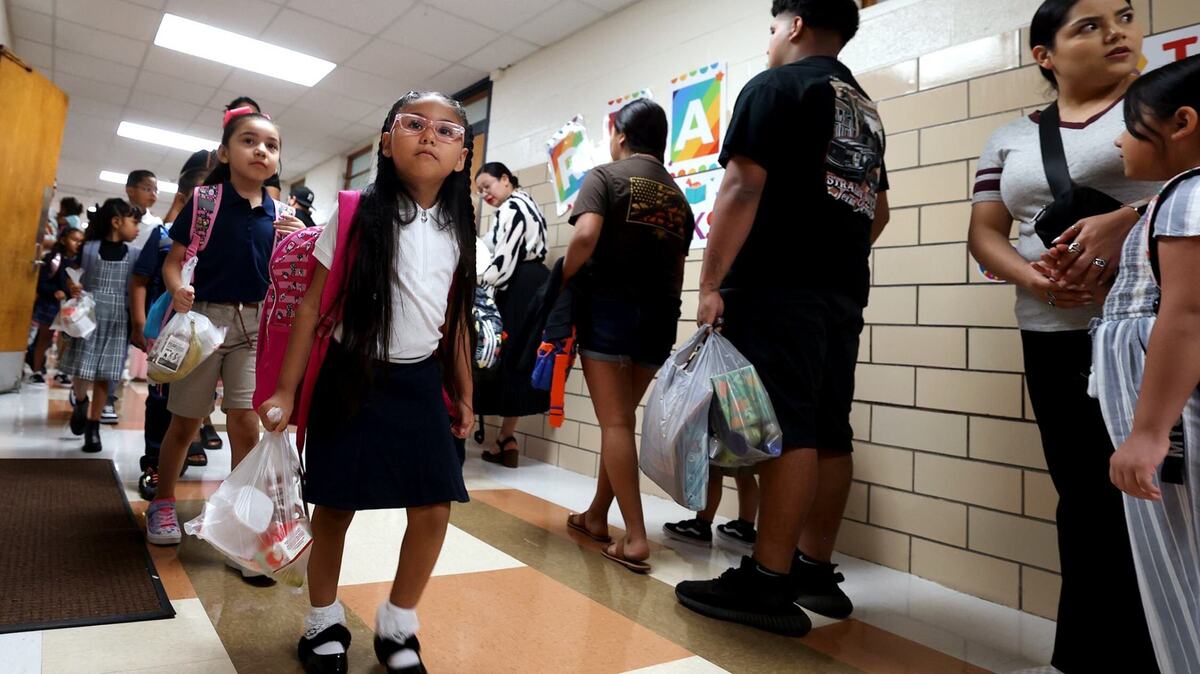
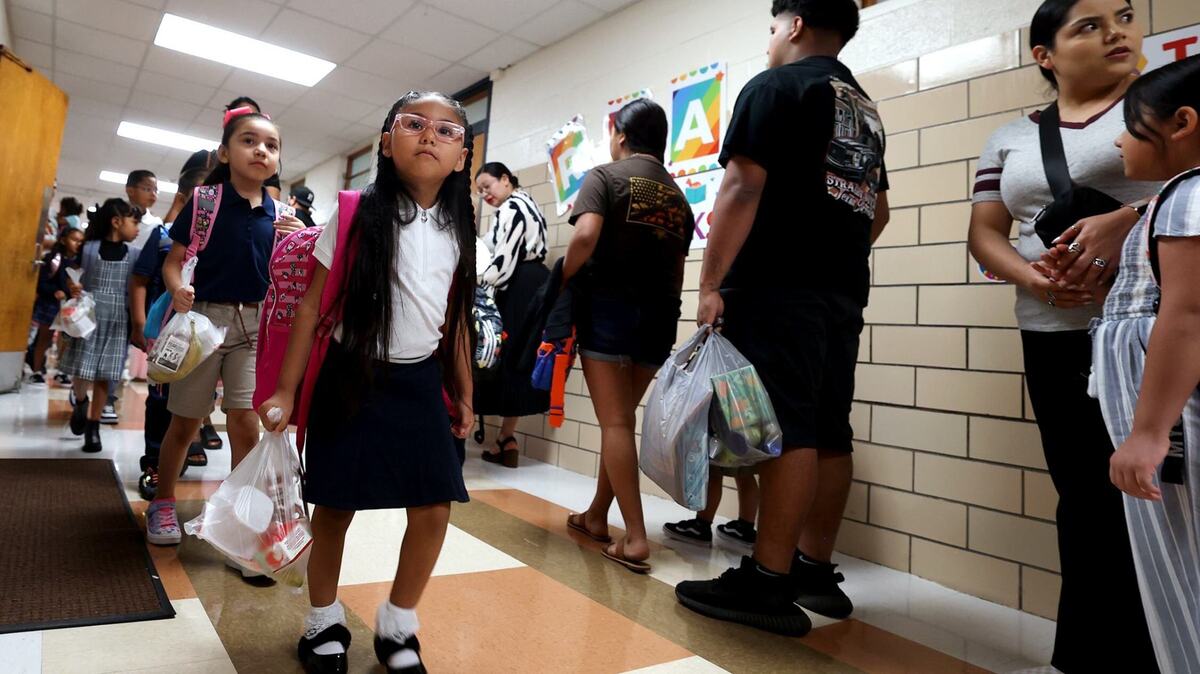
Students arrive at M.H. Moore Elementary School for the first day of school on Aug. 13, 2024.
Amanda McCoy
amccoy@star-telegram.com
Elementary and middle school students in Fort Worth ISD and several other districts across Tarrant County are further below the state average in mathematics than almost any other district in Texas, according to STAAR exam data from the Texas Education Agency.
Just 34% of Fort Worth ISD students in grades 3-8 met or exceeded grade level on the math STAAR exam at the end of last school year. In all districts in Tarrant County combined, 41% of students met or exceeded grade level, data shows.
Math performance in grades 6 and 7 is significantly behind — just 8% of Fort Worth ISD seventh graders met or exceeded grade level and 21% of sixth graders met that mark.
Math scores in Fort Worth ISD and across Tarrant County have not improved as much as reading scores in recent years. While the number of students in Fort Worth ISD who have met grade level on reading STAAR exams has risen 8 percentage points from 2019 to 2026, that number has risen just 3 points in that same time period for math results.
With so much attention given across Fort Worth and Tarrant County to the reading and literacy crisis, the district’s subpar performance in math has become a quieter problem, said Trenace Dorsey-Hollins, founder and executive director of the education advocacy group Parent Shield Fort Worth.
“I think everyone has been pushing so hard for reading improvement and everybody’s mindset was on reading and we just overlooked the fact that math scores were just as poor,” Dorsey-Hollins said. “So now I feel like as a community, we need to ramp it up together for our kids to be able to do both: read and do math.”
Dorsey-Hollins and other leaders at Parent Shield Fort Worth heard from several parents last year who were concerned about their child’s grades and test scores in math. That caused her to look more into math scores, which she found were much lower than reading results in Fort Worth ISD.
Parent Shield quickly got to work planning a math intervention pilot program, similar to the regular Literacy is Freedom Texas, or LIFT, programs the organization frequently holds.
“We do all this intervention and advocacy work around reading, so it was time to take a look at math,” Dorsey-Hollins said. “We had about 55-60 kids in our first math program and we saw an amazing uptick in growth from students who were provided that intensive intervention.”
Parent Shield’s math intervention program used Zearn Math, a top-rated online math learning program, to help students build a stronger fundamental understanding of math problems. The program also included trained interventionists providing students with target skills multiple times a week, and reevaluated them as the program progressed.
Dorsey-Hollins said 86% of the students who participated in the program made measurable academic growth in math by the end of the intervention.
“One thing that stood out to us in this is that literacy and math go hand in hand,” Dorsey-Hollins said. “You can’t break the two. Students who were in our program frequently misunderstood some math concepts because they couldn’t read or interpret the word problems. So to us that just reinforces that if we can continue investing in literacy, that is also an investment in math.”
Data from the Learning Policy Institute shows students who perform poorly in math in middle school rarely suddenly improve in high school, since foundational understanding of mathematics is built in lower level middle school courses.
Learning Policy Institute data also shows that students with higher math scores build stronger critical thinking skills and unlock higher-paying jobs. Above-average math skills can also serve as a strong predictor of future financial success, the study finds.
“Math scores are a better predictive factor of future income levels than reading scores, peer relationships, or health,” a portion of the study reads. “Math scores around age 11 have the most impact on future earnings. A half-standard deviation increase in middle childhood math scores can raise future earnings by approximately 3.5%, equal to around $1,200 per year.”
In Fort Worth ISD, well-below average reading scores and the subsequent literacy crisis across Tarrant County have dominated district attention in recent years. Just 40% of students in grades 3-8 in Fort Worth ISD met grade level on reading STAAR exams this past school year, according to TEA data. For high school freshmen, that number was even lower, at just 38% meeting grade level on the English I STAAR exam.
But those numbers are improving at a quicker pace than math scores. A spokesperson for Fort Worth ISD told the Star-Telegram the district is just as focused on improving math scores as it is on reading.
“We recognize that too many students remain below grade level in math, particularly in middle school, and that is exactly why mathematics has become one of the district’s highest instructional priorities,” the spokesperson wrote. “Every mathematics grade from Grades 3 through 8 either improved or held steady at the Meets Grade Level standard. Our work now is to build on that momentum and accelerate improvement until every student is prepared for Algebra I and higher-level mathematics.”
Fort Worth ISD leaders have also stated that improving math results in grades 3-8 is a significant priority because it leads to success in Algebra I, advanced coursework, college, careers and many high-demand professions.
This year, the district is implementing a new comprehensive mathematics strategy that includes the adoption of Bluebonnet instructional materials, daily lesson internalization and collaborative planning for teachers, daily formative assessments so teachers immediately identify misconceptions and provide targeted intervention, increased instruction coaching and classroom support, and dedicated reteach and acceleration time built into every instructional block.
“Rather than relying on one initiative, we are strengthening the entire instructional system so students receive consistent high-quality mathematics instruction every day,” the spokesperson wrote. “Our goal is not simply higher test scores. Our goal is ensuring every student leaves our classrooms with the mathematical knowledge and problem-solving skills needed for success in high school, college, careers, and life.”
Related Stories from Fort Worth Star-Telegram

Fort Worth Star-Telegram
Samuel O’Neal is the K-12 Education Reporter at the Fort Worth Star-Telegram, covering public schools and policy that impacts them. He previously worked as a staff writer at the Philadelphia Inquirer and is a graduate of Temple University.