

Until Saturday Newsletter 🏈 | This is The Athletic’s college football newsletter. Sign up here to receive Until Saturday directly in your inbox.
Just four full Saturdays left. If you don’t keep an eye on the Georgia Southern-Appalachian State rivalry tonight, don’t come crying to me in February about football abandoning you.
November Madness: Ducks ‘down,’ Big 12 ‘up’
A funny moment in each college football season from 1998 onward: the midseason evening when we stop referring to teams by their AP rankings and start using their BCS/CFP rankings instead, meaning various top-25 teams suddenly feel like they’ve just risen or fallen while obliviously playing Battlefield in their dorms.
First, the main reason these two rankings are different is because of their methods.
The AP is the sport’s historical gold standard, but it’s put together late Saturday night by writers who almost certainly didn’t have the time to scrutinize every result (and who aren’t debating all their votes with each other).
The CFP committee members get to patiently parse each team, to mostly agree on criteria and to re-parse early games in light of what’s happened since. Of course these products look different.
Now that we have the season’s first CFP rankings, let’s assess some things that feel like changes, since we’d all been used to the AP Top 25. “Losers” and “winners” from 2025’s CFP debut on Tuesday, based on which teams now rank worse or better than they’d ranked moments prior to Rece Davis reading a list:
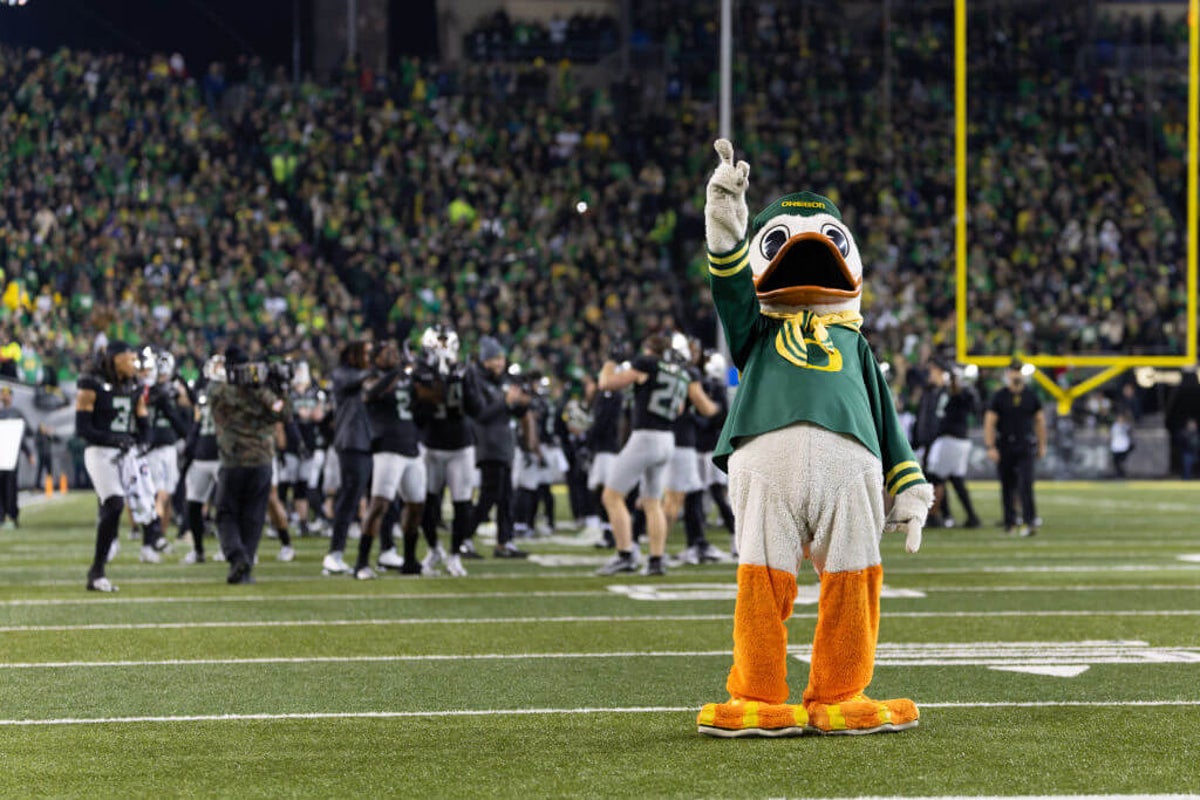
Loser: No. 9 Oregon, 7-1. The Ducks rank No. 6 in the AP, where they’d only fallen to No. 8 right after losing to Indiana. Oregon has otherwise won comfortably, but if you’re going to lose by 10 at home, you’d prefer to have beaten somebody better than 5-3 Northwestern. (The Ducks “slipping” a few spots also meant two Big 12 teams, No. 7 BYU and No. 8 Texas Tech, “moving up” from their AP rankings before playing each other Saturday.)
Does this matter? No, though the revelation did hurt the Ducks’ title odds. Penn State’s downfall ruined their signature win, but they finish with four of their best chances to impress — at No. 20 Iowa this week, vs. 6-3 Minnesota, vs. No. 19 USC and at No. 23 Washington. Tough group. A team angling for a bid would finish 3-1 or better, no matter its starting position.
Winner: No. 10 Notre Dame, 6-2. That’s the same ranking that the Irish have in the AP, but any time you start 0-2 and then show up as the top-ranked two-loss team, all while knowing you won’t have to play a 13th game, you’re sitting pretty. Probably even hosting-another-Playoff-game pretty.
Does this matter? Yes, though it’s the same ranking we already thought Notre Dame had, so no. Facing the 16th-toughest schedule so far (per Austin Mock), the Irish have six multi-score wins and two squeaker losses. Solid recovery by my preseason title pick. 😎 Regardless, they surely have to win out, including against 7-1 Navy on Saturday and No. 24 Pitt.
Loser: The ACC. Virginia “fell” two spots from No. 12 in the AP to No. 14 in the CFP, with that big September win over former No. 8 Florida State now looking merely decent. No. 15 Louisville and No. 17 Georgia Tech “fell” one each.
Does this matter? No, with a semi-caveat. The computer composite has UVA and GT down in the 20s (!) after various close-call wins. Still, the conference getting multiple bids isn’t out of the question, and at least the top three can’t knock each other out before Charlotte. Besides, if the CFP really had it out for the ACC, it wouldn’t have ranked the AP-unranked Pitt. (Also, if Tech can beat Georgia in a few weeks, this all feels like ancient history.)
Semi-caveat: No. 18 Miami should rank higher. The 6-2 Canes are No. 12 in the computers, have a win over the CFP’s No. 10 team (Notre Dame), blew out a USF team that might otherwise be ranked and only lost (close) to No. 15 Louisville and on the road to 6-3 SMU. Then again, Miami’s also No. 18 in the AP, so this wasn’t a “fall” and therefore doesn’t fit this exercise anyway.
Winner: No. 11 Texas, 7-2. When teams are clustered together, the committee prefers to stack them by their head-to-head results. So if Oklahoma and Texas are both No. 11-ish teams, the winner of their October meeting gets a nicer perch than the Longhorns’ No. 13 spot in the AP. (When the committee doesn’t do this, as in the case of Miami, it means they think those two teams aren’t actually clustered. I’m just the messenger.)
Does this matter? No. Both Red River rivals already looked like potential 9-3 Playoff teams. Each has two ranked wins and has only lost to ranked teams and/or on the road. If Texas beats Georgia next week but loses to Texas A&M (or vice versa) or Oklahoma wins at Alabama before losing to Missouri, the armies of “STRENGTH OF SCHEDULE!” and “SEC BIAS!” will clash ferociously. (And no, the reason for the SEC’s good position isn’t how annoying the conference’s PR was in the summer.)
Loser: The Group of 5. No 7-1 Memphis, unlike the AP, and no 7-1 JMU, 8-1 North Texas, 7-1 San Diego State or 6-2 USF. Also no 4-6 Akron, technically.
Does this matter? No. Though I’d prefer to see representation, the committee might’ve included all those non-Akron teams if it’d done a top-35 ranking. For now, whenever zero G5 teams appear, the committee still names the top rep: Memphis, a good sign for the American’s horde of contenders. (Also, for those who believe the CFP manipulates its rankings in order to promote upcoming games: Note it didn’t rank Navy during Notre Dame week.)
Winner: No. 20 Iowa, 6-2. Soaring forth from the also-receiving-votes outskirts of the AP. Overdue recognition for a team with a typically great defense and alarmingly competent offense.
Does this matter? Maybe a little. But it would feel bad to break the streak of saying no. Winning upcoming games against Oregon, USC and 6-3 Nebraska would’ve gotten the committee’s attention regardless.
Winner: No. 13 Utah, 7-2. The week’s biggest “jump,” from No. 17 in the AP. About time we caught on to the Utes crushing everything except the Big 12’s two top-eight teams. In fact, Utah’s No. 11 in the computers.
Does this matter? Maybe yes, actually. Though not at the moment. So still no. The Utes are somewhat surprisingly on the verge of a bid already, a good sign that the CFP’s supposed new emphasis on schedule strength isn’t hurting the Big 12. But even if they’d started lower, perhaps they still could’ve made it in by finishing with wins at 5-4 Baylor, against 4-5 Kansas State and at 5-4 Kansas.
Quick Snaps
🎠 Two morsels from Chris Vannini’s coaching-carousel notebook: Few in the industry are taking the Louisiana governor drama all that seriously, and Curt Cignetti’s Indiana contract has an interesting incentive, letting him exit to another team without buying himself out if he makes a CFP semifinal and the Hoosiers don’t then give him a top-three salary.
🤳 “My California liberal-arts-college mind cannot comprehend some of the numbers in this,” said my colleague Torrey Hart about Ira Gorawara’s report on Tuscaloosa’s sorority-influencer-industrial complex.
🧢 Early signing day is in 27 days. Look alive! Current No. 1 class: still USC! As Grace Raynor explains in her new recruiting catch-up, watch out for Georgia and Texas A&M. Also, the next coaches at LSU and Florida might have chances to hold together top-15 classes.
How one of the most chaotic midseason carousels ever is affecting QB recruiting. Few stable opportunities: “There are only four Power 4 schools that have not fired a head coach this season that do not currently have a quarterback in their class.”
📰 News:
Auburn and Notre Dame will meet for the first times ever, and these aren’t being scheduled for 2077 and 2099, as is the CFB custom, but for 2027 and 2028.
Next season, WMU-Michigan is moving from Germany back to Ann Arbor “after fan pushback.”
“The prediction market Kalshi has caught the attention of the NCAA, which issued a letter last week requesting changes to how Kalshi describes its sports markets and seeking clarification on integrity safeguards against gambling risks.”
⏰ New NFL mock draft led by five straight linemen and/or defenders, including Ohio State’s Arvell Reese at No. 1 and Caleb Downs at No. 5. First QB: Indiana’s Fernando Mendoza.
The Watch Grid: Big 12 so up, it’s stolen the weekend spotlight
For the second Saturday in a row, a game that felt in August like it might define the season will instead barely define its time slot. Last week it was Penn State-Ohio State, and now it’s … well, both Florida State-Clemson and LSU-Alabama. (Unless the Tigers have become truly mediocre enough to beat Kalen DeBoer, the coach who only loses to mediocre teams.)
Having said that, it will be difficult to pry my sinful eyes away from FSU-Clemson, when either the former No. 7 Noles become 4-5 or the former No. 4 Tigers reach 3-6. Clemson’s favored by 2.5, per BetMGM. Don’t act like you’re too good of a person to watch.
Still, as mentioned above, there is an actual season-definer earlier in the day:
The 8-1 Red Raiders, 10-point home favorites despite the Second Amendment no longer applying to tortillas, can assert themselves as the clear Big 12 favorites and set up a potential rematch against BYU, maybe even with a top-four seed on the line. With an upset, the Cougars would be 9-0 and very close to clinching a previously unexpected bid.
If you’re watching Texas Tech for the first time this season, know this team is elite at defense, getting tons of pressure without blitzing often. Still not tired of noting this is the opposite of TTU’s Mike Leach days.
Also, know BYU’s true freshman starting quarterback, Bear Bachmeier, wears No. 47. Sporting a fullback’s number actually helps him access fullback mindset. No, for real.
These Big 12 rivals (in the loosest sense of the word) don’t have a lot in common, but they came together to raise money for Texas Tech’s barber, Ivan Ortiz, and his wife, Maddie Ortiz, after her recent car crash.
Elsewhere, this really is a great Saturday schedule (they’re all great Saturday schedules, Brent), once you allow yourself to view the late-night games through the crucial lens of comedy.
Tulane at Memphis (-3.5) is one of the biggest G5 games left, Texas A&M (6.5) can juuust about clinch a Playoff spot (or inject some chaos atop the SEC race) and even the finale between San Diego State (-6.5) and Hawaii pairs bowl-eligible teams. And hey, there’s plenty of historical gambling data that suggests Navy might give the Irish much more of a fight than that 26.5-point spread suggests.
In Manny Navarro’s weekend predictions, Iowa (+6.5) upsets Oregon.
Finally, if you or someone you love has been afflicted by YouTube TV not carrying ESPN networks, fill out this survey for us. With that, I’ll see you Sunday. Holler at untilsaturday@theathletic.com if you want.
📫 Love Until Saturday? Check out The Athletic’s other newsletters, too.