
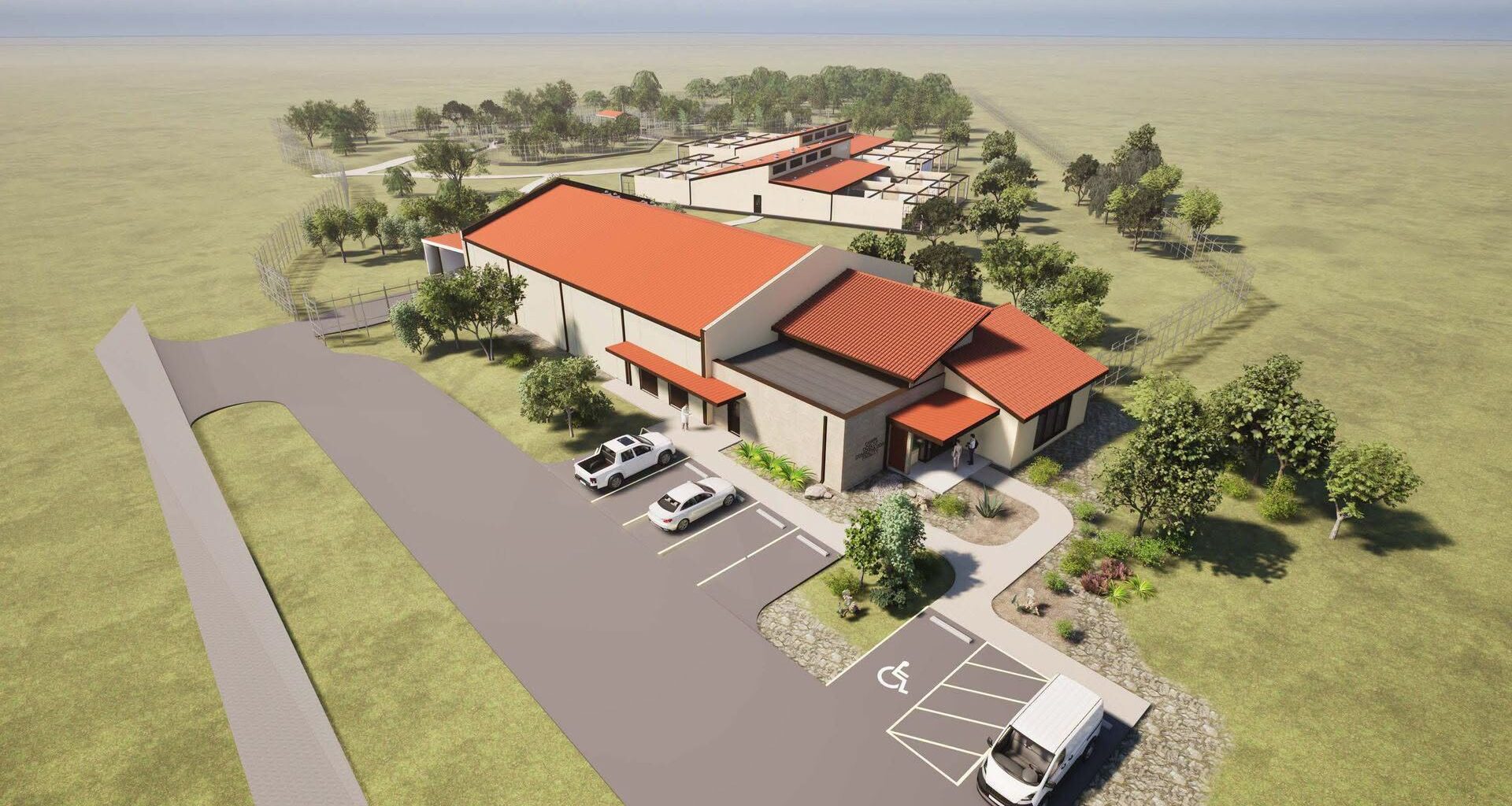
East Foundation this week released a first look at the new Caesar Kleberg Wildlife Research Institute (CKWRI) Ocelot Conservation Facility, a breeding center that will raise endangered ocelots for release into the wild as conservationists work to rebuild the state’s dwindling population. Fewer than 120 wild ocelots remain in Texas because of decades of habitat loss and hunting.
The facility, which began construction in early 2025, is expected to open later this year on a roughly six-acre site within the Tio and Janell Kleberg Wildlife Research Park at Texas A&M University-Kingsville. The complex includes a 9,650-square-foot research building with quarantine space, veterinary facilities, laboratories and staff offices, along with 16 breeding enclosures and four outdoor “wilding” enclosures where young cats can develop natural behaviors before release.
“The CKWRI Ocelot Conservation Facility will be recognized as the most significant conservation effort to date as we strive to sustain the legacy of the United States ocelot,” East Foundation said. “The CKWRI Ocelot Conservation Facility will provide solutions to the many needs surrounding ocelot conservation and recovery throughout South Texas. All spaces have been carefully designed with the animals’ well-being and safety as the highest priority.”
Once the facility is complete, ocelots from U.S. zoos participating in the Saving Animals From Extinction (SAFE) program will be brought in to begin a managed breeding effort. Researchers will also use genetic material collected from wild Texas ocelots over the past several years to help produce kittens through assisted reproduction.
The goal is to house multiple breeding pairs in one location before raising the next generation in large, semi-natural enclosures designed to encourage wild behaviors. Young ocelots will have limited human contact while learning to explore dense brush and hunt live prey.
If they demonstrate the necessary survival skills by about one year of age, some of the facility-born cats will be released onto East Foundation’s San Antonio Viejo Ranch, where conservationists hope to establish a new wild population in an area that has been without ocelots for decades. Others could bolster existing populations at East Foundation’s El Sauz Ranch or other suitable habitat in Kenedy, Willacy and Cameron counties, providing a much-needed genetic boost.
Because the animals are being prepared for life in the wild, the facility will not be open to the public. Instead, East Foundation plans to monitor the cats through an extensive camera system and share photos, videos and updates from the breeding program.
The project builds on more than four decades of ocelot research at the Caesar Kleberg Wildlife Research Institute and was developed through a partnership with East Foundation, Texas A&M University-Kingsville and other conservation partners. Construction was made possible through funding from anonymous donors.