
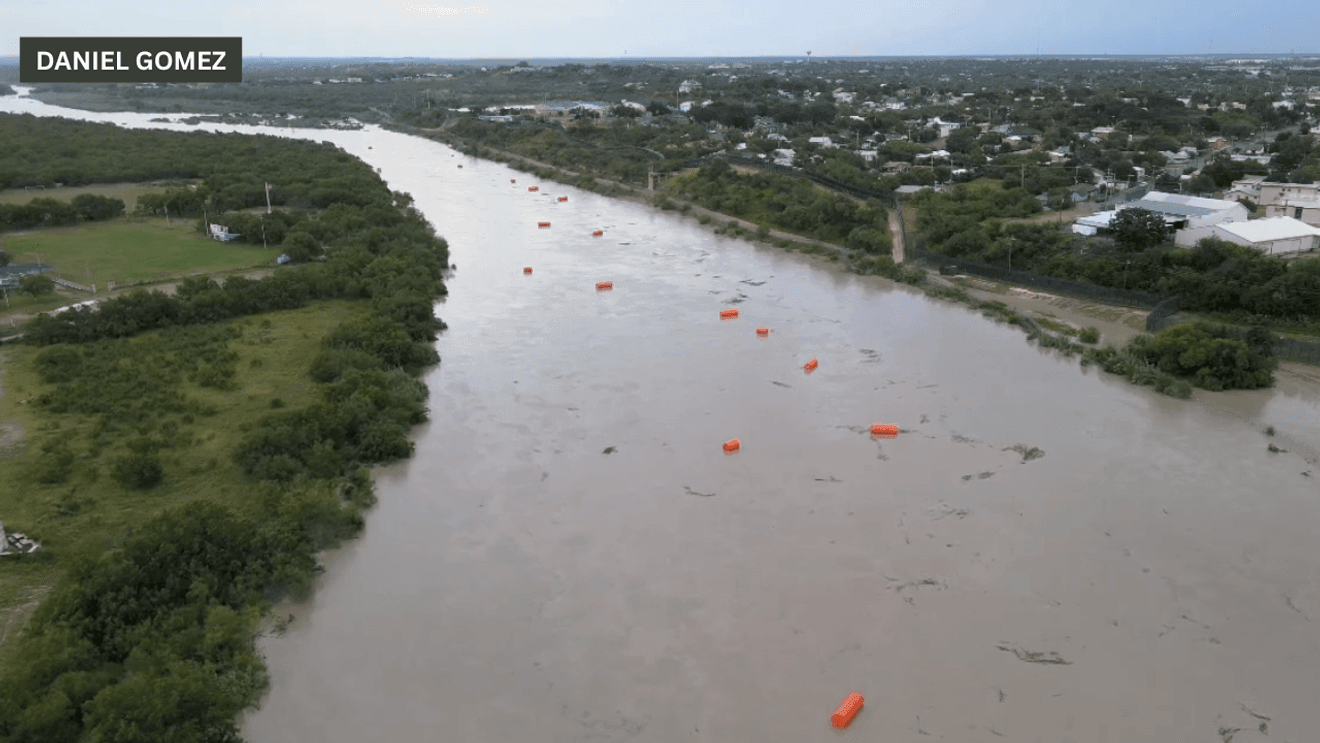
Recent flooding along the Rio Grande swept hundreds of federal border buoys from staging and installation areas near Eagle Pass, sending some of the barriers more than 100 miles downriver toward Laredo.
The flooding temporarily disrupted international bridge traffic, raised questions about who was responsible for securing the barriers and left federal contractors working to recover buoys from both sides of the river.
The flooding came as federal officials continued expanding buoy barriers along portions of the Texas-Mexico border.
Buoys were still scattered along the Rio Grande in Eagle Pass the morning of 7/17/2026 (Daniel Gomez Photography)
Buoys swept away near Eagle Pass
Video recorded during the flooding showed cylindrical buoys floating down the Rio Grande as people gathered along the Mexican side of the river to watch.
The buoys were floating individually rather than in connected sections, indicating that many had not yet been installed or anchored in the river.
U.S. Customs and Border Protection said the buoys were under the control of a contractor and had been staged at nearby Shelby Park when rapidly rising water swept them into the river.
As a result of the heavy rains in Eagle Pass, Texas, this week, buoys under the responsibility of control of the contractor that were staged at nearby Shelby Park, were swept into the river due to the fast-rising water. These were not buoys that were already deployed and anchored in the river. CBP is working with its contractor to retrieve these buoys.Waterborne barriers are intended to create a safer border environment for patrolling agents, as well as deter migrants from attempting to illegally cross the border through dangerous waterways. In addition, they provide effective impedance and denial capabilities that enhance natural barriers and complement land based, steel bollard border wall systems nearby.
Eagle Pass temporarily closed its international bridges because of concerns that the barriers could strike the bridge pillars and cause damage. The bridges reopened after inspections determined they were safe.
U.S. Rep. Henry Cuellar said local governments had prepared for the flooding and warned federal officials about the potential danger posed by the rising river.
“The CBP, DHS, and the contractors ignored the local communities and look, now they have an embarrassing situation because they didn’t listen to the local folks,” Cuellar said.
“Do you think that the contractors should face repercussions for that?” Jordan Elder asked.
“Well, you know, absolutely. They should answer why they did not move the buoys to a safer place. They have to answer: what are they going to reimburse the city because bridges were closed down? I think these contractors are paid billions of dollars. I think they definitely have to answer, and I will be asking DHS when they get back to me about, hey, who’s going to reimburse the local communities for this situation?”
Images taken after sunrise in Eagle Pass showed individual buoys continuing to move downriver. Other buoys had accumulated in an offshoot of the river, including a large number on the Mexican side.
The images were provided by Daniel Gomez.
There were also reports in the Eagle Pass News Leader that people on the Mexican side of the river removed some of the barriers from the water and dismantled them to retrieve materials from inside.
CBP initially did not provide an exact count of how many buoys were swept away near Eagle Pass.
The agency defended its continued use of the barriers, saying they are intended to deter dangerous river crossings and provide additional support to Border Patrol agents.
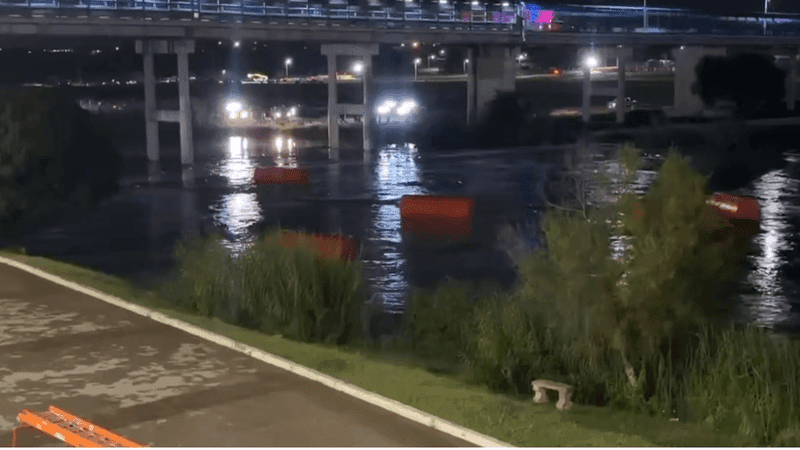
Buoys float near an international bridge in Eagle Pass on 7/16/26
Buoys travel downriver to Laredo
Contractors began retrieving the barriers after the Eagle Pass flooding, but some buoys continued moving down the Rio Grande and eventually reached Laredo.
Images from Laredo showed both individual cylindrical buoys and connected sections of the barrier floating in the river.
The connected sections represented buoys that were either being installed or had already been linked together as part of the deployment process.
CBP later said approximately 55 buoys that were in the process of being deployed by a contractor were swept away.
“All of the buoys remained under the control of the contractor and had not been transferred to U.S. Border Patrol custody,” the agency said.
Several sections accumulated near the World Trade Bridge, prompting officials to temporarily suspend traffic as a precaution. CBP said there were no reported injuries or damage to the bridge.
Contractors brought equipment to the area to remove the buoys. Border Patrol airboats and Laredo Sector leadership provided security and operational support during the recovery.
Laredo leaders provided an update on the recovery effort this week.
The recent flood reminded us that we had never underestimated the force of Mother Nature. Fortunately, there were no injuries or major property damage during the buoy retrieval operation. But, however, this event demonstrated the importance of reviewing whether additional engineering, planning, and operational safeguards should be considered before future deployments. As the number one inland port of the United States, Laredo continues to be one of America’s most important economic gateways. As what was recently reported in May, trade to the Laredo port has increased 17 percent over the same period last year, and approximately 1.2 million in commerce crossed the international bridges every minute, keeping us as the number one position in North America. And during the recent buoy retrieval operation… traffic delays exceeded 500 minutes, interrupting the movement of an estimated 600 million in merchandise, which was very significant. -Laredo Mayor Dr. Victor Trevino
The total cost of the damage and recovery effort remains unclear.
Federal records show the government has committed substantial funding to waterborne border barriers, but we haven’t received answers on exactly how many buoys were swept away and what it might cost to replace them.
Federal planning documents have described the barriers as being designed to withstand changing river conditions, including flooding and rising water.
However, many of the barriers involved in this incident had either not yet been installed or were still being deployed. It remains unclear how fully anchored barriers would have performed under the same conditions.
The federal barriers are cylindrical. They are different from the spherical buoy barriers installed by the state of Texas in another section of the Rio Grande.
Photographs reviewed by the News 4 I-Team showed that some of the state-owned spherical buoys shifted during the flooding but did not appear to break free from their anchors.
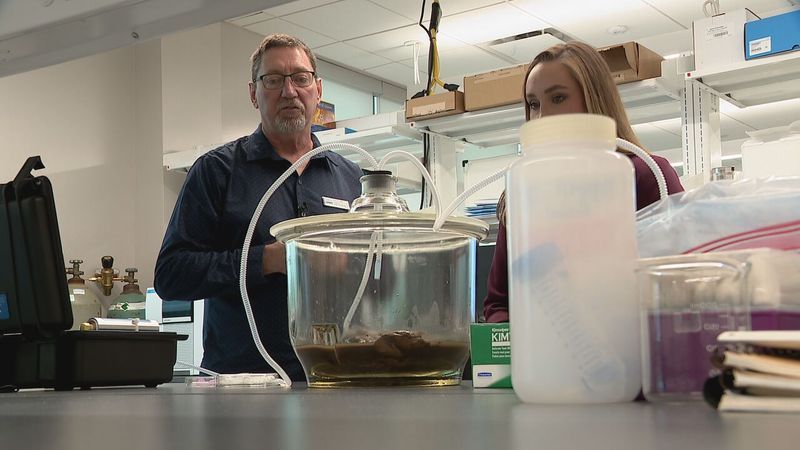
Beef liver is being aged and studied to develop more specific lures for New World Screwworm (SBG San Antonio)
Screwworm cases raise questions as livestock imports resume
There are about 40 active cases of New World screwworm in the United States, many of which are in Texas.
New World screwworm is a parasitic fly whose larvae infest open wounds and feed on the living tissue of warm-blooded animals.
The News 4 I-Team recently received an inside look at a U.S. Department of Agriculture laboratory in Kerrville where researchers are working on new tools to detect and control the pest.
Researchers are studying a product called NovoFly and testing new lures intended to attract screwworm flies more effectively.
‘Game-changing’ fly could strengthen fight against New World screwworm
Scientists are studying scents to develop better New World Screwworm traps
The USDA also announced plans to begin reopening parts of the southern border to livestock imports on Aug. 24.
The reopening will be phased, beginning with ports in Arizona and New Mexico. Texas ports are not included in the initial phase.
Livestock imports had been restricted since May 2025 as federal officials attempted to prevent the northward spread of New World screwworm.
The decision to reopen some ports has raised questions because screwworm cases have since moved closer to — and into — the United States.
Texas Agriculture Commissioner Sid Miller and several livestock industry groups praised the reopening, arguing that the closure caused significant economic losses for ranchers and other businesses.
R-CALF USA CEO Bill Bullard has argued that the border should remain closed to livestock imports until screwworm is eliminated from Mexico.
Federal authorities said every animal entering through a reopened port will undergo multiple veterinary inspections overseen by the USDA’s Animal and Plant Health Inspection Service.
Animals that do not meet import requirements will be denied entry. The USDA said any detection of New World screwworm would immediately halt imports through the affected facility.
U.S. Agriculture Secretary Brooke Rollins said the inspection requirements and other safeguards should reduce the risk of the pest spreading through livestock shipments.
The USDA has not announced when livestock imports will resume through Texas ports. Federal officials said the reopening timeline remains flexible and could change depending on screwworm detections and conditions in Mexico and the United States.