
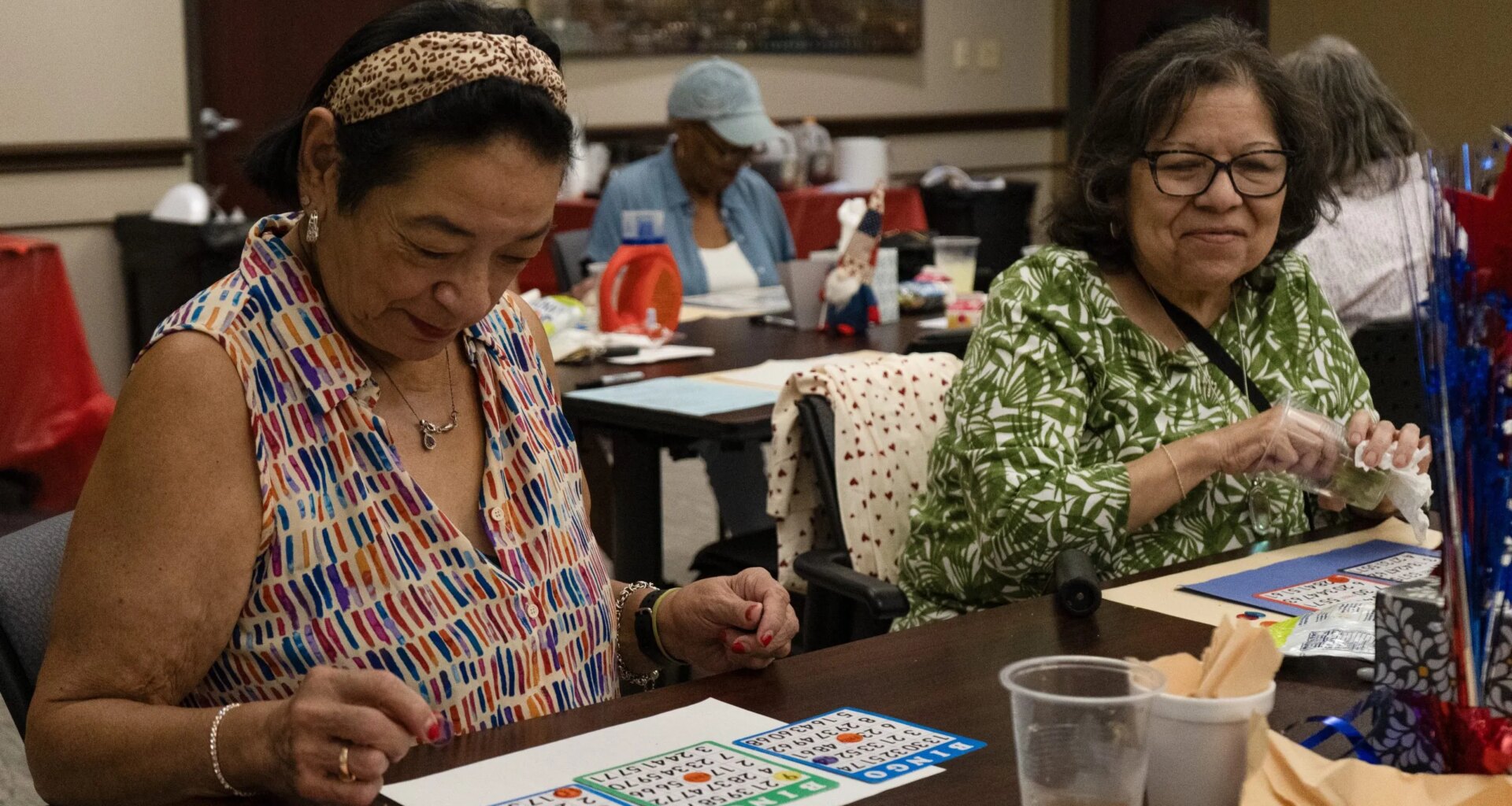
Just over a dozen older adults sat at tables decorated in red, white and blue in a meeting room at the Women’s Center of Tarrant County, eyes trained on a large projector screen.
Decades-old photos of celebrities from the 1980s and ’90s flashed across in a video quiz, challenging the group — all women — to call out the stars’ names.
Chevy Chase and Arnold Schwarzenegger came and went, as did Tom Cruise. The ladies had a lot to say.
“He was cute back then,” one said.
“He’s still cute!” another contended.
As the quiz continued, the women offered spirited interjections about which movies or TV shows the celebrities once appeared in, what they looked like now and which of them are still alive — all while enjoying hot dogs, fruits and vegetables, cupcakes and other snacks.
The women found themselves at the July gathering by way of a free program called PEARLS — an acronym for Program to Encourage Active, Rewarding Lives. Though this meetup featured only female attendees, the monthly sessions — known as PEARLS Connect — bring adults 60 and older of any gender together with the goal of fostering bonds and fighting depression.
The stakes are high. In Tarrant County, adults 65 and older have the highest rate of suicide mortality of any age group — 19.9 per 100,000 people, according to 2022 data.
“We were first interested in having a program for older adults because we saw something similar — that that population was growing and that that population was prone to suicide,” said Sherri Pratt, director of general counseling services at the Women’s Center. “We were like, yeah, we need to do something.”
Developed at the University of Washington in the late 1990s, PEARLS has been administered by local organizations around the country since. It has served more than 12,800 older adults nationwide, including nearly 800 in Tarrant County since it began locally in 2015.
PEARLS offers older adults individualized coaching to help them become more involved in their communities and improve their mental health. Pratt said the program took off soon after it began, and the Women’s Center began looking for ways to extend its impact.
“How could we make sure that the work we had done stuck, that they were still benefiting from it, that they were utilizing the tools that we had taught them during PEARLS?” she said.
Clients can be referred to PEARLS by doctors, social services organizations, family members or themselves. Trained coaches provide eight to nine sessions in the client’s home or a public place of their choice.
The process starts with coaches’ assessment of the older adults to see if the program would be a good fit for them.
During sessions, a coach talks with the client about the causes of their sadness or isolation. Once that is determined, the coach helps them set goals to address the issues — one social, one physical and one for pleasure. If the participants struggle to come up with ideas, coaches are ready with suggestions.
At each session, clients also fill out a mental health questionnaire that screens for depression and suicidality. PEARLS Connect participants also complete the form at the beginning of each monthly meeting, and if their score rises — indicating they are experiencing more symptoms — coaches check in to see how they can help.
Loneliness is a common reason that older adults may struggle with their mental health, Pratt said. Participants could also be battling grief after losing partners, children or friends.
One previous client was referred to the program by his daughter, after his wife of many years died.
“He was just sitting in his house waiting to die,” Pratt said. “She referred him to PEARLS, and he literally is on one of our posters here with the biggest, brightest smile now, because he got out of his house. He got busy. He stopped sitting there waiting to die.”
In another example provided by Pratt, a client wanted to go to dinner with her husband but could not because she was bedridden. She lacked the strength to transfer herself from her bed to her wheelchair. Her physical therapist had taught her exercises to help build her strength, but she struggled to find motivation.
Her PEARLS coach helped her find it. After she completed her sessions, the client sent along a photograph of herself sitting with her husband in a restaurant.
“It’s so amazing what happens in this program,” Pratt said.
Scores from the mental health questions indicate that after a Tarrant PEARLS participant completes their sessions with a coach, 97% see an average improvement of 87% in their symptoms.
Romona Dunlap, 73, joined PEARLS while recovering from a difficult two-and-a-half year period caring for her mother. Even with nearly two decades of experience as a professional in-home caregiver, those years were incredibly taxing, she said. Then came the grief after her mother died.
“The first time Shanna came, all I could do was sit and cry,” Dunlap said of her first session with her PEARLS coach. “I was in bad, bad shape, emotionally. And physically — I was just exhausted.”
Dunlap’s grief was so severe, it took nine months of attending a support group at her church before she could say the word “mama” without feeling tears coming.
At first, she wanted to stay quiet at PEARLS Connect meetings. Over time, she began to feel more comfortable.
“It took awhile for me to want to say anything,” she said. “The coaches’ support helps open that up.”
As part of monthly PEARLS Connect gatherings, time is set aside for participants to share with the group things going on in their lives, including joys and struggles.
At July’s meeting, one woman told a story about her recent trip to Yellowstone National Park and an ensuing flat tire. Another told the group about her new puppy. Yet another shared that she is struggling because her friends do not understand her Parkinson’s disease, prompting another participant to offer words of advice: Doing the best you can do is all you can do. Be who you are, and they will either accept you or they won’t.
Afterward, the group shifted gears to playing bingo — a favorite activity among the participants, Pratt said.
A PEARLS coach spun colorful balls inside a revolving cage, mixing them thoroughly before calling them out into a microphone with energy.
“B 11. B, B 11,” she said, peppily.
The women focused intently on their cards, placing colorful plastic chips with care.
 Terri Johnson places plastic discs on a bingo card during PEARLS Connect at the Women’s Center in Fort Worth on July 16, 2026. (McKinnon Rice | Fort Worth Report)
Periodical calls of “Bingo!” were met with celebration.
“Winner winner, chicken dinner!” a staff member exclaimed.
 Romona Dunlap, 73, celebrates after winning a round of bingo during PEARLS Connect at the Women’s Center in Fort Worth on July 16, 2026. “It’s healing,” she said of the program. (McKinnon Rice | Fort Worth Report)
Then, the winning participant got to choose their prize. Among the choices in July were a crochet craft kit, packages of toilet paper and a ziplock bag of sample-size lotions.
Dunlap, a jubilant winner, chose the toilet paper. She said she began working at age 15 but still found herself on food stamps at this point in life.
“But food stamps doesn’t pay for toilet paper,” she noted.
Financial stress can be a factor leading to older adults’ mental health challenges, Pratt said. They may have previously relied on a partner’s social security check that stopped coming after their death. They could also be in danger of losing their homes or unable to afford repairs amid deteriorating living conditions.
Prize options are assembled from what the staff can scrap together with limited funds and donated items. The program is on a tight budget, working with significantly less funding than it had last fiscal year.
The Women’s Center received nearly $200,000 from the Area Agency on Aging for the PEARLS Program last year. However, it received only $25,000 in 2026 after pandemic-era ARPA dollars expired and Older Americans Act funding through Texas Health and Human Services was reduced.
That drop forced the Women’s Center to let go of a coach and their PEARLS case manager, leaving the two remaining coaches to cover more ground. Their absence is felt by participants who remember them fondly by name.
A local grant had allowed the Women’s Center to offer transportation to PEARLS Connect, but that ended last fiscal year. The monthly gatherings no longer see as large a turnout as they used to, Pratt said.
While men do participate in sessions, they are usually outnumbered at the Women’s Center. Pratt said she believes the venue’s name might be a source of confusion.
Previously, about 25 older adults came to PEARLS Connect, Pratt said. July’s meeting saw about 15, among them friends with tight bonds.
Irene Bradshaw, 74, and Emily Ayala, 71, met through PEARLS Connect. Bradshaw lost her husband Elijah last year and joined after her son nudged her to find a reason to leave the house.
“Really, I was just crying all the time,” Bradshaw said. “I started coming here, and it was like little by little, I started getting out.”
For Ayala, PEARLS helped her find confidence and connect with others.
“It makes you feel like you’re not alone,” she said.
The two share the experience of having cared for a family member, and of the exhaustion that can come with it.
Bradshaw said she took care of a husband who had dementia, carrying the burden alone.
“It just got to where it was just so much I could not take it anymore,” Bradshaw said. “I wanted to just jump off the bridge. It got to be just that bad.”
Ayala cared for her mother by herself. Later, her sisters took her mom in.
“Now, they got each other,” she said, fighting tears.
And Ayala has Bradshaw.
“PEARLS saved me,” Ayala said.
“It saved a lot of us,” Bradshaw added.
McKinnon Rice is the health reporter for the Fort Worth Report. Her position is supported by a grant from Texas Health Resources. Contact her at mckinnon.rice@fortworthreport.org.
At the Fort Worth Report, news decisions are made independently of our board members and financial supporters. Read more about our editorial independence policy here.
This <a target=”_blank” href=”https://fortworthreport.org/2026/08/01/older-adults-have-the-highest-suicide-death-rate-in-tarrant-this-program-uplifts-seniors/”>article</a> first appeared on <a target=”_blank” href=”https://fortworthreport.org”>Fort Worth Report</a> and is republished here under a <a target=”_blank” href=”https://creativecommons.org/licenses/by-nd/4.0/”>Creative Commons Attribution-NoDerivatives 4.0 International License</a>.<img src=”https://i0.wp.com/fortworthreport.org/wp-content/uploads/2021/04/cropped-favicon.png?resize=150%2C150&ssl=1″ style=”width:1em;height:1em;margin-left:10px;”>
<img id=”republication-tracker-tool-source” src=”https://fortworthreport.org/?republication-pixel=true&post=703200&ga4=2820184429″ style=”width:1px;height:1px;”><script> PARSELY = { autotrack: false, onload: function() { PARSELY.beacon.trackPageView({ url: “https://fortworthreport.org/2026/08/01/older-adults-have-the-highest-suicide-death-rate-in-tarrant-this-program-uplifts-seniors/”, urlref: window.location.href }); } } </script> <script id=”parsely-cfg” src=”//cdn.parsely.com/keys/fortworthreport.org/p.js”></script>