
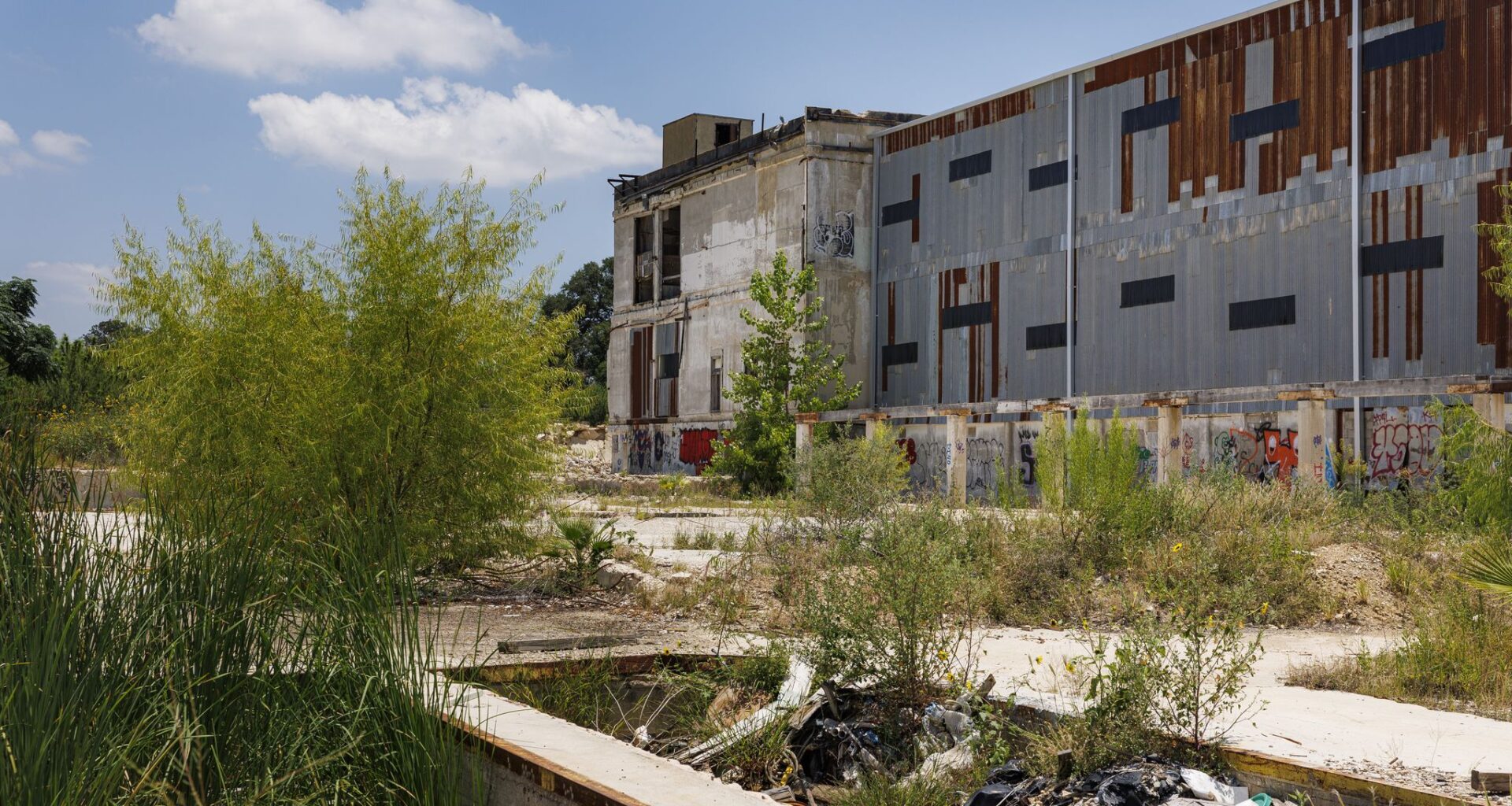
The bulk of the long-shuttered Friedrich refrigeration and air conditioning factory no longer looms over East Commerce Street as a constant reminder of what the community lost.

Once a humming manufacturing complex surrounded by shops and restaurants in the heart of San Antonio’s Black community, the 6-acre site has been mostly vacant for more than 40 years. Plans to redevelop it failed. What remained was a warren of decaying buildings pocked with broken windows — and the disappointment and frustration of area residents and business owners.
But their hopes rose in 2023 when crews began demolishing the buildings to make way for 358 mixed-income apartments, the first tangible sign of progress at the site. The San Antonio Housing Trust, American South Real Estate Fund and Provident Realty Advisors teamed up on the project, dubbed Friedrich Lofts.
Article continues below this ad
By mid-2024, the work had stopped and the heavy machinery was gone. Weeds pushed up around broken concrete slabs and piles of gravel, and plastic hung in tatters from a chain link fence encircling the property. The walls of a building deemed historically significant, and topped with a neon-red Friedrich sign, are littered with graffiti.
Most of the property was recently put up for sale.
“When they knocked the buildings down, we thought there was actually something happening. We thought, ‘Hey, got something going there,’” said Mark Outing, who has owned his eponymous burger joint across the street from the Friedrich site for 21 years. “The whole neighborhood would love to see it become something.”
Mark Outing owns Mark’s Outing, a burger joint across East Commerce Street from the Friedrich property. Outing said the property has long been an eyesore and neighbors are eager to see it redeveloped.
Sam Owens/San Antonio Express-News
Mark’s Outing, a longtime burger restaurant on San Antonio’s East Side, is pictured on Monday, July 27, 2026. The restaurant is across the street from the vacant Friedrich industrial site.
Sam Owens/San Antonio Express-News
But the group behind the project is struggling with the price tag — upwards of $100 million.
Article continues below this ad
“It has always been and will continue to be an extremely challenging site,” said Pete Alanis, executive director of the housing trust, which preserves and builds affordable housing. “There’s a lot of risk associated with the site.”
Investors and lenders have been spooked by both the cost and complexity of environmental cleanup at the site and the potentially slim returns they could expect based on what renters would pay for the apartments sandwiched between a school and a cemetery in a mixed-income neighborhood.
And then there are the many difficulties in lining up financing in a shaky economy. Interest rates and the cost of materials, labor and insurance have risen in recent years, making it more expensive to borrow money and build the apartments. Rent growth is sluggish across San Antonio because an influx of apartments built during the pandemic are still filling up — a situation that favors renters over landlords.
The housing trust’s ownership means Friedrich Lofts will be exempt from property taxes, and the organization has secured a loan from the U.S. Department of Housing and Urban Development and $10.6 million in equity from American South. The city is providing about $2.2 million worth of financial perks.
Article continues below this ad
But the partners are still coming up short, Alanis said.
American South, which is affiliated with Los Angeles-based SDS Capital Group and Shreveport, La.-based Vintage Realty Company, put the property on the market to see what it could fetch.
The fund has the right to sell it under certain conditions, such as financing taking a long time to be shored up, Alanis said.
American South could sell its interest to another equity investor, sell the property to a developer that brings its own capital, or hold onto the property and wait for costs to come down. The fund, as well as Dallas-based Provident Realty, declined to comment.
Article continues below this ad
“The project still doesn’t pencil out,” Alanis said.
It’s a blow to residents of nearby Denver Heights and Dignowity Hill, who say they’re eager to see more housing, stores and restaurants, and view the Friedrich as an obstacle to attracting those amenities. With the city’s proposed sports and entertainment district poised to reshape downtown, and the Alamodome slated to be renovated as part of so-called Project Marvel, they want to see investment flow east across the railroad tracks.
Business and property owners in Denver Heights and Dignowity Hill said they want to see the Friedrich property redeveloped, though some are concerned about environmental contamination. Buildings at the corner of Olive and Commerce streets, shown here on the left, feature a neon red “Friedrich Refrigerators” sign that has long loomed over the East Side.
Sam Owens/San Antonio Express-News
“It would be a shot in the arm for progress,” said Aubry Lewis, president of the Denver Heights Neighborhood Association.
Article continues below this ad
Charles Williams, a longtime East Side businessman and civil rights activist, said more affluent neighborhoods wouldn’t allow a large property on their doorstep to remain vacant for decades. They’d come up with redevelopment ideas and funding, and pressure elected officials.
East Side residents sometimes feel like stepchildren, he said.
“It’s hard for East Side citizens to understand why it has taken so long for some kind of development to take place in there,” said Williams, who once cut Friedrich employees’ hair at a barber shop a few blocks away.
IDEA Public Schools, the charter school network that operates IDEA Carver next to the site, said “the lack of progress is presenting challenges” for students and employees.
Article continues below this ad
Concerned about vagrants hanging out at the Friedrich property and the safety of their students, campus leaders have adjusted drop-off and pick-up procedures and increased staff supervision during outdoor activities, a spokesperson said.
Boom to bust
Friedrich Air Conditioning Co., a major manufacturer of commercial refrigeration equipment, started building the complex in stages in the 1920s.
Hundreds of people worked at the San Antonio company’s plant as its business swelled and it expanded to making air conditioners. Workers poured in when a whistle screeched at 8 a.m. and left when it sounded again at 5 p.m., with many of them stopping by neighborhood grocers, restaurants and bars.
Article continues below this ad
John “Chet” Klonek, a Denver Heights resident whose cousins worked at the plant, said the area was “booming” with businesses run by the middle-class and low-income Black and Latino families that called it home.
Wealthier, white residents didn’t want to live on the East Side, which was considered “a bad place to be from,” Klonek said. Houses were affordable. He said his grandmother purchased a home for $6,000.
But crime plagued some blocks, and Klonek recalls neighbors joking that they could only fall asleep after hearing gunshots and police helicopters.
“No one wanted to invest,” Klonek said.
Article continues below this ad
Most of the work at the Friedrich facility shifted to other factories, and the company closed it in 1990 after “continuous years of significant losses” due to slimmer profit margins, stiffer competition, higher operating costs and failure to win concessions from union workers. About 225 employees lost their jobs.
Alamo Iron Works, another prominent East Side employer, moved around the same time to make way for the Alamodome.
Dallas developer John Miller and Alamo Beer Co. founder Eugene Simor bought the Friedrich property in 1999 with dreams of turning it into lofts, stores and offices.
They struggled to attract investors and lenders, who worried about a lack of development in the area and environmental contamination — even though a report by independent consultants indicated that the plant needed no major cleanup before renovations could begin.
Article continues below this ad
Simor and Miller said they invested millions to secure financing and the City Council agreed to sponsor a loan in 2005, but their efforts to remake the property proved futile.
Crews started demolishing portions of the Friedrich industrial complex in 2023 to make way for a multifamily development. Most of the buildings were gone by mid-2024, save for several owned by a separate company. But progress on the apartment project has stalled, and a fund that provided equity for it is seeking to sell the property.
Sam Owens/San Antonio Express-News
“The loan never closed,” Miller told the San Antonio Express-News in 2008. “There’s a reason deals like the Friedrich take a long time — they’re hard to do. You have multiple sources of capital and equity and loans, and it all has to come in and be ready to go to closing on the same day. All the parts and pieces were never ready at the same time.”
A plan to move the San Antonio Independent School District’s headquarters to the six-acre property also floundered.
Article continues below this ad
Council members removed local historic designations from most of the buildings in 2015 to pave the way for demolition that could make the property easier to recast.
Miller’s partnership agreed to sell most of the property to an affiliate of the housing trust and Provident Realty in 2017, and the deal closed in 2020. Miller kept three small parcels, including the historic building with the Friedrich sign, and the housing trust and Provident unveiled plans for apartments.
By then, the demographics of Denver Heights and Dignowity Hill were morphing. Elderly homeowners who had lived in the neighborhoods for decades were relocating or dying, and their children often didn’t want to take over their properties. A group of developers and brokers began trying to revitalize sleepy St. Paul Square. Investors flipped houses as the housing market heated up during the pandemic. More white families moved in, drawn to some of the most affordable prices in the urban core.
“You see a lot of white people walking around now,” Klonek said.
Article continues below this ad
Council members on the housing trust’s board of directors sparred in 2021 over proposed income levels at Friedrich Lofts. Residents said at public meetings that they worried rents would be too high, fueling gentrification.
The board ultimately approved a plan to reserve 24 units for people earning up to 60% of the area’s median income and another 155 units for people making up to 80% of the median income. The remaining 179 apartments would be rented at market rates, meaning whatever price the area could support.
Provident Realty started razing buildings to conduct environmental studies required by the Texas Commission in Environmental Quality, which alarmed some residents concerned about contaminating the air, Lewis said. The company said it hired monitoring and environmental consultants to oversee the removal of hazardous materials such as asbestos before the work began, and it installed air-monitoring pumps.
Miller’s partnership sued entities affiliated with Provident Realty in 2023, alleging the developer damaged the historic building because it didn’t stabilize it before demolishing the buildings around it. Provident Realty denied the accusations, and the lawsuit is still ongoing.
Article continues below this ad
By mid-2024, the work appeared to have stopped. Alanis said that after obtaining the HUD loan, the owners had to close on financing for the project before conducting more clean-up — which is where Friedrich Lofts stands now.
Crews started demolishing portions of the Friedrich industrial complex in 2023 to make way for a multifamily development. Most of the buildings were gone by mid-2024, save for several owned by a separate company. But progress on the apartment project has stalled, and a fund that provided equity for it is seeking to sell the property.
Sam Owens/San Antonio Express-News
Klonek hopes the city’s proposed sports and entertainment district and more investment downtown helps jump-start the Friedrich site’s overhaul. He said he’d welcome more restaurants, coffee shops, bars and fitness studios opening on the East Side, where he and his wife often zip around in their golf cart from their house near the Alamodome to neighborhood businesses.
“I’m so happy to see all the renovations,” Klonek said. “It’s changed so much.”
Article continues below this ad
The economics are still tough. Williams said he has spent more than 70 years buying and selling various commercial buildings and businesses in the area because he wants young people to “see that a Black businessman can survive over there.” He said he understands costs aren’t adding up for the housing trust and American South, but it’s vexing to residents.
“I don’t know if it will ever really develop,” he said.