
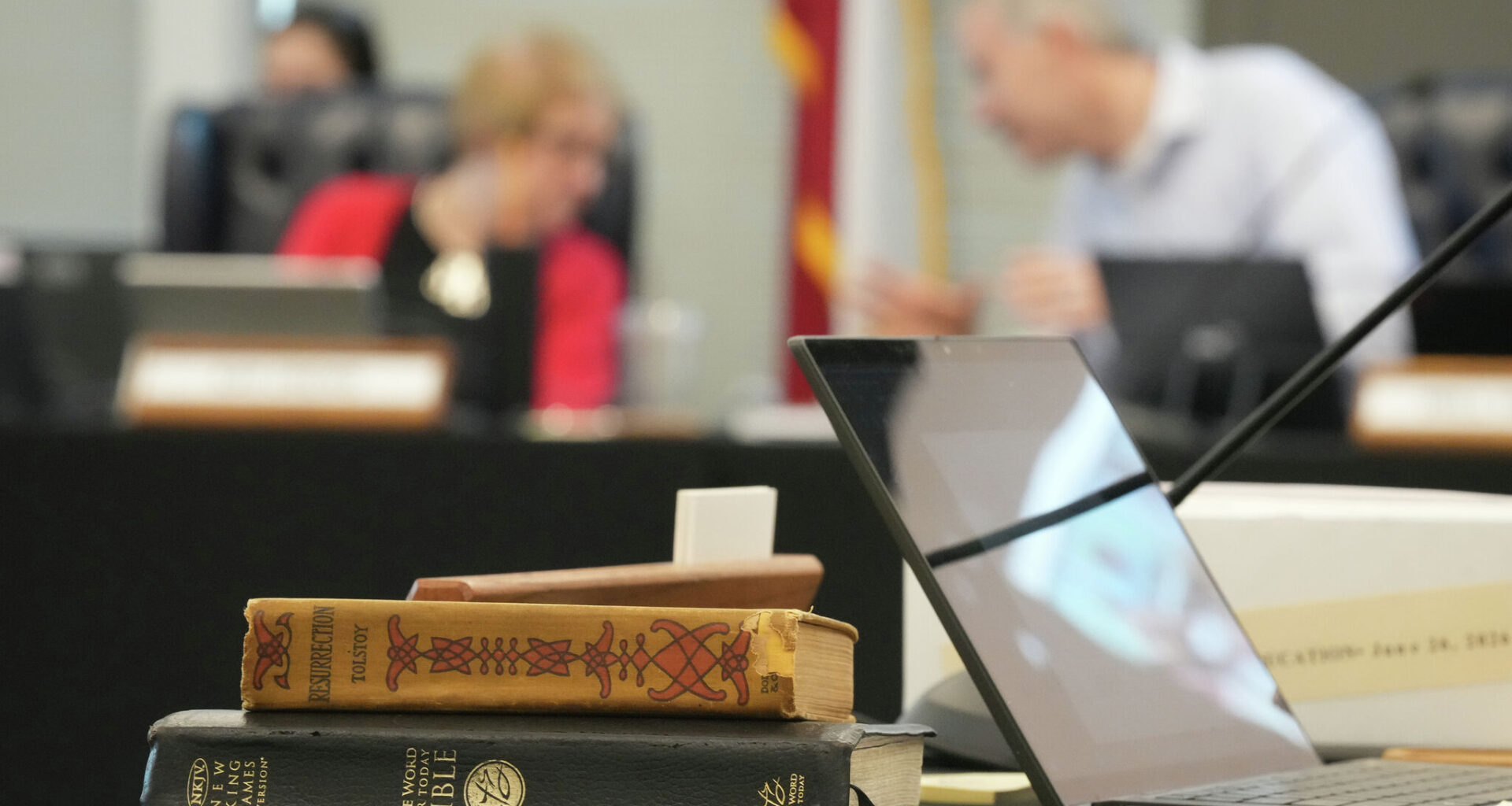
A Bible and Resurrection by Leo Tolstoy sit on the desk of State Board of Education member LJ Francis during a meeting on proposed social studies standards at the Barbara Jordan Building in Austin on Monday, June 22, 2026. The board is considering revisions that would place greater emphasis on Christian history and biblical content in public school classrooms.
Austin American-Statesman/Hearst/Austin American-Statesman via Ge
As the Texas State Board of Education (SBOE) debated this summer whether or not to add the Bible to the state’s required reading list, critics argued that asking students to read Bible passages would infuse public schools with Christianity. Supporters, in turn, contended that knowledge of the Bible was key to understanding literature and U.S. history.

“When we teach classical literature and social studies with biblical foundations, we are not simply preserving great books,” one Lubbock resident told the SBOE as the body approved the changes. “We’re helping raise young men and women who love truth, pursue wisdom and recognize God’s hand throughout history and human experience
Texas Republicans in support of requiring students to read Bible passages have made similar arguments, as well as said that it is important to emphasize America’s founding as a “Christian nation.” That echoes similar pushes such as the effort to put the Ten Commandments in every public school classroom.
Article continues below this ad
But after the SBOE approved adding passages like Matthew 6:25-34 or the parable of Jonah and the Whale, the argument that teaching the Bible wasn’t such a bad idea found purchase outside of Texas Republican spheres. A Houston Chronicle op-ed argued that “Teaching the Bible in Texas schools is good, actually.” A piece in The Atlantic magazine by Adam Kirsch declared that “The Bible Belongs in the Classroom.”
“Texas’ decision to start teaching Bible stories—like its requirement to display the Ten Commandments in classrooms, which the state legislature approved last year—is clearly meant to send a political message,” Kirsch writes. “But regardless of your political or religious beliefs, there are good reasons to agree that the Bible should be part of young people’s education.”
It’s a thought-provoking question argument. After all, as Kirsch points out, countless classics of American literature contain references to the Bible, and Biblical context is helpful when understanding historical documents written during our nation’s founding. And the Bible is, when viewed as a piece of literature, indeed a well-written, beautiful work. But to some religious scholars, these arguments are “divorced from reality” and miss out on the context of the push to put more religion in Texas schools.
“It sounds like the people who are behind this are really explicit that it is about American exceptionalism, and that it is about America as a Christian nation, which is very, very different from reading the Bible as literature,” Andrew Tobolowsky, an associate professor of religious studies at the College of William & Mary, argued.
“The potential for abuse is extreme.”
Tobolowsky, whose research and teaching focus on the Hebrew Bible, said he sees inherent value in teaching biblical texts to understand classical books and history. But that value is hard to square with the context, which includes efforts to put copies of the biblical Ten Commandments into classrooms, for more Christianity in Texas schools.
Article continues below this ad
“It’s fundamentally different from saying, like in a vacuum, would it be good or bad for students to learn about biblical texts,” Tobolowsky said. “What is happening is that there is a theological intent of exposing people to traditions by people who want them to believe those traditions in a way that I think really cuts against the separation of church and state.”
He also pointed out that, at the same time that the SBOE added Bible passages to the required reading list, the board also recommended U.S. history lessons that, among other things, changed the name of the 1921 Tulsa race massacre to the “Tulsa Race Riots.”
“It’s happening along with decentering anybody but white Christians from the discussion,” Tobolowsky said. “You have to take that into account when you’re talking about ‘Is this gonna be a good thing or a bad thing?'”
Article continues below this ad
Tobolowsky recalled his own time in Texas public schools. Growing up in Dallas and attending a school that “didn’t have many Jews,” Tobolowsky said he worried that Muslim, Jewish and Hindu students would inevitably be taught about the Bible by Christian teachers who, intentionally or not, may present Christianity as above other faiths.
“I think there’s no question that regardless of the intentions, and we sort of know more about the intentions,” Tobolowsky said. “The potential for abuse is extreme.”
People hold signs reading Teach the Truth and Don’t erase our history during a rally on the Capitol Mall outside the Barbara Jordan State Office Building, where the State Board of Education meets, Tuesday, April 7, 2026, in Austin, Texas.
Austin American-Statesman/Hearst/Austin American-Statesman via Ge
“There’s really just no way to win.”
David Brockman, a nonresident scholar at Rice University’s Baker Institute, agreed that the curriculum had potential to give students the wrong idea. He noted that the only religious materials on Texas’ new required reading list are from the Bible. During meetings of the SBOE, one Texas lawmaker who testified in support of requiring Bible passages compared Islam to Nazism. Brockman also referenced demographic surveys showing that Texas, while still largely Christian, has a large population of residents who are non-Christian or non-religious.
Article continues below this ad
“Students working with this required reading list are likely to get the impression that the Bible is the only religious text worth knowing anything about, and that therefore Judaism and Christianity are the only two important religions,” Brockman told Chron. “Should students learn only about the Bible, excluding all other religions? The answer to that, I think, is no.”
Brockman, who himself is Episcopalian, has taught religious studies and believes there is value in teaching religious texts in public and private schools. However, he pointed out that unlike Texas’ new Bible-infused Bluebonnet Curriculum, which includes references to Christianity but is optional, the required reading list isn’t. And while Texas allows parents to opt students out of lessons, state officials said students may still be tested on the Bible passages.
All of that leads Brockman to believe the curriculum will put Texas teachers in a difficult situation. He thought of a hypothetical scenario where a student asks a teacher if the parable of Jonah and the whale really happened. A parent who is an evangelical or literalist Christian may be frustrated by a teacher who doesn’t believe events in the Bible literally took place.
Smart, funny and sometimes unhinged look at the week that was.
By signing up, you agree to our Terms Of Use and acknowledge that your information will be used as described in our Privacy Policy.
“There’s really just no way to win for the teacher,” Brockman said. “A lot of that, I think, could be solved by having more diverse readings, so you’re not privileging the Bible over everything else.”
Article continues below this ad
Tobolowsky, the religious studies professor, said that while it would be great if Texas students could engage in thoughtful discussion of Christian and other religious texts as a way to understand history and culture, he didn’t believe Texas’ curriculum was interested in such a task.
“It’s presented as like, oh, these are just books you should read, which is totally true. But so much about the context tells you that this is a dangerous thing to engage in, that it might not be done in the right way,” Tobolowsky said. “And that can have a lot of negative consequences for a lot of different people.”