
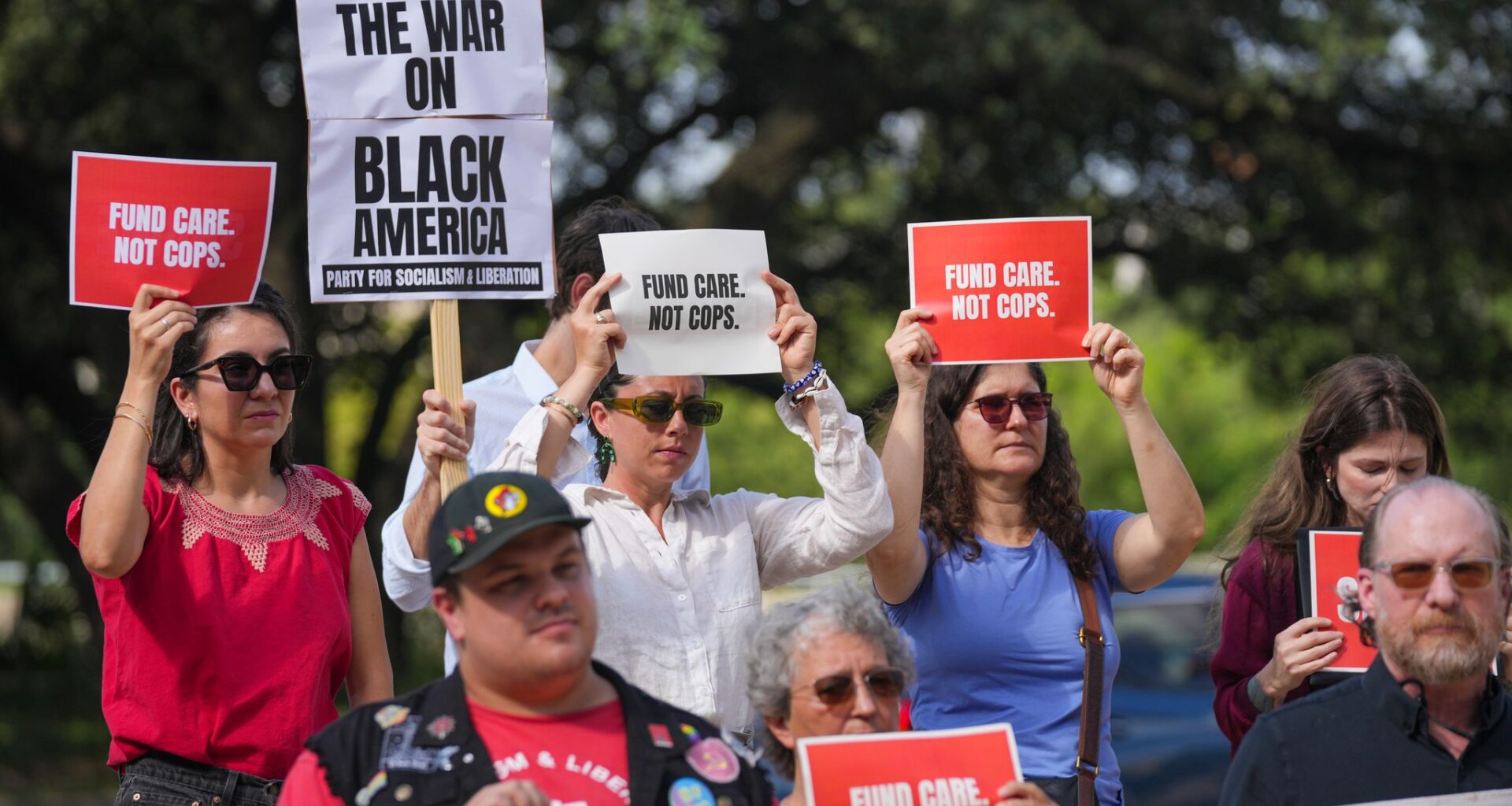
People listen during a news conference outside Austin City Hall on Thursday, July 30, 2026, before an Austin City Council budget work session. Advocacy groups, including Austin Justice Coalition, Equity Action, Grassroots Leadership, PSL and Hands Off Central TX, called on council to keep the Austin Police Department budget flat and reject proposed reductions to social services in the city manager’s proposed fiscal year 2026-27 budget.
Jay Janner/Austin American-Statesman
Just hours after community advocates urged the Austin City Council to reject a proposed $25 million budget increase for the Austin Police Department in the wake of the fatal police shooting of 17-year-old Anthoneil Williams II, council members spent relatively little time Thursday publicly debating whether police funding should be reduced or shifted toward mental health response.

Instead, much of the discussion during the council’s public safety budget work session centered on explaining why the proposed increase appears so large, with Austin Police Chief Lisa Davis emphasizing that most of the additional funding is driven by contractual pay raises and routine operating costs rather than new programs.
Article continues below this ad
Protesters rally outside Austin City Hall after the City Council meeting, calling for a reprioritization of public safety funds Thursday, July 30, 2026. Following the fatal police shooting of 17-year-old Anthoneil Williams II, advocates are asking council to keep the police budget flat to help preserve funding for social services and expand Austin’s mental health response system.
Mikala Compton/Austin American-Statesman
Ameer Alogaili, 16, friend of Anthoneil Williams II, and advocates rally outside Austin City Hall after the City Council meeting, calling for a reprioritization of public safety funds Thursday, July 30, 2026. Following the fatal police shooting of Williams II, advocates are asking council to keep the police budget flat to help preserve funding for social services and expand Austin’s mental health response system.
Mikala Compton/Austin American-Statesman
Shelby Evans of Hands Off Central Texas speaks at a rally outside Austin City Hall after the City Council meeting as advocates call for a reprioritization of public safety funds Thursday, July 30, 2026. Following the fatal police shooting of 17-year-old Anthoneil Williams II, advocates are asking council to keep the police budget flat to help preserve funding for social services and expand Austin’s mental health response system.
Mikala Compton/Austin American-Statesman
Protesters rally outside Austin City Hall after the City Council meeting, calling for a reprioritization of public safety funds Thursday, July 30, 2026. Following the fatal police shooting of 17-year-old Anthoneil Williams II, advocates are asking council to keep the police budget flat to help preserve funding for social services and expand Austin’s mental health response system.
Mikala Compton/Austin American-Statesman
Outside City Hall earlier Thursday, organizations including the Austin Justice Coalition, Grassroots Leadership, the Texas Civil Rights Project and the Workers Defense Action Fund called on council to keep the police budget flat to help preserve funding for social services, which are facing deep budget cuts, while also expanding Austin’s mental health response system. The groups argued Williams’ death illustrated the consequences of relying on armed officers to respond to behavioral health crises.
Texas Civil Rights Project Associate Director of Advocacy Chris Harris said the proposed budget sends the wrong message after Williams’ death.
“Our choices could not be more clear,” Harris said. “We have people in need of services calling our city for help and being killed by the police. And our city’s response is to increase the police funding and cut the very services that people are asking for.”
Article continues below this ad
Inside City Council Chambers, however, relatively few members directly responded to those demands.
City Council Member Natasha Harper-Madison speaks during a budget work session at Austin City Hall on Thursday, July 30, 2026.
Jay Janner/Austin American-Statesman
Council Member Natasha Harper-Madison, whose Northeast Austin district includes the park where Williams was killed, opened the discussion by offering condolences to the teenager’s family and saying the shooting underscored that “public safety goes beyond policing.”
She said the city must invest not only in policing but also in emergency medical services, behavioral health support, violence prevention and community partnerships while emphasizing the importance of transparency, accountability and public trust. But she did not offer specific ideas for how to achieve those goals.
Article continues below this ad
Under Austin City Manager T.C. Broadnax’s budget proposal, the Police Department’s budget would grow from about $525.4 million this year to $549.6 million next year. The most direct question about this increase came from Council Member José Velásquez, who asked what would happen if the council declined to approve the roughly $25 million increase for the Police Department.
Davis said there is little wiggle room, because the proposal does not contain much in the way of new spending.
Austin Police Chief Lisa Davis answers questions from city council members during an Austin City Council budget work session at Austin City Hall on Thursday, July 30, 2026.
Jay Janner/Austin American-Statesman
“The increases are all contracts,” Davis said, breaking down the proposal as $14.2 million for sworn officers’ contractual wage increases, insurance and pension costs, $2.4 million for civilian pay raises, $9.9 million in citywide allocations for information technology, facilities, fleet and fuel, and about $500,000 for software, uniforms and one recruiting position. The remainder reflects transfers of existing positions to other city departments.
Article continues below this ad
Velásquez then asked city officials whether the council could simply decline to fund the increase. Chris Coppola, a lawyer in the City Attorney’s office, noted that the $14.2 million for sworn personnel is governed by the city’s labor contract with the Austin Police Association and could expose the city to grievances if not funded.
The budget discussion came less than a week after three Austin police officers fatally shot Williams, an unarmed 17-year-old Black teenager, seconds after confronting him at a Northeast Austin playground.
Police were responding to a 911 call from Williams himself, who reported seeing a young person with a gun near the park. When officers arrived around 3:55 a.m., body-camera and surveillance video show Williams lifting his shirt and reaching toward his waistband before officers opened fire. Investigators later determined the object tucked into his waistband was a water bottle, and no firearm was found. Chief Lisa Davis has repeatedly characterized the shooting as an apparent case of “suicide by police.”
Activist group Dare to Struggle holds a protest to demand justice for Anthoneil Williams II in downtown Austin, Tuesday, July 28, 2026. The 17-year-old was fatally shot by Austin police last week during what authorities believe was a mental health crisis.
Mikala Compton/Austin American-Statesman
The shooting has sparked protests and renewed debate over how Austin responds to mental health crises. While the city has expanded its behavioral health response in recent years — including adding a 911 option that connects some callers to mental health services and deploying specialized co-response teams in limited areas — advocates argue those programs remain too limited and should receive greater investment.
Article continues below this ad
City leaders, meanwhile, have pointed to state law prohibiting cities from reducing police funding below the previous year’s level, along with contractual obligations for officer pay and benefits, as key constraints on reducing the Police Department’s budget.
At Thursday’s City Council meeting, District 10 resident Noel Gaylord told members that teachers, social workers and librarians routinely de-escalate conflicts without force and asked why the city would not instead fund “people who are doing the actual work” of community safety. Susana Carranza, of District 9, warned that each police increase also raises the funding floor imposed by state law.
After the meeting, protesters gathered outside City Hall, chanting Williams’ name and rejecting Davis’ characterization of the shooting as an apparent “suicide by police,” arguing that he sounded disoriented and in need of help when he called 911. They demanded the officers’ removal and possible prosecution.
Chas Moore of the Austin Justice Coalition said Williams had dialed the number people are taught to use in an emergency but was met by armed officers instead of mental health professionals.
Article continues below this ad
“We need better options,” Moore said. “People need a government that when they call for help, they get the help.”
Hands Off Central Texas organizer Shelby Evans urged demonstrators to turn their outrage into sustained political pressure beyond the budget process.
The City Council is expected to hold at least one more budget discussion next week before meeting Aug. 12 to approve a final budget.
Article continues below this ad