
The highest-paid administrators at Texas’ largest charter school networks made upwards of $450,000 in total pay for the 2024-25 school year – rivaling the pay of superintendents who lead traditional public school districts, tax records show.
Sehba Ali, the CEO of KIPP Texas – the second-largest charter district in the state with about 31,000 students – made nearly $536,000 in the 2024-25 school year, and Larry Guillory, the former Chief Administrative Officer, made about $506,000 in total pay, although Guillory appeared to have left the company in October 2024, according to his LinkedIn profile.
The third highest-paid leader was from YES Prep, a Houston-area charter school network with about 21,000 students. CEO Mark Dibella made nearly $470,000 in the 2024-25 school year for his work leading the district.
For comparison, Houston ISD Superintendent Mike Miles, who leads the state’s largest school district with roughly 168,000 students, earned an estimated $506,000 in base and bonus pay that year.
The Houston Chronicle analyzed federal tax filings for the nonprofits overseeing the state’s 25 largest charter districts serving over 4,000 students, and compared them with state salary reports for public school districts with the same enrollment threshold. The nonprofits’ tax filings show total compensation figures for senior leaders and other top-paid employees who meet certain income thresholds, including pay they receive from related organizations and, for some, bonuses, housing stipends and more.
The Chronicle’s analysis found that bonuses and other additional pay drove many of the largest paychecks. Similar to Miles, who earned a large bonus for his work in the 2023-24 school year, many of the highest-paid charter administrators received large amounts beyond their base pay.
Five of the 27 senior leaders listed by the largest charters on their tax records reported receiving at least 20% of their total pay from bonuses and other compensation, which can include severance pay or moving stipends.
The analysis also shows that high pay extended beyond the top leadership of Texas’ largest charter networks. At least 20 of Texas’ highest-paid charter school employees – including roles like deputy superintendents and chief operating officers – made above $300,000 including pay from related organizations and bonuses in the 2024-25 school year, tax records show. In some cases, charter employees outside the top leadership ranks made more than the average superintendent at traditional public school districts.
Still, these high earners were outliers. As a whole, charter schools’ highest-ranking leaders – including superintendents, presidents, and chief executive and administrative officers – made less on average than ISD leaders in similar roles, the Chronicle analysis shows.
According to state salary data, the average superintendent of the largest public ISDs earned just over $276,000 in base pay in the 2024-25 school year. Federal tax filings show that Texas’ largest charter districts paid about $48,500 less, or roughly $227,500, in average base salary for similar top-ranking roles.
“Charter salaries overall, even including teachers, for the most part are lower. (But) it definitely varies,” said Jessica Shopoff, Vice President of Policy & Research at the Texas Public Charter School Association.
This is partly because charter schools have different funding structures than ISDs, Shopoff said. At charter schools, all funding comes from the state and federal government. At traditional public schools, the largest share of operational funding comes from local tax revenue, which ISDs can adjust to increase or decrease revenue, either by a board vote or a tax-rate increase election.
ISDs can also pass bonds locally, which helps bolster facilities funding, while charter schools must cover facilities funding from their operating budget or with fundraising efforts like a capital campaign. That means these districts may have more obstacles when competing for pay with ISDs.
Charter schools received around $1,500 less per-pupil funding than ISDs in the 2023-24 school year, according to an analysis by The Texas Public Charter School Association.
“When you’re talking about several thousand less per pupil in facilities funding, that facilities funding comes basically out of your typical day-to-day operations of the school, and so now less of the pie is left for salaries,” Shopoff said.
While not a large chunk of the salary budget, some Texas charter schools fundraise more than others, and use that additional income to supplement charter operations.
“Employee compensation is primarily funded through public education funding,” wrote YES Prep communications director Rebecca Suarez. “YES Prep also responsibly supplements public funding with philanthropic support from individuals, foundations, corporate partners, and competitive grants.”
A closer look at the numbers
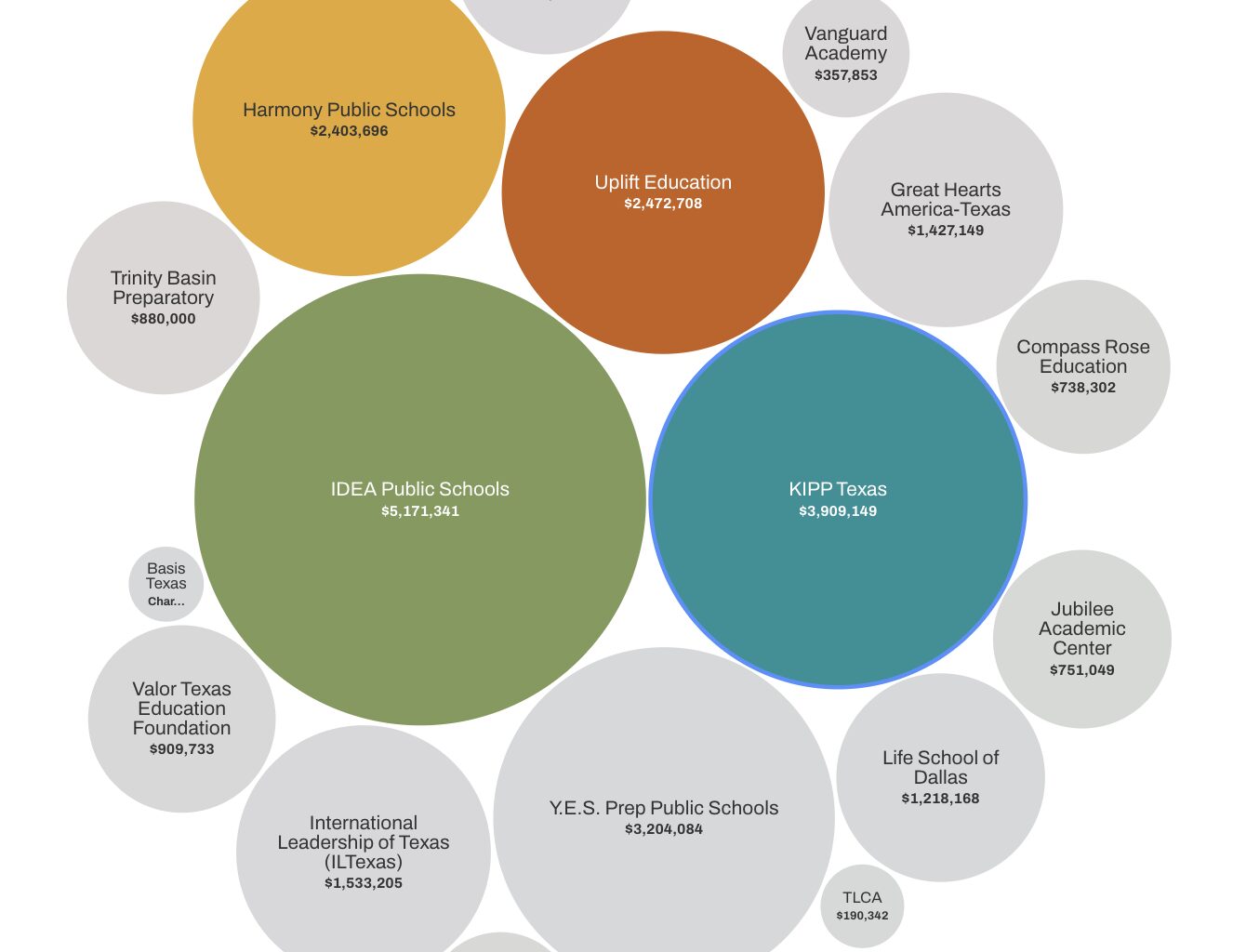
IDEA Public Schools, KIPP Texas and Harmony Public Schools reported the largest total pay for officers, board members, top-paid key staff and the five highest-paid employees above $100,000 – the categories nonprofits must disclose in their federal tax filings.
IDEA Public Schools reported the largest total compensation amount: $6.27 million across 24 people, and KIPP Texas ranked second at $4.97 million across 17 people. Harmony Public Schools, which had the most people reported but lower average pay, ranked third, paying $3.78 million across 27 people.
Employees reported on tax records include top management and financial officials, key employees with higher-level management responsibilities and the five other highest-paid employees earning over $100,000 per year. For a charter school nonprofit, this usually means the superintendent and/or chief executive officer, the chief financial officer and others in leadership positions, such as deputy or associate superintendents. Principals and other employees may be reported depending on the nonprofit’s organizational and compensation structure.
KIPP Texas had the highest average pay at about $292,500 per person. A representative from KIPP Texas declined to comment on this data, citing personnel matters.
Despite being the largest charter network in Texas, with nearly 80,000 students, IDEA paid its superintendent Jeffrey Cottrill just under $400,000 in total pay, making him the sixth highest paid leader on the list.
According to the senior assistant communications director for IDEA Public Schools, Lynnette Montemayor, the organization matches its pay with the 10 largest school districts by enrollment in Texas.
“Salaries are aligned with organizations of similar size and scope. Eligible leaders may also receive performance-based incentives tied to a broad range of organizational goals, including academic, operational, financial, and strategic priorities,” said Montemayor.
Harmony Public Schools, the third-largest charter network in the state with roughly 44,000 students across seven districts, had the most paid employees reported on 990s and the third highest compensation among its total employee pool. However, no district employees appeared among the 25 top-paid leaders.
Harmony’s Chief Communications and Marketing Officer John Boyd said this was a deliberate strategy among the charter network to ensure fair compensation for teachers.
“Harmony Public Schools has intentionally designed its compensation philosophy to prioritize competitive pay for the employees who work most directly with students,” Boyd said. “Rather than concentrating a larger share of compensation at the executive level, we intentionally allocate more of our available resources toward classroom instruction and campus-level personnel.”
The district also does not provide an incentive-pay program, meaning employees do not receive bonuses for improving academic outcomes.
Boyd said that the charter network competes with other districts and the private sector for top leadership, and that most of the district’s leaders choose to work there despite the slightly lower leadership pay because of the network’s mission.
“While compensation is certainly one factor candidates consider, many of Harmony’s leaders are attracted by our mission, our statewide impact, opportunities for professional growth, and the ability to help improve outcomes for students across Texas,” he said.
How do top-paid charter administrators compare to public school ISD leadership?
Kipp Texas CEO Ali, who topped the Chronicle’s list of highest-paid senior charter leaders, earned a base pay of over $400,000, in line with the top 10 highest-paid public school superintendents in the state, who earned between $410,000 and $490,000 in base salary in the 2024-25 school year. Ali’s bonus bumped her up to nearly $536,000 for the same school year.
By comparison, the highest paid ISD superintendent was Gregory Poole from Barbers Hill ISD, who earned around $489,000, followed by Martha Salazar Zamora from Tomball ISD, who earned about $470,000. Superintendent Doug Killian from Cypress-Fairbanks ISD, the third-largest district in Texas, made nearly $459,000 in the same school year. Superintendent Miles from the state’s largest school district, Houston ISD, made $380,000 in base pay.
However, Miles earned a large bonus for his work in the 2023-24 school year, which bumped his total pay up to above $500,000. Similar to top-paid charter administrators, it is likely many of these superintendents are making more than that amount when factoring in bonuses, housing stipends and other allotments they may receive in their contracts, though total pay figures for superintendents for the 2024-25 school year are not available in state data.
Former ResponsiveEd Texas CEO Charles Cook was one of the highest paid leaders of the largest charter networks in Texas that year, however a large chunk of his total pay came from his role in a related organization.
Cook earned a base pay of roughly $277,000 for his work leading ResponsiveEd Texas, however he also received around $177,000 for his role leading a related organization which provides “educational management services, products, and related services to families nationwide,” wrote Nichole Castignino, the assistant director of communications at Blue Learning, a charter management organization that works with ResponsiveEd Texas.
That brought his total pay to about $454,000. He also earned a car allowance and a cell phone stipend, totaling $16,300 in the 2024-25 school year, according to Catsignino.
ResponsiveEd is a nationwide charter school network with a large branch in Texas, educating about 28,000 students among more than 130 campuses across the state. Cook is no longer the Superintendent and CEO of ResponsiveEd Texas and is now exclusively the CEO of Responsive Education Solutions, the related organization.
What goes into additional pay?
Bonuses at these large networks are often awarded to leaders for working to sustain and reach the organization’s goals.
For example, at YES Prep Public Schools, performance incentives may be tied to goals including “student outcomes, academic performance, enrollment, attendance, student persistence, organizational priorities, and other network performance measures,” Suarez said.
Superintendent Eddie Conger, the founder and leader of the International Leadership Academy of Texas, or ILTexas, with about 25,000 students, said his bonus last year came from academic improvements across the district.
“The board takes into consideration: Has the charter had any financial strikes? Has the charter had any academic strikes? Is the charter improving the performance of the students? And using those metrics, they make a decision,” Conger said. “We, like all of the school systems, took a hit academically when the state changed the test and changed the metric. But we have gradually climbed over these last three years.”
Conger received $35,500 on top of his base salary of $290,000 according to 990 data, which he confirmed, and he said the board approved a bonus a few years in a row for his performance.
Other reportable compensation on the 990s can be any taxable pay that isn’t considered a bonus, like moving expenses, paid-out leave time or severance pay.
However, not all large charter networks have pay-for-performance structures. Harmony Public Schools, Great Hearts Texas and ResponsiveEd Texas, for example, do not offer incentivized bonuses for leadership, according to their communications directors.
“The only supplemental compensation available to certain campus leaders is a retention payment for Campus Directors, which is designed to encourage leadership continuity and retention,” wrote Castignino of Responsive Ed Texas.
Is this the full picture?
The Chronicle’s analysis only includes ISDs and charter school districts with at least 4,000 students.
However, many smaller charter school networks also received scrutiny after ProPublica and the Texas Tribune reported that one charter school district, Valere Public Schools, paid its top leader over $800,000 in one year, despite serving only around 900 students. Due to a data reporting loophole, that figure never appeared in state compensation data — only in federal tax filings, which traditional public school districts do not have to file.
“It’s nonsense. It doesn’t pass the smell test. It may sound too harsh, but it’s almost theft of public funds, even though a board is approving it,” Conger, superintendent of ILTexas, said.
About the data
The Houston Chronicle analyzed pay data from tax records filed by the nonprofits that run the 25 largest charter districts in the state, serving at least 4,000 students in the 2025-26 school year. Nonprofits must list the following employees on tax records: current officers, such as top management and financial officials, voting members of the governing board, key employees who hold certain responsibilities and make more than $150,000 in reportable compensation and the five highest compensated employees making over $100,000.
For a charter school nonprofit, this usually means board members, the superintendent, the chief executive officer, the chief financial officer or business officer, other senior leadership if they meet earnings thresholds, and the five highest paid non-leadership employees earning over $100,000. Total pay is typically available for all employees listed. Base pay, bonus pay and other compensation is usually only available for listed employees making over $150,000. For this analysis, base pay reflects the amount reported by the filing organization. Total pay includes base, bonus and other reportable compensation from the nonprofit filing organization and related organizations.
Traditional public and charter schools also report superintendent base pay in annual state salary reports, but those salaries don’t include pay from related organizations and, until this year, excluded anything above base salary. For ISDs, there is no equivalent federal tax data, so a full picture of total superintendent pay would require public records requests to individual districts.
The most recent state salary reports for ISDs and charter schools released in March included a data field for “total pay” for the first time this year, resulting in greater transparency on additional pay top leaders receive. However, the state has flagged some salaries as misreported, and there still appear to be some discrepancies in how the districts reported total pay versus base pay. For example, HISD Superintendent Mike Miles was reported to have earned a base salary of $462,000 and no additional pay. While he did earn a bonus for the 2024-25 school year in September 2025, it was not included in the March salary report, and he has not yet been awarded a bonus for the 2025-26 school year.
CreditsReporting by Taylor Nichols and Elizabeth Sander. Data analysis and graphics by Taylor Nichols. Editing by Caroline Ghisolfi and Laura Isensee. Production by Brady Stone. Powered by the Hearst Newspapers DevHub.