
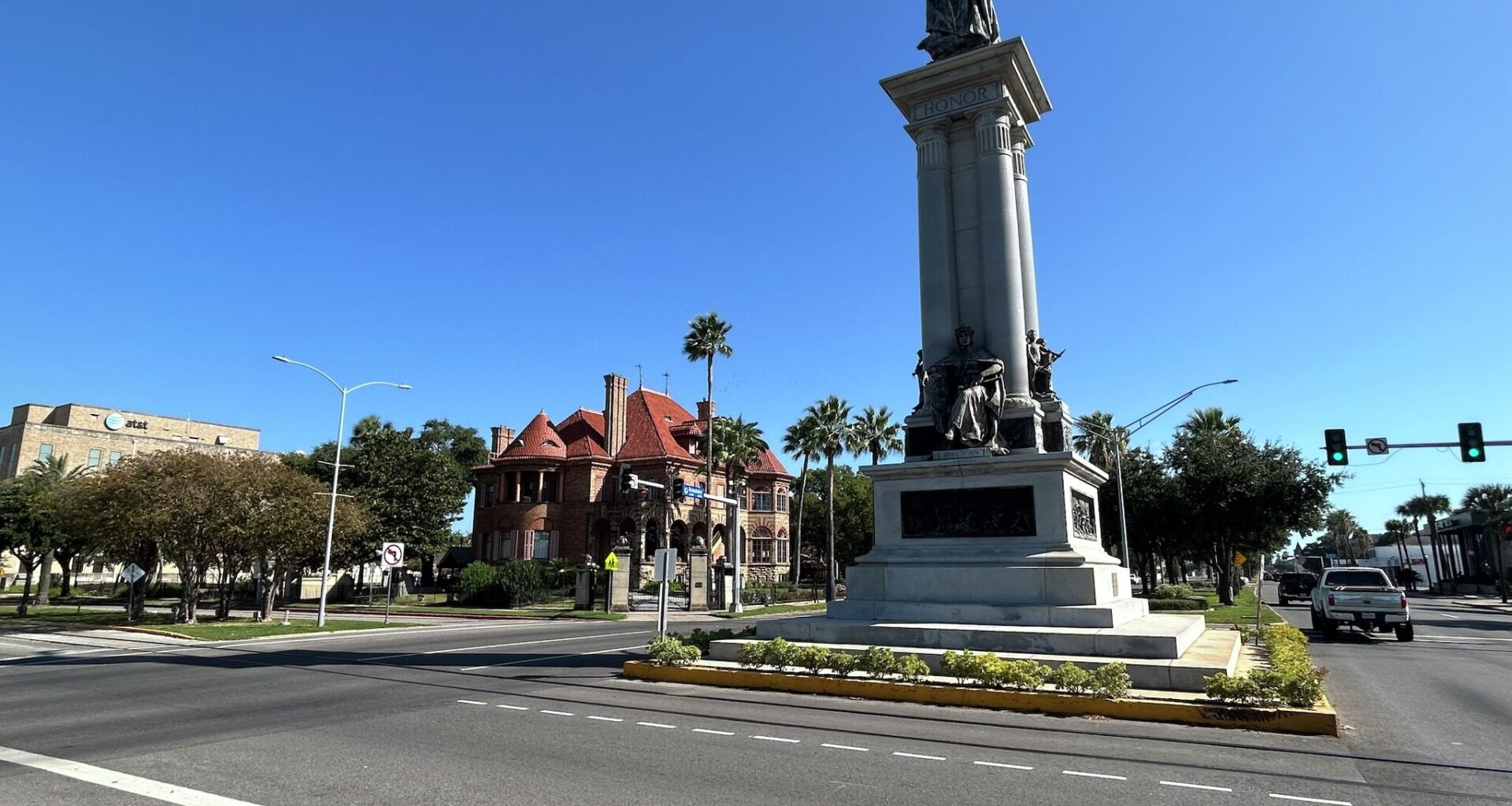
One of Galveston’s most distinctive qualities might also be among its most frustrating. To an uncanny degree, the city’s major thoroughfares are state highways: Broadway (Highway 87), Harborside (Highway 275), Seawall Boulevard (FM 3005) and 61st Street (Spur 342). Only the one-way crosstown arteries Avenue O and Avenue P fall entirely under the city’s jurisdiction.

Therefore, ultimate responsibility for these other roadways’ upkeep falls to the state, a longstanding point of contention that occasionally erupts into an awkward public episode; the recent outcry (and subsequent cleanup) over the 61st Street corridor’s shabby appearance comes to mind. But the state is now coming through in a major way.
Contractors hired by the Texas Department of Transportation have been mowing, trimming and pruning the vegetation along Interstate 45 and Broadway for the past few weeks. They’ve also been marking the trees that didn’t make it because, according to the Galveston Island Tree Conservancy, “the biggest hazard for a street tree is cars.”
Article continues below this ad
Landscaping crews hired by the Texas Department of Transportation have been identifying and marking dead palm trees and other plants that need to be removed.
Chris Gray/Chron
TxDOT’s work is part of a $3.2 million contract with commercial landscaping firm Yellowstone, Danny Perez, lead public information officer for the department’s Houston district, told Chron Thursday.
According to Perez, the department has engaged two crews to spruce up the I-45 corridor, including Broadway, all the way to the seawall. The work includes cleanup, trimming, and removing dead trees and plant material, while another crew assesses and repairs the roadway’s irrigation system.
“The TxDOT landscape architect and arborist will review the proposed work with the city and stakeholder groups prior to pruning,” Perez said. “Hazardous dead trees will be removed; for example, there are dead palm trees along the corridor.”
Article continues below this ad
Crews have also been assessing and repairing Broadway’s irrigation systems.
Chris Gray/Chron
The contract also includes work on TxDOT-maintained roadways elsewhere on the island, including FM 3005 (also known as Termini-San Luis Pass Road) from 61st Street to San Luis Pass, and from Seawall Boulevard to the Bolivar ferry landing. Perez said the contract runs through the end of 2027, but maintenance will continue afterward.
The timing only seems impeccable: it actually took two years of planning and “at least four public meetings” to reach this point, the conservancy noted Wednesday.
Tree-planting initiative
Priscilla Files, the conservancy’s senior arborist and executive director, told Chron Friday that her organization has coordinated four planting projects along Broadway since Hurricane Ike’s devastating storm surge, which destroyed more than 60 palm trees and an additional 400-plus live oaks along the avenue’s esplanades and easements in 2008.
Article continues below this ad
The Galveston Island Tree Conservancy has organized four planting projects since Hurricane Ike’s storm surge destroyed more than 400 live oaks along Broadway.
Chris Gray/Chron
“On Broadway and Galveston as a whole, palms survived Ike fairly well; however, they are not biologically trees (they’re grasses) and they are more suited for an inundation of saltwater after major drought as in Ike conditions,” Files said.
Smart, funny and sometimes unhinged look at the week that was.
By signing up, you agree to our Terms Of Use and acknowledge that your information will be used as described in our Privacy Policy.
“Over the years, some palms have succumbed to disease and freezes,” she added. “Of the live oaks that survived Ike on Broadway, most have revived. Live Oaks were the No. 1 best survivors of all species of trees after the storm.”
Article continues below this ad
Perez credited the local nonprofits TxDOT partnered with on its project, including the conservancy, plus Galveston Historical Foundation, Galveston Tree Committee and the Galveston Island Nature Tourism Council. Additionally, TxDOT coordinated with three city departments—public works, parks and recreation, and the city manager’s office—in what Perez called “a great example of government entities coming together with local nonprofit organizations to enhance the local community aesthetics collectively.”
“Tackling this individually may be a tall order, but we are so appreciative to have the support of the City of Galveston and our other stakeholders to do something great for the community,” he added. “When this is done, the local residents and those that travel to the island will see something beautiful and pleasant.”