
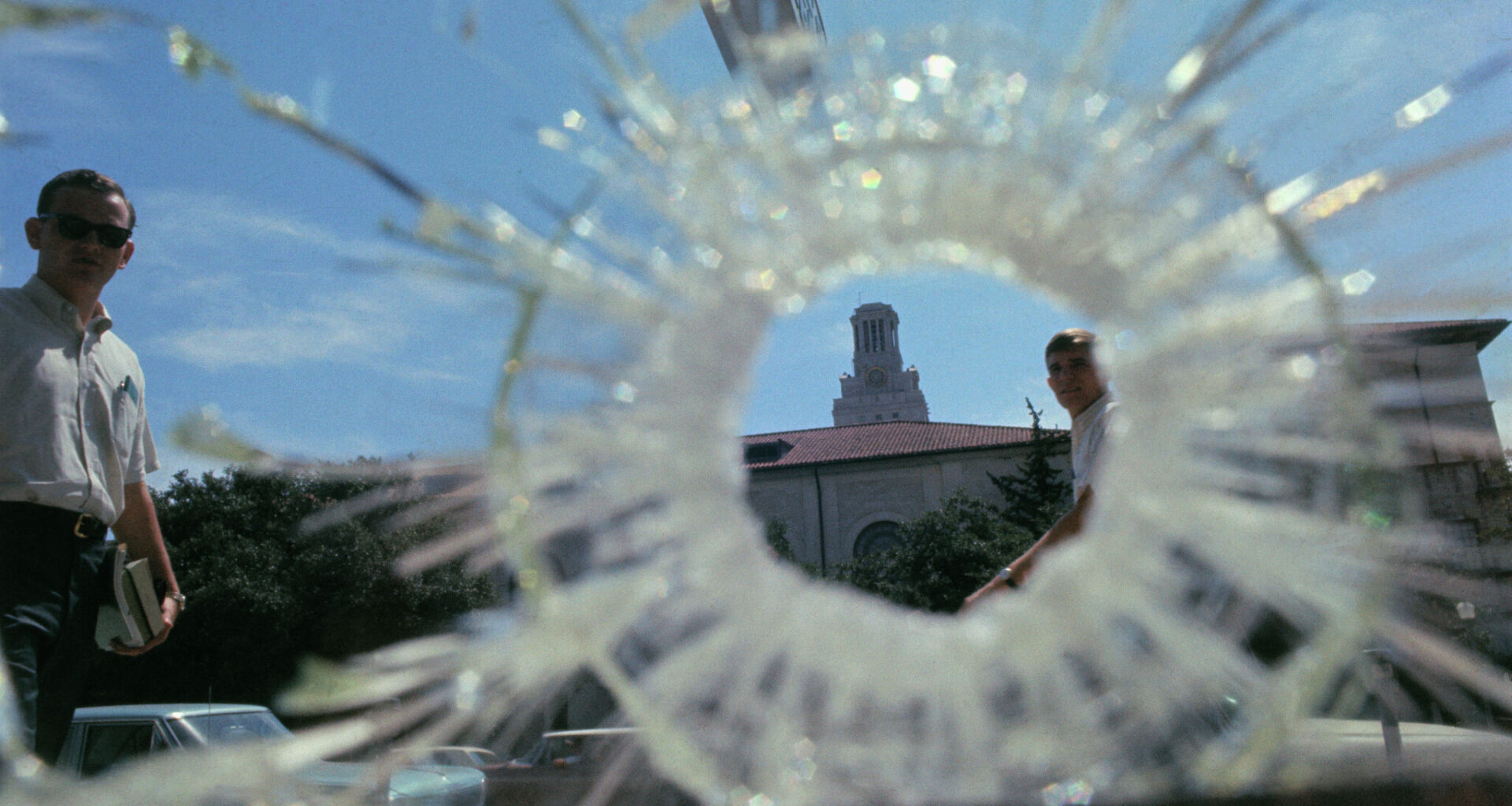
A view of the tower where Charles Whitman carried out his sniper spree through a bullet hole in glass.
Bettmann/Bettmann Archive
Edna Elizabeth Townsley, Mark Jerome Gabour, Marguerite M. Lamport, Thomas Frederick Eckman, Dr. Robert Hamilton Boyer, Karen John Griffith, Thomas Ray Karr, David Hubert Gunby, Thomas Aquinas Ashgton, Paul Bolton Sonntag, Claudia Marilyn Rutt, Harry Walchuk, Officer Billy Paul Speed, Roy Dell Schmidt and the unborn son of Claire Wilson.

These are the names of the people who lost their lives when a shooter turned a simple day at the University of Texas into one of the darkest days in Texas history. This Saturday, August 1, marks the 60th anniversary of the UT Tower shooting, a day when 18 people lost their lives, including the shooter, and more than 30 were injured.
Article continues below this ad
“The entire nation experienced the terror of what was going on in that 96 minutes in real time, and it happened just three years after America had gone through the mass trauma of literally witnessing in real time the murder of the President of the United States,” Seamus McGraw, author of From a Taller Tower: The Rise of the American Mass Shooter, said to MySA. “Had it not been for that, I don’t know what would have happened, but I do know that it established this rhythm of atrocity in search of fame or infamy.”
A victim of sniper Charles Whitman is placed into a waiting ambulance during the shooting spree at the University of Texas in Austin, Aug. 2, 1966.
AP
What happened during the UT Tower shooting?
Charles Whitman was 25 years old, a former Marine and a former mechanical engineering student at UT when, on August 1, 1966, he murdered 17 people. Whitman had murdered his wife, Kathleen Frances Whitman, and mother, Margaret Elizabeth Whitman, hours before he climbed to the 28th floor of the UT Tower and began shooting at 11:48 a.m.
Article continues below this ad
Receptionist Edna Elizabeth Townsley, 51, was the first person killed that day. She was followed by Mark Jerome Gabour, 18, and Marguerite M. Lamport, 56, who were touring the tower when they were fatally shot as Whitman made his way to the observation deck. Eighteen-year-old Claire Wilson was the first person wounded after Whitman opened fire. She survived but lost her unborn son as a result of her injuries.
A woman cowers in fear behind a statue while a man lies wounded a few feet away, victim of sniper Charles Whitman. Whitman killed a dozen people firing a rifle from the observation deck of the University of Texas Tower in Austin.
Bettmann/Bettmann Archive
A Texas Department of Public Safety patrolman looks through the scope on his rifle at the observation deck on the University of Texas Tower where a sniper, identified as Charles Whitman, was shooting people in a wild noon hour spree.
Bettmann/Bettmann Archive
Whitman terrorized the UT campus for 96 minutes, firing from the tower as dozens desperately clung to shelter and every Austin Police Department officer in the area descended on the scene. Ultimately, it was the combined efforts of officers Houston McCoy and Ramiro Martinez, who responded despite being off duty, and civilian Allen Crum, a retired Air Force tail gunner, who climbed the tower to confront Whitman. McCoy fatally shot Whitman at 1:24 p.m., ending the attack.
Article continues below this ad
The final toll stood at 18 people killed, including Whitman, Kathleen and Margaret, with another 31 injured. David Hubert Gunby did not die on August 1, but his only functioning kidney was damaged in the shooting. He ultimately died in 2001 at age 58 from kidney disease, but his death was ruled a homicide.
Police officer Ramiro Martinez (left) at a press conference after he and other officers shot student Charles Whitman (1941 – 1966) dead after Whitman went on a shooting spree at the University of Texas at Austin, 1st August 1966, killing 15 and wounding 31.
Shel Hershorn – Hulton Archive/Inactive/Getty Images
What led to the UT Tower shooting?
Gary Lavergne was an employee at ACT, the non-profit organization best known for administering the college readiness assessment test, and in 1995 he traveled around the country. During one of his many trips, he stumbled upon an episode of American Justice with Bill Kurtis that touched on the UT Tower shooting. Remembering the massacre as a kid, Lavergne went in search of a book on the shooting and couldn’t find one that had gone in depth about the incident, even 30 years later. So, he set out to write the definitive true crime book about August 1, 1966, resulting in A Sniper in the Tower: The Charles Whitman Murders, published in 1997.
Article continues below this ad
One of the questions Lavergne explores throughout the book is what drove Whitman to carry out the attack. While an autopsy revealed Whitman had a brain tumor — a finding that has fueled decades of speculation about its role in the shooting — Lavergne strongly disputes the idea that the tumor was to blame.
“I wanted to believe that something drove him to do this against his will. That something overpowered him,” Lavergne said to MySA. “I researched that book for over two years, and when you look at what he actually did the 48 hours before he went up there and started shooting people, I came across with the firm belief that nothing made him do this against his will. He spent 48 hours planning and making serial decisions in a correct order, leading to a goal.”
HANDOUT PHOTO. CREDIT: AUSTIN HISTORY CENTER AR.2000.002(077). Photographs from the Austin Police Department Records of the 1966 Charles Whitman Mass Murder Case: Charles Whitman’s rifles and shotgun found on the UT Tower after the shooting.
AUSTIN HISTORY CENTER
Clutching the lapels of his jacket, Dr. Maurice Dean Heatly, staff psychiatrist at the University of Texas Health Center, tells of Charles Whitman’s only visit with him, at an August 2nd news conference. In the report of the visit, which was on March 29, 1966, Heatly quoted Whitman as “thinking about going up on the tower with a deer rifle and start shooting at people.” Whitman did just that, killing 15 persons and wounding more than 30 before he was killed himself by police.
Bettmann/Bettmann Archive
Whitman’s past leading up to the shooting has been a topic of scrutiny. Jo Scott-Coe’s book Mass: A Sniper, a Father, and a Priest looked into a Catholic priest who may have abused Whitman. Her second book connected to Whitman, Unheard Whitness, investigated his wife and how she may have experienced years of abuse before the shooting.
Article continues below this ad
“I think one of the most surprising things is looking at the narrative of this history differently,” Scott-Coe said to MySA. “In other words, instead of seeing the tower shooting as the event, seeing it as the culmination of events already in motion.”
Six decades later, no single explanation has emerged for why Whitman carried out the attack. As McGraw put it, hundreds of thousands of people die of tumors every year, but not one of them died on the University of Texas campus on August 1, 1966.
In this Aug. 1, 1966 file photo, smoke rises from a sniper’s gun as he fires from the tower of the University of Texas administration building in Austin, Texas at people below. Grant Duwe, a criminologist with the Minnesota Department of Corrections, says, “Mass shootings provoke instant debates about violence and guns and mental health and that’s been the case since Charles Whitman climbed the tower at the University of Texas in 1966.” The engineering student and former Marine killed 13 people and an unborn child and wounded 32 others in the shooting.
AP
One of the darkest days in Texas history
The Sutherland Springs church shooting remains the deadliest mass shooting in Texas history. The attack at Robb Elementary in Uvalde horrified the nation with the killing of 19 children and two teachers. Mass shootings at an El Paso Walmart, Luby’s Cafeteria in Killeen and Fort Hood each left lasting scars on Texas. Many historians consider the shooting at the UT Tower on August 1, 1966, a turning point in the history of mass shootings in America, changing how the nation understood and responded to such attacks.
Article continues below this ad
The UT Tower shooting is widely regarded as the nation’s first modern mass shooting on a college campus. It was the first to make international news. Television and radio helped people follow the events in real time. These things are all too common, as more than 500 mass shootings have occurred across the country in the last 60 years, according to the Rockefeller Institute of Government.
“The University of Texas massacre stands out because I honestly believe it was the progenitor of so many of these [shootings],” McGraw said to MySA. “There’s a lot of blood that’s been spilled that may not have been spilled otherwise had things gone down differently that day.”