
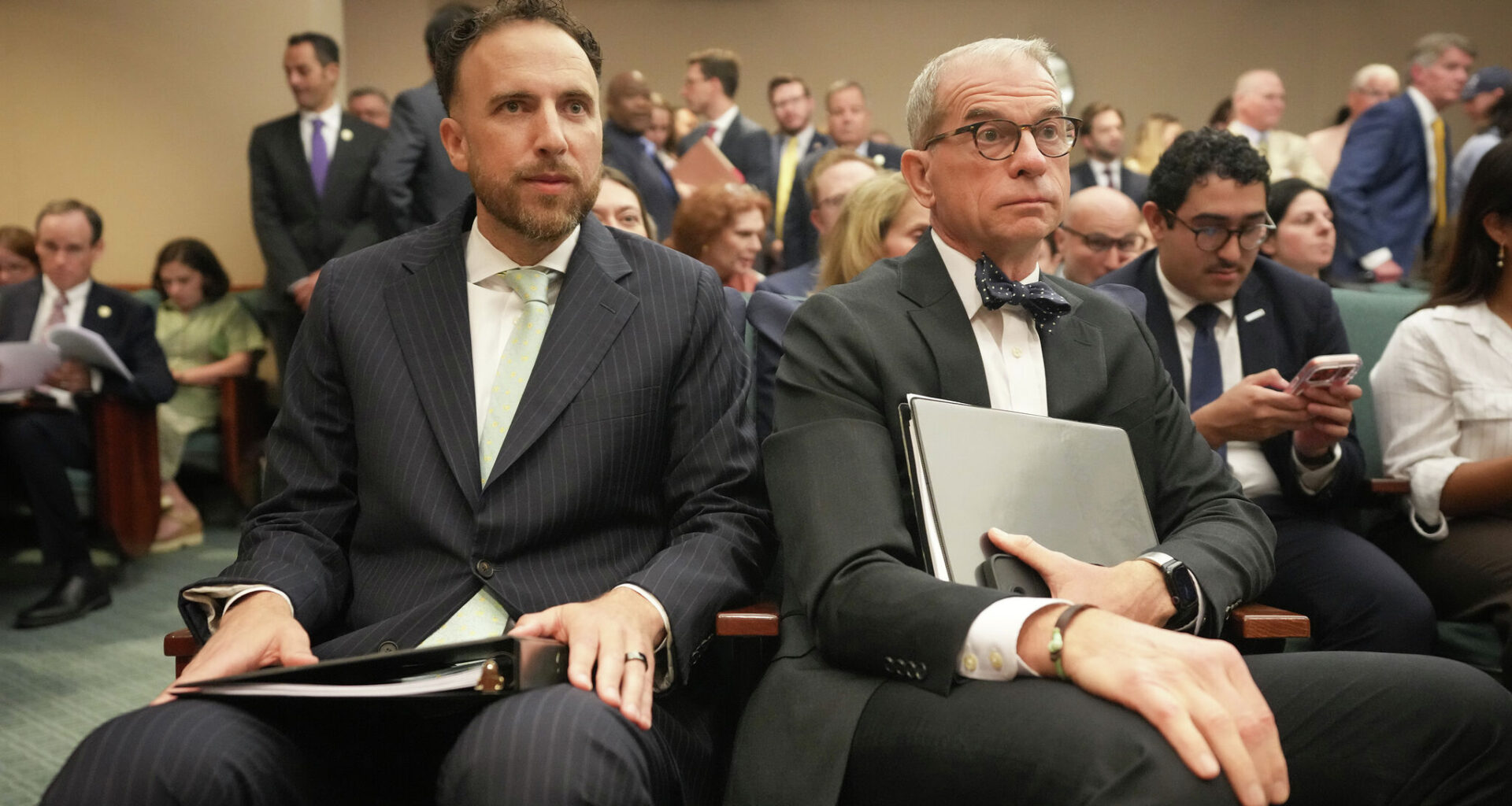
Brandon Simmons (left) ombudsman for the Texas Higher Education Coordinating Board, and Wynn Rosser, commissioner of the Texas Higher Education Coordinating Board, wait to testify during a Texas Senate Committee on Higher Education hearing on Senate Bill 37 at the Capitol in Austin, on July 28, 2026.
Jay Janner/Austin American-Statesman
A new state office is tasked with holding Texas’ public universities accountable.

Launched in January, the governor-appointed ombudsman’s office receives and investigates complaints from the public about alleged violations of state law at universities.
It describes itself as an “intermediary among the state’s institutions of higher education, the Legislature, and the public.”
Article continues below this ad
The office, created under a new law that brought more state oversight to public universities, came as Republican leaders said they wanted to hold taxpayer-funded institutions accountable and root out perceived liberal bias.
Related: Republican lawmakers praise new college oversight law. Critics say it’s led to censorship
Gov. Greg Abbott has said the new ombudsman’s office will “help ensure Texas’ higher education institutions continue to set the national standard and prepare our students to thrive.” Professors have warned that the office, with “little provision for due process,” is “ripe for abuse.”
Related: Republicans are remaking Texas’ public universities. Some professors are leaving
Here’s what to know about Texas’ new college watchdog.
Article continues below this ad
What does the ombudsman’s office do?
The Office of the Ombudsman can investigate alleged violations of two laws: SB 17, the state’s 2024 ban on diversity, equity and inclusion initiatives, and SB 37, a new law that places increased oversight on curriculum, academic programs and hiring.
It can only open investigations based on complaints from students, faculty and staff of a public university. Complaints cannot be anonymous. Members of the public can submit general feedback about the state’s universities, but the office does not have the power to investigate those.
Related: Texas launches website to collect complaints about public universities violating state law
People can submit complaints and feedback through the Office of the Ombudsman’s online portal.
Article continues below this ad
Abbott appointed Brandon Simmons, former chair of Texas Southern University’s Board of Regents, to head the office last year.
The office, which is housed within the Texas Higher Education Coordinating Board, has three former lawyers from the Attorney General’s office on staff and is expected to cost more than $3 million per biennium.
What can the office investigate? What falls outside of the office’s purview?
The office has a limited scope of what kinds of alleged violations it can investigate.
They have oversight of any alleged violations of SB 17 and SB 37, including DEI initiatives, faculty senates; the governing board’s power to review an institution’s general education curriculum; and the institutional authority of a university president.
Article continues below this ad
Related: UNT won’t cover 11 faculty memberships to academic groups, cites DEI ban
The office cannot investigate complaints about classroom instruction, according to its website.
What are the consequences for a university under investigation?
Simmons can recommend lawmakers bar a school from spending state funding while it is under investigation.
State support is one of the main funding sources for public universities, though tuition and fees typically provide the largest revenue chunk. At the University of North Texas, for example, state appropriations will provide 16% of this fiscal year’s revenue. The University of Texas at Austin sees 22% of its budget come from the state endowment and appropriations.
Article continues below this ad
How many complaints have been submitted? How many investigations have been opened?
At a Senate Higher Education Committee meeting in July, Simmons told lawmakers that the office had received 73 complaints.
Only two, both about alleged violations of the DEI ban, turned into investigations.
About 20% of the complaints were about classroom instruction, which is not regulated by SB 17 or SB 37, Simmons said.
What challenges has the office run into?
Simmons told lawmakers that there is a need to increase awareness about the office and the laws it has oversight over.
Article continues below this ad
“I’ve been kind of surprised at some of the faculty objections, specifically to SB 17, because they seem to often be rooted in a misunderstanding about the academic course instruction exception,” Simmons said.
Neither SB 17 nor SB 37 limits what professors can teach in the classroom, although some university leaders have instituted their own policies restricting classroom discussions about race and gender.
Simmons also said not enough Texans know about the office or are comfortable bringing complaints forward. His office plans to increase its outreach, including on social media.
“It’s not yet well known,” Simmons said.
The DMN Education Lab deepens the coverage and conversation about urgent education issues critical to the future of North Texas.
The DMN Education Lab is a community-funded journalism initiative, with support from Bobby and Lottye Lyle, Communities Foundation of Texas, The Dallas Foundation, Dallas Regional Chamber, Deedie Rose, Garrett and Cecilia Boone, Judy and Jim Gibbs, The Meadows Foundation, The Murrell Foundation, Ron Steinhart, Solutions Journalism Network, Southern Methodist University, Sydney Smith Hicks, and the University of Texas at Dallas. The Dallas Morning News retains full editorial control of the Education Lab’s journalism.