
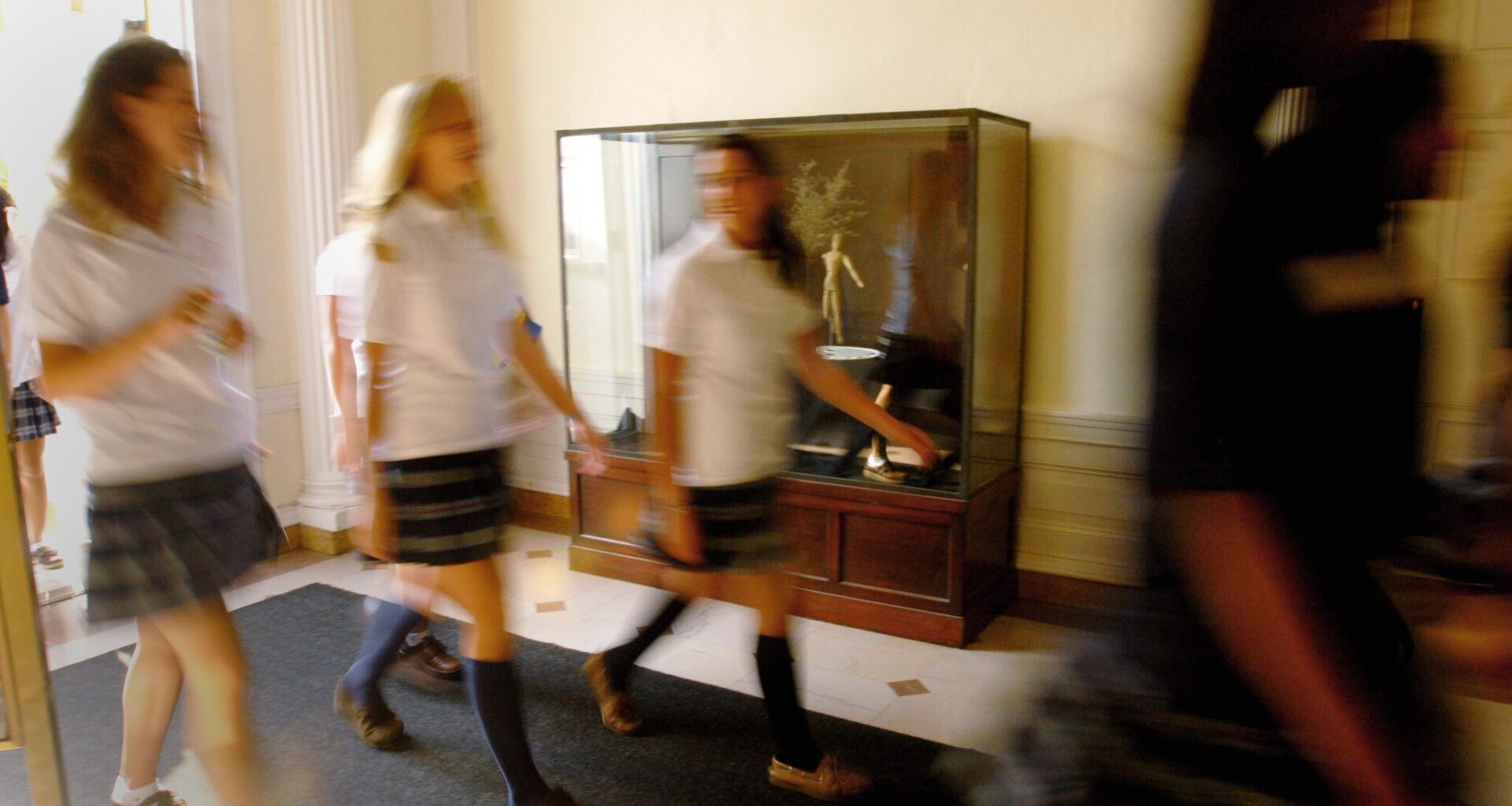
The Dallas-Fort Worth area is home to hundreds of private schools. Private education is set to get a boost, as Texas’ landmark school choice program launches this fall.
LMF LUANNE M. FERRIS/ALBANY TIMES UNION
Choosing a private school is more a marathon than a sprint. Families spend months researching, visiting and weighing their options.

The Dallas-Fort Worth area is dotted with hundreds of private schools — ranging from religious to college preparatory to Montessori. In Texas, more than 300,000 students are enrolled in private schools.
Now, private education is getting a shot in the arm, as Texas’ landmark school choice program launches this fall. The Texas Education Freedom Accounts offers eligible families $10,474 to offset private schooling costs, while students with disabilities could receive up to $30,000.
Article continues below this ad
“I have 1,200 private schools that I represent. They’re all very different and offer different things,” said Laura Colangelo, executive director of Texas Private Schools Association. “That’s the beauty of a private education. It’s not standardized.”
The Dallas Morning News spoke to admissions consultants to help parents in their search.
What kinds of private schools exist?
Dallas is home to recognizable names, like St. Mark’s School of Texas, a college preparatory school for boys, and the Hockaday School, one for girls.
Related: Some top D-FW private schools are sitting out Texas’ school choice program. Here’s why
Article continues below this ad
Private schools range from religious, to somewhat religious, to nonreligious. The religious schools cater to different belief systems, including Catholicism, Judaism, Islam and Protestantism.
Other schools center around a method of teaching. For example, Montessori schools, which are popular among young children, promote hands-on learning and lean on self-directed activities. Waldorf schools seek to integrate arts into academics, focusing on fostering imagination and creativity. Classical schools emphasize history, literature and language.
Schools, such as the Notre Dame School of Dallas and Shelton School, are geared toward students with disabilities and hire specialized staff.
At Notre Dame School of Dallas, students get ready to leave for a field trip to a local grocery store.
Tom Fox/Staff Photographer
What are the student-teacher ratios in private and public schools?
Private schools tend to have lower student-teacher ratios, allowing children to receive more individualized attention, said Eleanor Munson. The educational consultant helps Dallas-area families across socioeconomic backgrounds with their search.
Article continues below this ad
“If kids need extra help or if they’re advanced in a subject,” Munson said, “private schools are able to do that.”
How much do private schools cost?
When a child attends private school, families enter a “contractual relationship,” governed by the school’s policies and procedures, Colangelo said. Families with TEFA funds should see how much the state aid covers and be aware of additional costs, she said.
In Texas, the median private school tuition is about $9,400, according to the Texas Private Schools Association. That usually does not include transportation, books and other fees. At some schools, annual tuition can reach more than $40,000.
Private schools can offer financial aid and scholarships. Families can often choose between a full payment or monthly payments.
Article continues below this ad
Related: How do private schools become eligible for Texas’ school voucher-like program?
What are the different regulations for public and private schools?
Private schools are subject to fewer regulations than public ones. For example, private schools do not have to hire certified teachers or run background checks.
However, accredited private schools must meet tighter guidelines. Private school accreditation agencies can adopt the educator standards laid out by the state, or they can develop their own, provided their own benchmarks are more rigorous. As a condition of accreditation, private schools must screen employees. Private schools still must report misconduct to authorities.
Students with special needs receive fewer legal protections in private schools. For example, public schools must provide an individualized education program, or IEP, and provide those services at no cost. Private schools do not have to develop such a plan. Also, private schools set their own admissions criteria and can turn students away.
Article continues below this ad
While public schools must administer State of Texas Assessments of Academic Readiness (STAAR), private schools don’t. However, schools accepting TEFA funds must conduct a standardized test that compares a student’s performance to a representative national sample, such as the Iowa Assessments or ACT.
What is the timeline?
Private schools start hosting events, like open houses, in September. Visits are usually scheduled into January. Families test and submit applications from January through March. Decisions are sent out around mid-March.
“The more touchpoints you have, the more confidence an admissions office can have in selecting you,” said Allen Koh, the founder of Cardinal Education. The consulting firm helps wealthy families get admitted to top private schools across the country, including in Dallas.
Koh encouraged families to attend as many school events as possible — and to show up prepared.
Article continues below this ad
What should I look for in a private school?
Families should consider a school’s academic rigor. The child should manage the pace and difficulty of the schoolwork — while having the energy to participate in extracurriculars, Munson said.
“The key is choosing a place where your child feels safe enough to take risks,” Munson said. “They’re not just to keep their head above water, either academically or socially.”
Margeaux Maurer, a fifth grade student at The Hockaday School, visits the Indo-Pacific Reef exhibit at the Children’s Aquarium at Fair Park in Dallas.
Lynda M. Gonz�lez/Staff Photographer
Parents should think about when “entry points and exit points,” Koh said. Generally, schools with longer durations — like kindergarten through twelfth grade — are more competitive, he said.
Families can consider athletics. At a smaller private school, it’s easier to make the team. But in a larger public one, not everyone gets to play on varsity, Koh said.
“That’s a level of heartbreak some people don’t think about: the athletic fit,” he said.
A private school’s culture matters — for both parents and children, he added. Some schools have a tight parent community with socializing, fundraising and even vacationing. At one school, the “cool kids” are the ones who attend top universities; at another, they’re the ones playing sports.
“Every school has different priorities, so you should just really understand what the culture is,” Koh said. “What is it like to be there? Does it align with who you guys are?”
How many schools should I look at?
Munson suggests families visit five to ten schools, depending on their schedule. Seeing the school in-person will make it clear whether the child belongs there, sort of like a “gut feeling,” Munson said. Parents should visit during the week, so they can watch class in session.
The number of applications depends on the family, she said.
If the family is aiming for a competitive school, they should also apply to safe options, she said. For a child already in a private school, the family can apply to a few schools — just the ones that spark the most interest.
Munson encouraged families to look into unfamiliar schools.
“That may end up being the school that they’re most excited about,” she said.
What about testing?
Some private schools, frequently the top ones, require testing. The Independent School Entrance Examination (ISEE) takes nearly three hours and consists of five sections. The difficult test spans reading comprehension, writing and mathematics.
The Collaborative Academic Testing Service (CATS) measures a young child’s intellectual aptitude. Since it is administered by psychologists, students cannot receive tutoring on the test.
No test score automatically gets a child in, Koh said. Still, the better you do, he said, the better your chances.
What does an application look like?
In general, an application asks for basic biographical information. Schools may request academic records from previous schools. The application could require teacher recommendations and an in-person visit.
Admissions officials may consider the behavior of a parent, such as their monetary investment and involvement in their current school, Koh said.
“This is the best way for a prospective school to understand how you will behave in their school,” he said. “They want great parents. Great parents volunteer a lot and they volunteer in high-value ways.”
What if my child gets rejected?
While private schools are not required to explain a rejection, some may be willing to give feedback, Munson said. Sometimes, the student isn’t academically strong enough. Other times, there aren’t enough seats.
The duty falls upon parents to request feedback. She recommends they wait a few months after the admission decision.
“No parent wants negative feedback, of course,” Munson said. “But it is helpful to parents to get a sense of what happened.”
The DMN Education Lab deepens the coverage and conversation about urgent education issues critical to the future of North Texas.
The DMN Education Lab is a community-funded journalism initiative, with support from Bobby and Lottye Lyle, Communities Foundation of Texas, The Dallas Foundation, Dallas Regional Chamber, Deedie Rose, Garrett and Cecilia Boone, Judy and Jim Gibbs, The Meadows Foundation, The Murrell Foundation, Ron Steinhart, Solutions Journalism Network, Southern Methodist University, Sydney Smith Hicks, and the University of Texas at Dallas. The Dallas Morning News retains full editorial control of the Education Lab’s journalism.