
A blue line crawls across my computer screen at an excruciatingly slow pace. An accompanying number of potential customers waiting in the queue ticks down with equal sluggishness. Then, suddenly, it’s my turn. A map of the stadium pops up, and it’s littered with glorious blue dots symbolizing seats still available for the show.
Excitement courses through me as I click one in the lower section. Sheesh, that’s too expensive. In the balcony? Nope, still too much. I make a desperate attempt by checking the general admission floor standing room. OK, those are sell-a-kidney prices. I stare at the screen defeatedly, weighing the options of missing out on one of my favorite artists or dipping into the meager savings I should be setting aside for my kid’s college fund.
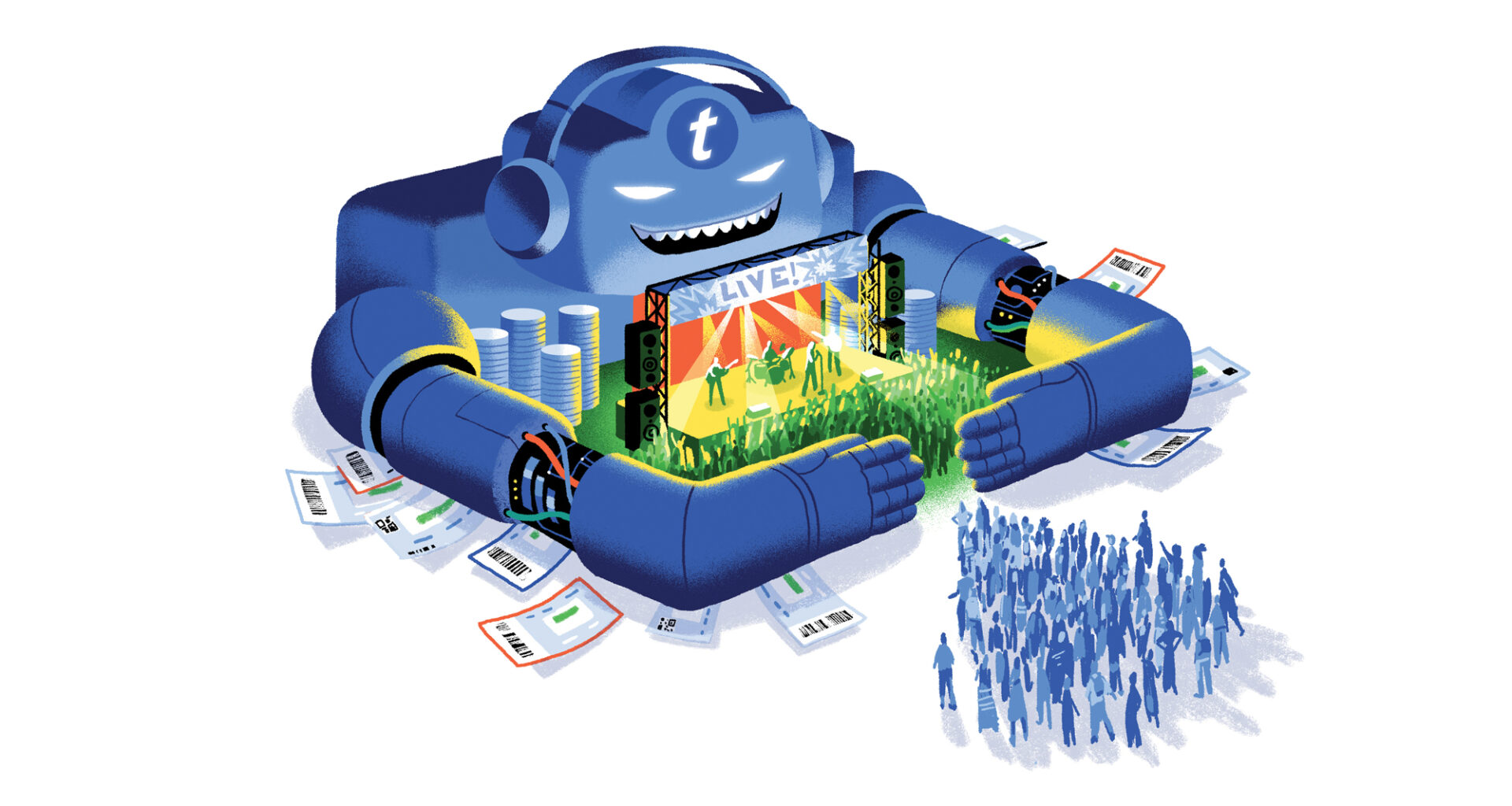
If you’re a frequent concertgoer, you’ve almost certainly had a run-in like this with Ticketmaster and its parent company, Live Nation Entertainment. It’s no secret that the soaring ticket prices and exorbitant fees have put attending major live music events out of reach for many hardworking Americans. Now, a federal court has found the company to be an unlawful monopoly.
So, how did it come to this? Just take a look in our own backyard: The Live Music Capital of the World offers a good example of the way they built their empire.
In the mid-aughts, a big dry-erase board down at Waterloo Records listed all the concert tickets you could purchase in person and have printed onsite from smaller vendors like Star Tickets and homegrown company Front Gate Tickets. ACL Fest had recently been founded by a group of local entrepreneurs, who soon after formed event promotions company C3 Presents. The local music biz was popping.
In 2010, Live Nation merged with Ticketmaster to consolidate the power of two of live music’s most dominant companies. The pair had just earned a collective $5.6 billion in revenue the previous year, generating $4.1 and $1.5 billion, respectively.
The newly formed entity didn’t take long to start expanding in the live music capital, beginning with the acquisition of a controlling 51% stake in C3 Presents in 2014 for $125 million. They followed up by purchasing Front Gate Tickets in 2015 and promotions upstart ScoreMore Entertainment in 2018. All three were independent, Austin-born companies with exciting energy driven by the vibrant local music scene.
More recently, Live Nation purchased iconic music venue Stubb’s, including the coveted downtown land it sits on, in 2021. And it has secured exclusive booking and ticketing contracts for the city’s three newest, largest venues: Germania Insurance Amphitheater, Moody Amphitheater, and Moody Center.
In simple terms, because the conglomerate controls so much of the market, they dictate the terms, from the price of admission to which artists get opportunities. Cities around the globe mirror what has happened here in Austin.
“There are just so many layers where they’re controlling so many pieces of the business that it makes it hard for other businesses to operate,” says Graham Williams, owner and founder of Austin-based independent booking and promotions company Resound Presents.
 A woman holds a sign protesting Live Nation and Ticketmaster outside the U.S. Capitol. Photo by Getty Images / Drew Angerer.
But Live Nation’s grip on the music ecosystem doesn’t stop with venues. The company also manages hundreds of artists—and they’ve even made strategic investments in other business ventures. If you noticed the sudden proliferation of Liquid Death waters at concerts, you should know that the beverage company had $15 million in Series C investments that came in part from Live Nation, which gives them a vested interest in stocking the product.
“I’ve noticed, nationwide and in Austin, Live Nation doing a lot more venue and club level shows,” Williams says. “It used to be just larger-scale events, and there’s definitely more 300-person, 500-person-type shows they’re doing to try and grow those artists up to their venues.”
In Austin, venues of that kind include Stubb’s indoors and Scoot Inn. It’s a common occurrence for Live Nation’s artist development and management teams to sign nascent musicians, book them in small venues, pour promotion dollars into them, and help them graduate from one tier of venue to the next, making stops at key festivals along the way. States like New York and California have strict laws that prohibit some of these maneuvers by disallowing a manager to procure employment for talent without going through a separate, licensed booking agent.
Live Nation’s vertical and horizontal integration allows them to flex their muscles across the industry. For example, The New York Times reported that when Matchbox 20 toured the country in 2013, an Atlanta venue alleges that Live Nation had the band eschew the arena because it had recently moved away from Ticketmaster in favor of a primary competitor, AEG.
It’s practices like this that landed the corporation on the Department of Justice’s radar, and in May 2024, the federal agency, along with a cadre of more than 30 state attorneys general from both political parties, filed an antitrust lawsuit against the company. Just months after the 2024 election, the case stalled out amid massive turnover in U.S. governmental offices, and in March 2026, the DOJ announced that a settlement had quietly been reached with Live Nation. The deal required some changes to the business along with a payout of $280 million in damages. But the music powerhouse could still continue to operate, largely unchecked.
However, most of the state attorneys in the lawsuit snubbed the settlement deal and decided to persist with the case. A little over a month later, a jury ruled against Live Nation, finding them liable on all antitrust claims in an overwhelming victory for the plaintiffs.
Now, the case moves into a remedies phase to decide what happens next, which could include separating the two major components of the company, along with hefty fines. But don’t expect things to change overnight: The case is likely to be appealed, and implementation of the changes could take years to accomplish.
“It was hopeful just to see it,” Williams says, “but things move slowly, and they have a lot of power, so I’m not sure what will happen long term.”
Here in Austin, more competition is already rearing its head. Rival AEG is building a new 4,000-capacity venue on Riverside Drive, and news recently broke that it would take over operations of the previously Live Nation–run Emo’s venue just down the street.
Ticketmaster and Live Nation’s defeat in court will have a practical effect on the concert juggernauts, but the most damaging fallout might be psychological. The negative PR could motivate artists, music industry businesses, and customers to distance themselves from the company.
For years, concertgoers felt like they were being ripped off when they clicked purchase to see their favorite musicians. Now, they have a court ruling that proves they were right.

Dominating live music delivers some eye-popping numbers.
$25 billion
Live Nation’s total revenue in 2026.
646 million
Tickets sold by Ticketmaster in 2025, per The New York Times.
$216
Average cost of a ticket at a large stadium, per Pollstar.
300+
Venues owned by Live Nation worldwide.
80%
Portion of top-tier arenas handled by Ticketmaster, per the antitrust lawsuit.