
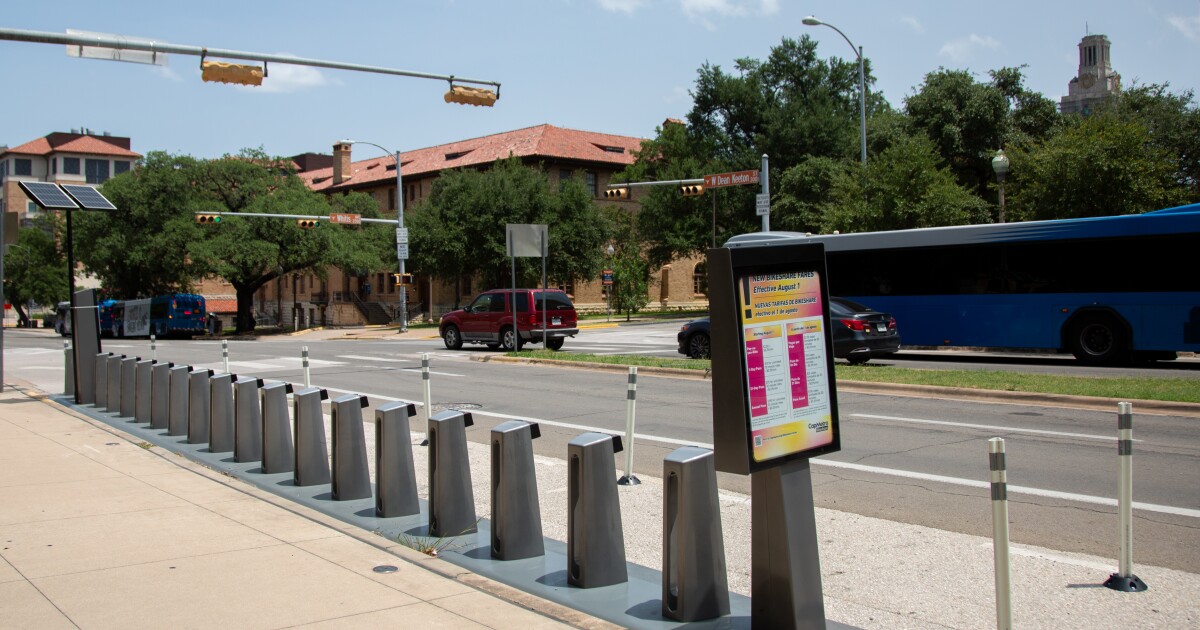
Austin’s publicly-owned Bikeshare system comes back Aug. 11, almost three months after CapMetro’s pulled its fleet of nearly 500 electric-assist bikes off the street following a fire at its charging facility on East Ben White Boulevard.
CapMetro says the fire destroyed about $159,000 worth of equipment. But that figure was the estimated value of used gear, not what it would cost to buy again. The agency hasn’t said what that amount will be.
Neither CapMetro nor the city of Austin, which owns the bikes and batteries, had insurance covering any of it. Only the building in which the fire happened was insured.
Coming back in parts
Service will return in stages. The first 150 bikes will be concentrated around the University of Texas at Austin, where ridership is the highest. Students can buy an annual pass for half-price and make up about 60% of Bikeshare customers, according to CapMetro.
Riders will be able to return bikes to any station, but workers may haul them back to the UT area until service is more widely restored. CapMetro expects the full system to be up and running by the end of the year.
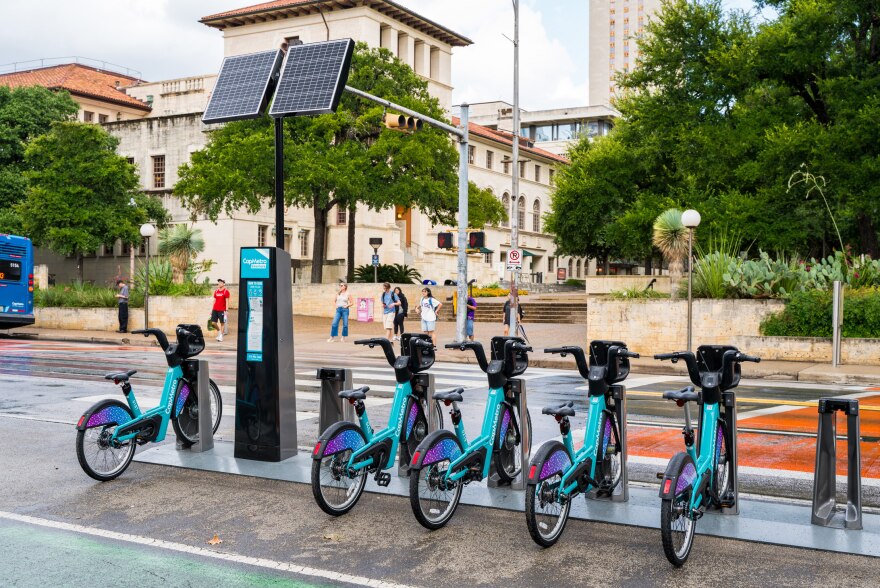
About 60% of Bikeshare customers are students, according to CapMetro.
Charging is a big bottleneck. Before the fire, employees pulled depleted batteries off bikes in the field and brought them to the Ben White facility to charge. A raw data feed from CapMetro’s vendor lists only 12 of the system’s 84 stations as able to charge a bike while it’s docked.
Until the facility is rebuilt, crews will charge bikes at those dozen stations and repair them out of a temporary trailer. More bikes will go out as replacement chargers and new stations arrive. The replacements will come from the same vendor, the Montreal-area company Lyft Urban Solutions (formerly PBSC).
Who insured it
“The building, the structure is covered by insurance,” CapMetro’s chief operating officer Andy Skabowski said at a July 27 board meeting. “The contents of the building were not covered by insurance.”
The fire in May destroyed about a quarter of Bikeshare’s batteries, most of its chargers, maintenance tools and repair equipment, along with office and workspace areas, Skabowski said.
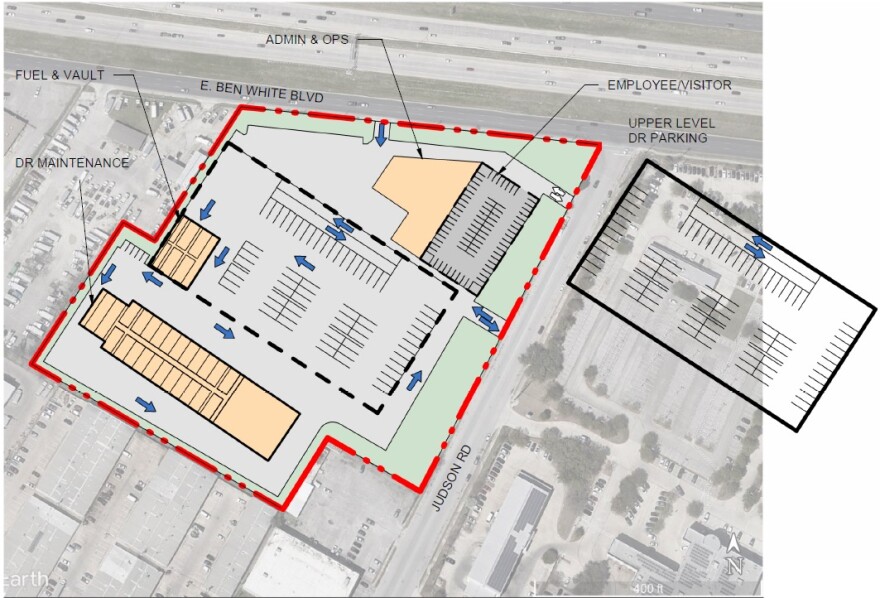
The building that caught fire was located at its “Demand Response” base on Ben White Boulevard. This is an illustration of a possible configuration of the 11.5-acre property when CapMetro was still considering buying the tract in 2024 from the former Lief Johnson Superstore South.
The city launched the bikeshare program in 2013, and kept ownership of bikes, batteries and stations when CapMetro took over running the system in 2023. The city didn’t insure them either.
“The city of Austin has no specific policy related to the bikeshare assets,” said Brad Cesak, a spokesperson for Austin Transportation and Public Works. He said the city is self-insured, meaning it set aside money for potential losses.
The interlocal agreement between CapMetro and the city doesn’t appear to require either agency to insure the other’s property. Asked whether the city expected CapMetro to have covered the Bikeshare equipment, Cesak said only that per the agreement “it is CapMetro’s purview to operates its facilities.”
What it cost
Roughly $127,000 of the loss was bike parts and equipment, including 140 e-bike batteries worth about $69,000. Eleven bicycles were valued at $27,000. Roughly $5,000 in tools were damaged.
CapMetro said replacing it all will cost more. Much of what burned “had been in service for over a decade and depreciated over time, so their current value differs from what it will cost to replace them,” CapMetro spokesperson Blythe Nebeker said.
The bikes and batteries were newer, bought in 2024 after CapMetro converted the system to electric-assist bicycles, which give people a boost as they pedal. Those bikes had always been far more popular than traditional, non-electric bicycles.
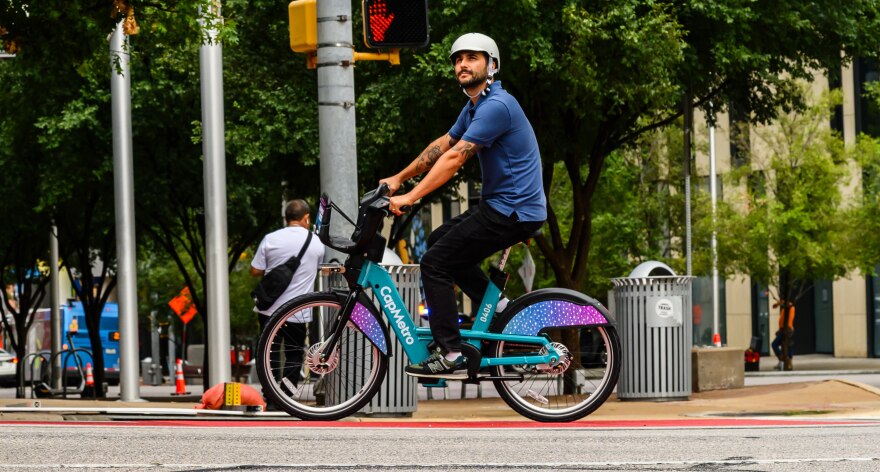
After CapMetro took over the Bikeshare system, it swapped out all the bicycles for more popular electric-assist bikes. They have a built-in motor that gives riders a boost while pedaling, so it takes less effort.
CapMetro’s insurance is paying to repair and renovate the fire-damaged building, and the agency is paying a deductible, but didn’t specify how much that was.
Nebeker said CapMetro’s insurance policy on the Ben White building includes “extra expense coverage with a limit of up to $540,000 to help offset additional costs following a covered event.” CapMetro didn’t answer whether that coverage could be applied to the destroyed equipment.
Replacement costs will come out of the Capital Projects budget, Nebeker said.
What caused it
CapMetro hasn’t said what started the fire, and a forensic engineering report on the cause has yet to be released.
An Austin Fire Department incident report obtained by KUT News said the blaze started in a battery storage room.
“The room was full of batteries, most of which were probably E-bike batteries,” the report stated. “We cooled them enough to load them in mobile bins that allowed us to bring them outside and submerge them in water.”
CapMetro hired the firm Rimkus to investigate both the facility fire and a bike that started smoking outside Jo’s Coffee on South Congress about four hours earlier. A witness to that incident, Tag Brown, told KUT News the smoke smelled “putrid and just had a sulfuric scent to it.”
At the board meeting, chief counsel Brad Bowman said the forensic report was nearly finished.
“The short answer is very shortly,” Bowman said of its release. “The final report is not quite ready yet. But we’re very close to that, we believe.”
Board member Eric Stratton asked at the meeting what happens if investigators find evidence that the fire was caused by negligence. Bowman said that conversation might not happen in public.
“We might need to brief the board in an executive session or something of that nature,” Bowman said.
CapMetro hasn’t said the way batteries and chargers were arranged caused the fire. But the agency plans to separate battery storage from charging equipment to limit potential damage in the future.
“Don’t put them in the same spot,” COO Skabowski told the board on July 27. “That’s one of the big ones. Because sometimes if something does occur, your impact is much less.”