
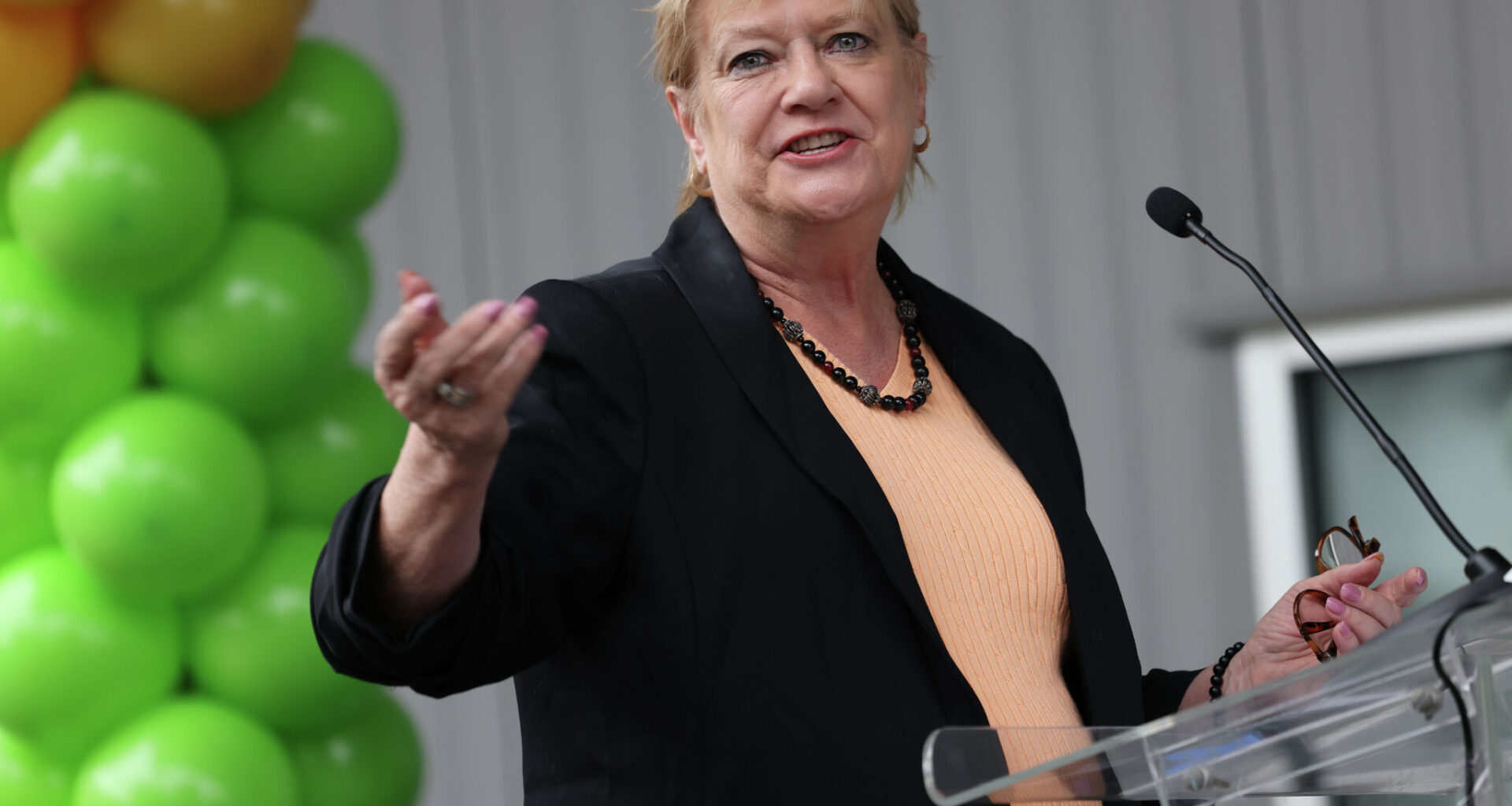
Dallas County Commissioner Dr. Theresa Daniel praises the accomplishments of Stewpot since it’s inception a half century ago. The Stewpot held it’s 50th Birthday Celebration at 1610 Malcolm X Boulevard in Dallas on October 24, 2025.
Steve Hamm/Dallas Morning News
When a divided Dallas County Commissioners Court on Tuesday killed the idea of asking residents to vote on a higher tax rate to generate $150 million for homeless services, the swing vote was a shocker.

Commissioner Theresa Daniel has been a staunch proponent for homeless solutions over her 14 years in office. Yet she joined Commissioners John Wiley Price and Elba Garcia in voting down the proposal, saying she “would question” whether that responsibility “is on Dallas County government.”
After returning from a closed executive session, Daniel asked her colleagues for a redo vote, citing confusion around “understandability of the wording” of the motion.
Article continues below this ad
In the second round, five hours after the first and with Daniel now in support, commissioners voted 3-2 to advertise the higher tax rate for the seven days required by state law before they can vote to put it on the Nov. 3 ballot. The advertising had to begin Tuesday because Aug. 11 is the last scheduled meeting before the deadline to finalize the ballot.
Daniel, 73, did not respond to a call or text message asking about the confusion during her first vote. In a statement to The Dallas Morning News, Sarah Kahn, CEO of regional homeless response agency Housing Forward, said she appreciated the consideration of the group’s proposal and thanked Daniel, County Judge Clay Lewis Jenkins and Commissioner Andrew Sommerman for their yes votes.
Dallas County Judge Clay Lewis Jenkins, center, runs interference between commissioners Andrew Sommerman, left, and John Wiley Price during a discussion on the 2026 fiscal year budget at a Commissioners Court meeting on Tuesday, Sept. 2, 2025 in Dallas.
Angela Piazza/Staff Photographer
“Dallas County residents are eager to address homelessness, and Housing Forward and the All Neighbors Coalition are committed to answering the call to get people off the streets and improve neighborhoods across our community,” Kahn said.
‘Invest in success’
The highest tax rate commissioners could adopt Aug. 11 without seeking voter approval is 22.46 cents per $100 of a property’s valuation — that would mean $786 for a $350,000 home. The current rate of 21.55 cents levies a $754 tax on a home of $350,000.
Article continues below this ad
If commissioners vote to add a portion to fund homeless services, the tax rate requiring voter approval at the ballot box would be 25.31 cents per $100 of valuation or $886 for a $350,000 home.
Garcia and Price pushed strongly against asking voters to increase the tax rate, saying such a social intervention was not the responsibility of county government — especially at a time when average residents are struggling to pay for gas and groceries and county officials must address their core responsibilities.
“Where does it stop?” Price said. “If the test is (being) impoverished, the nonprofits can line up on us. Governance isn’t a race for who can get the money first.”
In the first round of voting, Daniel said she agreed with Price, adding there was no “coldness of heart” in their positions when considering how to balance the budget.
“This is one of those items that is incredibly painful for all of us because we do see the needs but where is the final responsibility?” Daniel said. “And I would question whether it is on the Dallas County government.”
Article continues below this ad
Daniel did not articulate her position change when voting in the second round to support advertising the higher tax rate.
Sommerman urged his colleagues to give voters the chance to decide on the higher tax at the ballot box, saying homelessness is costing the county through the burden placed on the jail and hospital. Taxpayers, he said, can “pay for failure or invest in success.”
Dallas County Commissioner Andrew Sommerman listens to a discussion on a budget and tax presentation on the 2026 fiscal year during a Commissioners Court meeting on Tuesday, Sept. 2, 2025 in Dallas.
Angela Piazza/Staff Photographer
He recited data showing 6,004 unsheltered people accounted for 5,728 repeat bookings at the jail last year. Sommerman said 7,367 people represented 52,000 visits at Parkland hospital “because they have no place to go.”
“A dedicated homeless tax is not charity, it’s stewardship,” Sommerman said. “It’s financial responsibility, it’s public safety, it’s economic development and most of all it’s hope.”
Article continues below this ad
Shrinking population
At the same time Housing Forward began pushing for a tax to support homeless services earlier this year, a coalition of childcare advocates pitched a 3-cent property tax increase to fund childcare scholarships and support infant and toddler classrooms.
The group pointed to a critical need in the region, where about 9,500 families are on a waitlist to receive childcare assistance through Workforce Solutions Greater Dallas and others cannot afford the $11,000 price per year for one child.
Commissioners did not discuss the proposed childcare tax Tuesday, though advocates said they will regroup and evaluate their options.
With the shrinking populations of Dallas and Dallas County, Jenkins said he worried unaddressed homelessness may worsen the exodus.
Article continues below this ad
One of the drivers of that, Jenkins said, is a perception “that the quality of life and the public safety is better in places where they don’t see homeless encampments.” He said he supported giving voters the chance to decide on funding homeless solutions with their tax dollars.
From July 2024 through January, a coalition of organizations led by Housing Forward helped clear more than 250 tent encampments in the loop from the public library and City Hall to the Lorenzo Hotel.
In January the Commissioners Court voted unanimously to allocate $10 million to support Housing Forward’s Street to Home Initiative aimed at helping 1,100 more homeless people across Dallas County while preventing tents from returning to downtown streets, business and parks. The award matched the $10 million pledged by the Dallas City Council and $8 million from private donations.
If the tax increase for homeless services passes, Kahn said the funding would support rental assistance, substance abuse treatment and other services to get people out of homelessness in all areas of the county. She said such initiatives work: of nearly 24,000 homeless individuals served by Housing Forward’s network since 2021, Kahn said 93% did not return to the system.