
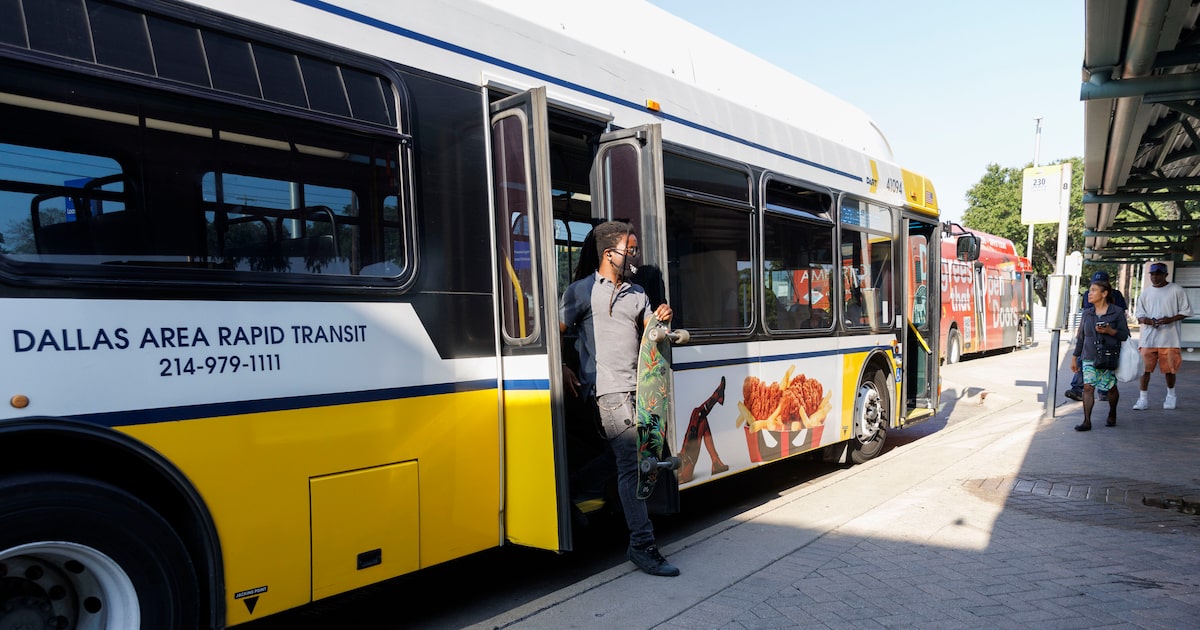
Irving became the fourth city this week to put its relationship with the Dallas Area Rapid Transit up for a vote.
On Thursday, the City Council voted 9-0 to authorize an election next year where voters will decide whether the city should stay or leave the transit system. It’s the third time the city has held a referendum of this kind, with voters siding with DART in 1989 and 1996.
Highland Park, Farmers Branch and Plano approved similar elections earlier this week. Each argued that their one cent sales tax contributions far exceed the services they receive in return and cited a 2024 report by the firm EY to make their case. The suburban cities have also questioned the transit agency’s governance model, which gives the city of Dallas more representation on its board as it’s determined by population.
In Irving, dozens of speakers who depended upon public transit to travel to different parts of the Metroplex — from the airport to Irving to downtown Dallas — urged the City Council to stick with the agency. They shared personal stories of relying on the system to attend classes, go to work or enjoy the amenities near the Irving Convention Center and in the city’s entertainment district.
Political Points
Some expressed support for an election as they felt DART buses and rail lines did not have the type of ridership that justified the kind of investment Irving makes.
“We have been treated wrongly. We have not been treated the same,” said Mayor Rick Stopfer, adding that Irving gets no credit for making adjustments and purchasing infrastructure at its expense while other cities such as Dallas appeared to have gotten their way. Stopfer, a member of the DART board, said he often found himself in the minority when it came to steering the agency’s decisions.
DART Board Chair Randall Bryant and CEO Nadine Lee arrived once again to implore the council to continue negotiations with the transit agency instead of going to the ballot box. Lee said Irving enjoyed higher ridership routes and billions of dollars in economic impacts from transit-oriented investments.
Bryant cited an email he had sent member cities urging them to delay their votes by 30 days to reach a compromise. However, after seeing back-to-back actions by cities, Bryant said he knew where things were headed in Irving.
“Contrary, though, to the other three cities, I’m intrigued to hear the city of Irving’s rationale for withdrawal election, given the two complaints I’ve heard are governance and funding,” Bryant said.
Unlike the other three cities, Irving gets more than it invests. The city puts in $102 million and gets $123 million in return. But city officials say giving up the one cent sales tax has impacted the city’s ability to use money for attracting corporations and sports teams to spur economic development.
“It’s obvious to me that the whole concept was ill-conceived,” said deputy mayor pro tem Mark Cronenwett about the arrangement where 13 cities pay into the system and others don’t.
“It’s obviously created this disparity where cities like Arlington or Frisco use that 1% for economic development, creating sports venues in particular, where you would think there’ll be a great interest in having mass transit to them, but there isn’t, because they’re not in DART,” he said.
Several council members said they were not opposed to mass transit and expressed support for a micro-transit network like “Via,” deployed by the city of Arlington to cover the costs of the city’s needs. Some speakers, such as Alex Flores, questioned the efficacy of that system, citing their experiences of finding that option less reliable than DART.
If they prevail in the elections, cities would still be obligated to pay off debt associated with cities’ contributions for a period of time.
Gary Slagel, the former DART board chair from Richardson, also asked the City Council to reconsider their decision.
He highlighted work underway at the North Central Texas Council of Governments and the Regional Transportation Council, a multi-city transit collaborative, were putting together a plan that would introduce mass transit in various municipalities in the Metroplex and may result in cities that are part of DART to recoup some of the money they’ve spent. North Texas leaders are working to prepare for the arrival of millions of new residents in one of the fastest-growing regions in the country.