
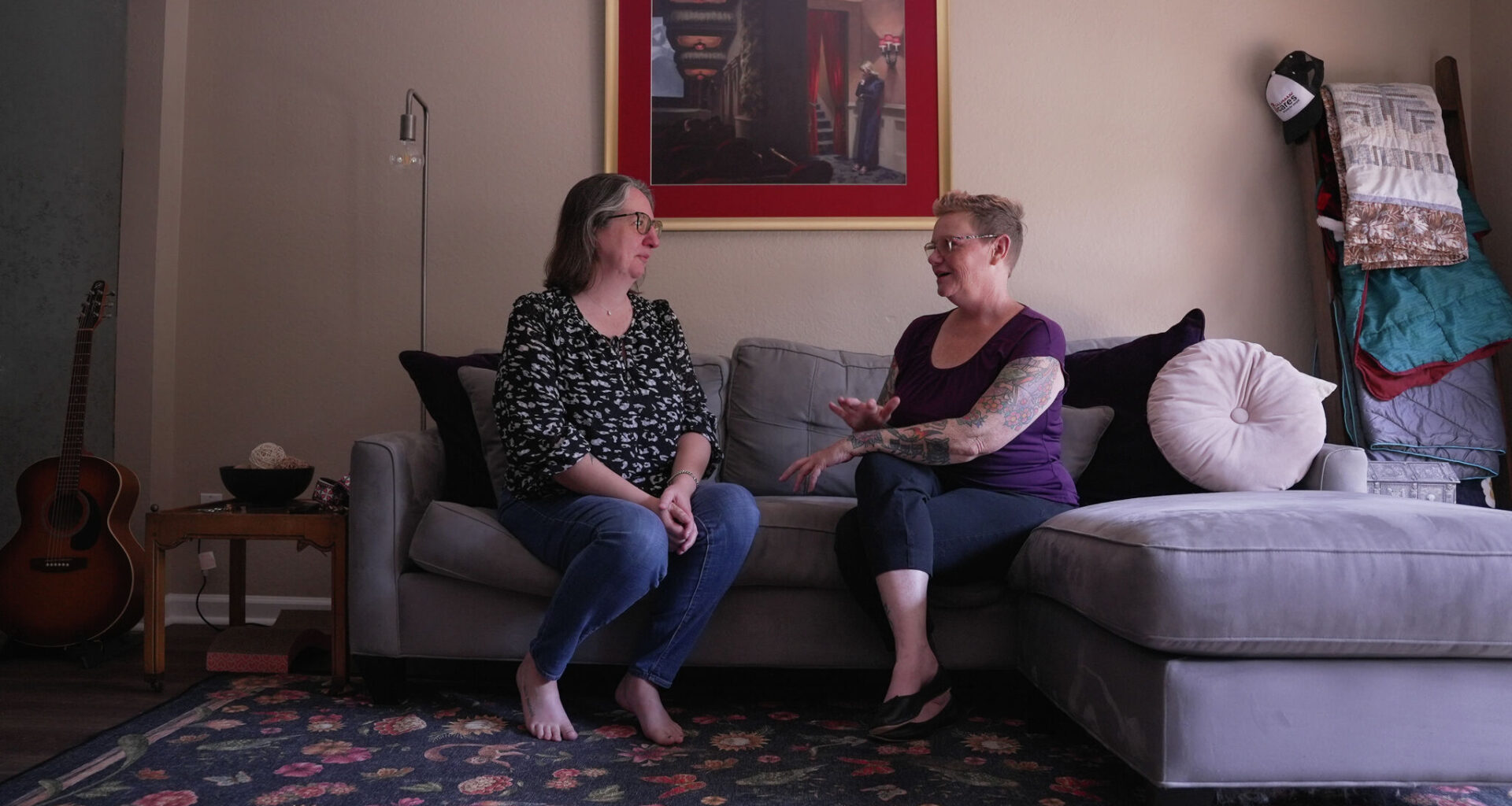
Jeanine Blair opened the door for her death doula on a cloudless Friday morning in July. They greeted each other like old friends.
They sat, and the pink-haired, heavily tattooed doula pulled out her binder and spread documents across the dinner table. The papers held decisions most people avoid making: advanced directives, funeral wishes, body donation plans and instructions for what should happen when Blair could no longer speak.
A ginger cat descended the stairs and went straight to the doula. The cat, Tiger Lily, weaved through her legs in figure eights, circling once, twice, then jumped onto the table.
Article continues below this ad
Blair watched Tiger Lily examine the papers, sheets that documented the plan for Blair’s death.
Blair was already well acquainted with funerals before she started planning her own. Her mother, brother and father had died within the last four years, one loss after the next.
She and her sisters largely went through that process alone. Their parents did not plan for death, and it created turmoil in their lives when they quickly declined and went into hospice. Blair didn’t want her death to be another burden for her sisters to carry.
But she didn’t want to go through it alone, either. That’s where her death doula came in.
Article continues below this ad
The diagnosis
Blair, 48, knew she had cancer before the results were confirmed back in January 2025. Her doctor told her it was probably nothing. Her boss optimistically waved away her concerns when she brought it up. But the biopsy results confirmed what Blair already felt to be true: She had rectal cancer.
At first, doctors told her the outlook wasn’t too bad. More tests revealed that it was, and that treatment options would significantly affect her quality of life.
“The more time and the more tests that I did,” Blair said, “the bleaker that picture kind of looked.”
Jeanine Blair poses for a photo with her cat, Tiger Lily, at her home in Dallas on Monday, July 20.
Joe Snell/The Dallas Morning News
After months of moving through different treatments, she decided to stop to enjoy the time she had left. Blair’s next step was to plan her own funeral.
Article continues below this ad
When she Googled “funeral planner,” she found something she didn’t expect: a website called “Dallas Death Doula.”
Blair wasn’t sure what a death doula was, so she read more. She learned that death doulas provide end of life planning, emotional support and funeral and legacy planning. It was the emphasis on empathy for the dying and their loved ones that pushed her to pick up the phone and call the “Dallas Death Doula” herself.
The more she read, the more she wished she and her sisters had hired one to help deal with their parents’ deaths.
“It was very traumatic for me and my sister because we were both here trying to take care of them as best we could,” Blair said. “Why didn’t I have this when I was going through what I was going through with my parents?”
It only took one phone call for her to determine that she wanted to hire Dallas-based death doula Britna Savarese for a planning session. Blair saw her as compassionate, understanding and, most importantly, unfazed by anything Blair “threw at her.”
Article continues below this ad
“She’s prepared,” Blair said, “and has answers to a lot of questions that I don’t think people are necessarily brave enough to ask.”
Besides logistics, Savarese helps people come to terms with the process of dying. She said she and Blair are a good fit because they share a sense of humor.
“We can cry when we need to and be serious when we need to, but let’s just joke around when we can and bring some levity to it,” Savarese said. “That’s not for everyone. That’s what Jeanine wants.”
At the dining table in Blair’s condo, Blair explained that she wants to donate her body to The University of Texas Southwestern’s willed body program so that scientists can learn from her case. Savarese listened as Blair described her frustration with the lack of research on her type of cancer.
“There’s not a lot of information on rectal cancer,” Blair said. “Study me, cut me up, do whatever and learn from it so other people don’t have to go through this.”
Article continues below this ad
Savarese nodded. They discussed the rise of rectal cancer among younger women. The conversation trailed off, then Blair smiled.
“I have not done it yet, but I really want to get an LMAO tattoo on my a–,” Blair said. Both women burst out into giggles.
“You know what?” Savarese laughed. “I know some good artists.”
A guide through dying
Before Savarese entered Blair’s home, she paused at the doorway. She placed her hand against the doorjamb, then stepped inside. The ritual lasts only a moment, but she does it every time she enters a client’s house.
Article continues below this ad
When she leaves, hours later, she repeats it, reminding herself that the grief inside belongs to the people she’s there to serve, not to her.
Britna Savarese, a death doula, pauses before entering the home of Jeanine Blair in Dallas.
Joe Snell/The Dallas Morning News
At 10 years old, Savarese wanted to be a mortician. That, or a princess.
She grew up in a small town where funerals frequently took place. Her local funeral home’s director was a pillar of the community. Watching him support grieving families motivated her to train as a mortician, a pull that Savarese said is referred to in the industry as the “death whisper.”
She quickly became disillusioned with mortuary school, though.
“I went to mortuary college and learned that a lot of it was the psychology of selling: how do you upsell a family that wants a wooden casket to get the $30,000 Cadillac of caskets?” Savarese said. “So I quit school. I felt very jaded about the funeral industry.”
It wasn’t until she saw author and death doula instructor Alua Arthur talk about the field on social media that she heard about death doulas. That was the moment the “death whisper” became a shout, Savarese said.
“That’s what I was keying into as a little girl,” Savarese said.
Now, as a death doula, she often meets people when their world begins to shrink. A terminal diagnosis. A hospice referral. A family gathered around a bedside, unsure of what comes next.
Her goal isn’t to make sure people have a good death. There’s no guarantee of that, Savarese said. Her job is to help people prepare to deal with their death or the death of a loved one.
After three funerals
Blair’s parents did not plan for their deaths. Her mother died in March 2022 after bouncing between the hospital, rehab and hospice. She only spent 24 hours in hospice before she died. Blair said the death felt sudden and traumatic, partly because her parents refused to accept additional support as they aged.
Losing a parent is difficult. Blair said her parents being in denial about the severity of their conditions made the process harder. She and her oldest sister had to do the end-of-life planning while their parents resisted their efforts.
“All of this was kind of some stubbornness and not really understanding or appreciating where she was in her timeline,” Blair said. “Not just from her but from my dad.”
Blair’s father died a little over a year later in June 2023. Between them, her brother died in a car accident. She and her sisters, 6 and 11 years older than Blair, were swamped in the bureaucratic tasks of dealing with the funerals, wills and everything else that comes with dying on top of their grief.
When Blair received her diagnosis in January 2025, it hit the sisters hard.
The former senior project manager retired to focus on her health after a decades-long career at Cinemark. Grief, whether for herself or others, didn’t turn off her love of a well-executed plan.
The day her mother entered hospice, Blair started calling funeral homes to make sure they could accommodate her mother’s religious beliefs. Blair approached her own death with the same pragmatism.
“I wanted my journey to be completely wrapped up in a bow as much as it can be,” Blair said.
After initially contracting Savarese in late 2025, Blair stopped seeing her doula when she decided to go through radiation last January. Blair dreamed of a trip to Scotland and her symptoms prevented her from doing that.
Blair hoped that restarting treatment would allow her to feel well enough to go and, for a while, it did. She went on a bus tour to see castles with friends. She loved it, but the whole time she felt tired, and she couldn’t quite tell if it was jet lag or her symptoms catching up with her.
When Blair returned from the trip, her doctors told her she would need an invasive surgery to have a chance of limiting the tumor’s growth. It wasn’t a guarantee of complete remission and it would decrease her quality of life.
It wasn’t worth it to Blair. So she called Savarese again. She needs to take naps during the day now, and she enrolled in hospice after connecting with one of Savarese’s death doula peers who works with Angel Hands Hospice and Palliative Care.
Now that a nurse comes to visit her home once a week, having her affairs in order feels increasingly important.
A life well-lived
There’s a lot for Blair to consider before she dies, and Savarese said she’s there to help with that. Besides planning details such as who has legal and medical power of attorney (her oldest sister) and how Blair wants to be cared for when it becomes difficult to perform basic functions (at home for as long as possible), there are the details people often don’t think about until it’s time.
Blair is divorced and doesn’t have children. But she has a wide network of friends who’ve stuck with her through hard times, and she wants to make sure they’re cared for along with her sisters. Some of them had a difficult time understanding that she was dying.
“It’s been a rollercoaster, for sure,” Blair said. “When I was telling one of my friends about my diagnosis, she goes, ‘What does that mean? Do you have an expiration date? ’”
Blair put her medical information into Chat GPT, asked it to explain what her diagnosis meant in layman’s terms and then sent it to her friends. When Savarese heard that, she laughed. Now, Savarese can help Blair have those difficult conversations.
An unregulated field
Death doulas can perform a wide range of functions. Estate planning, holding vigil over someone as they die, creating legacy projects and massage therapy are just a few of the tasks a doula may offer.
Some of those tasks require licensing, but the profession of being a death doula is unregulated in the state of Texas. Anyone can call themselves a doula and sell their services. Savarese said she’s seen people take a three-hour course or even go into the field with no experience.
Savarese took a 14-week training course. She recommended people interested in becoming a death doula vet the training course they take, and that people looking for a doula’s services check their credentials.
The lack of state regulation can be a positive, Savarese said. It allows doulas to care for people in whatever way the client needs without having to go through multiple layers of state bureaucracy. It does mean that anyone can say they’re a death doula without any experience. Savarese said untrained doulas could harm the client if they provide bad advice that leads to a legal or medical decision that’s not aligned with the client’s wishes.
The fact that Savarese isn’t registered with a government agency doesn’t bother Blair because she said Savarese has no control of Blair’s medical or financial decisions. Plus, she trusts her doula.
“I don’t feel like there’s anything that she’s doing or that she would have access to that makes me vulnerable,” Blair said.
Besides, Blair is not alone. Her oldest sister and brother-in-law live nearby. Savarese isn’t meant to replace them, she said, just make their lives easier during painful moments.
Putting the fun back in funeral
Blair doesn’t want her friends and family to feel like they have to be sad when her life ends. They’ve been through too much already.
“Having gone through so many, especially recently, my sister and brother-in-law and I always joke, let’s put the fun back in funeral,” Blair said. “I want to celebrate who I was during my life.”
Blair wants there to be a celebration, but she also recognizes that her loved ones may need space to mourn. That means two funerals.
In the first she wants to pay tribute to her years at Cinemark with a memorial service in a movie theater. The setting feels fitting to Blair, who started there over 30 years ago as a teenager popping popcorn and whose home and body are peppered with references to movies. A print of the Ed Hopper painting “New York Movie” hangs over her sofa while two sparrows attempt to fly while carrying a coconut on her arm — a reference to the 1975 comedy “Monty Python and the Holy Grail.”
Then Blair wants an “after party” with karaoke, dancing and music.
“I’m there with them in spirit,” Blair said, “doing the dancing and the singing and all those fun things.”
There’s still time left before that, though. Savarese asked Blair what she wanted to do with her possessions. The guitar will go to a musically inclined friend. The desk and clock her father carved will go to her oldest sister, and then the next eldest if she doesn’t want it. Savarese encouraged her to think about why she wanted to give certain items to certain people when Blair writes goodbye letters to them.
Tiger Lily jumped on the dining table. Blair prepared for what will happen to Tiger Lily and her sister Daisy after she dies. A friend from work, also a cat mom who took care of them when Blair was redoing her floor, will adopt them.
The twin tabbies will have to get used to a new home, but Blair trusts that it’ll be one that feels familiar.
Staff writer Sana Muneer contributed to this article.