
Digital subscribers can listen to this article.
Subscribe today for unlimited access to Texas Monthly. Already a subscriber? Log in.
The ink was barely dry on my divorce decree when I arrived in Austin on May 1, 2021. I’d been offered a job at Texas Monthly, but I wasn’t sure if Texas would become home or just another stopover in my itinerant early adulthood, which had included nine moves in as many years. Twelve months in, the job was inspiring, but the city was not. I packed up again and relocated thirty miles north, to Georgetown, hoping that life on the periphery might do the trick. This felt less like moving to a place than getting the heck out of one I’d held at arm’s length.
One night in 2022, I met Kate, a friend of a friend, at a Charley Crockett concert in Austin. During the show, I noticed people in the audience two-stepping in the aisles and realized I hadn’t been out dancing in years. Raised in Chicago, I grew up in a Cuban-Colombian family; my sister, cousins, and I were taught to dance salsa and cumbia pretty much as soon as we could stand, and at family gatherings our living rooms would transform into mini–Buena Vista Social Club dance floors. I told Kate about my attempts to teach my ex-wife to dance and how she mocked my efforts, which stung. Kate suggested I give two-stepping a try. “Go to the White Horse on a Tuesday,” she said. “That’s when the best dancers show up.”
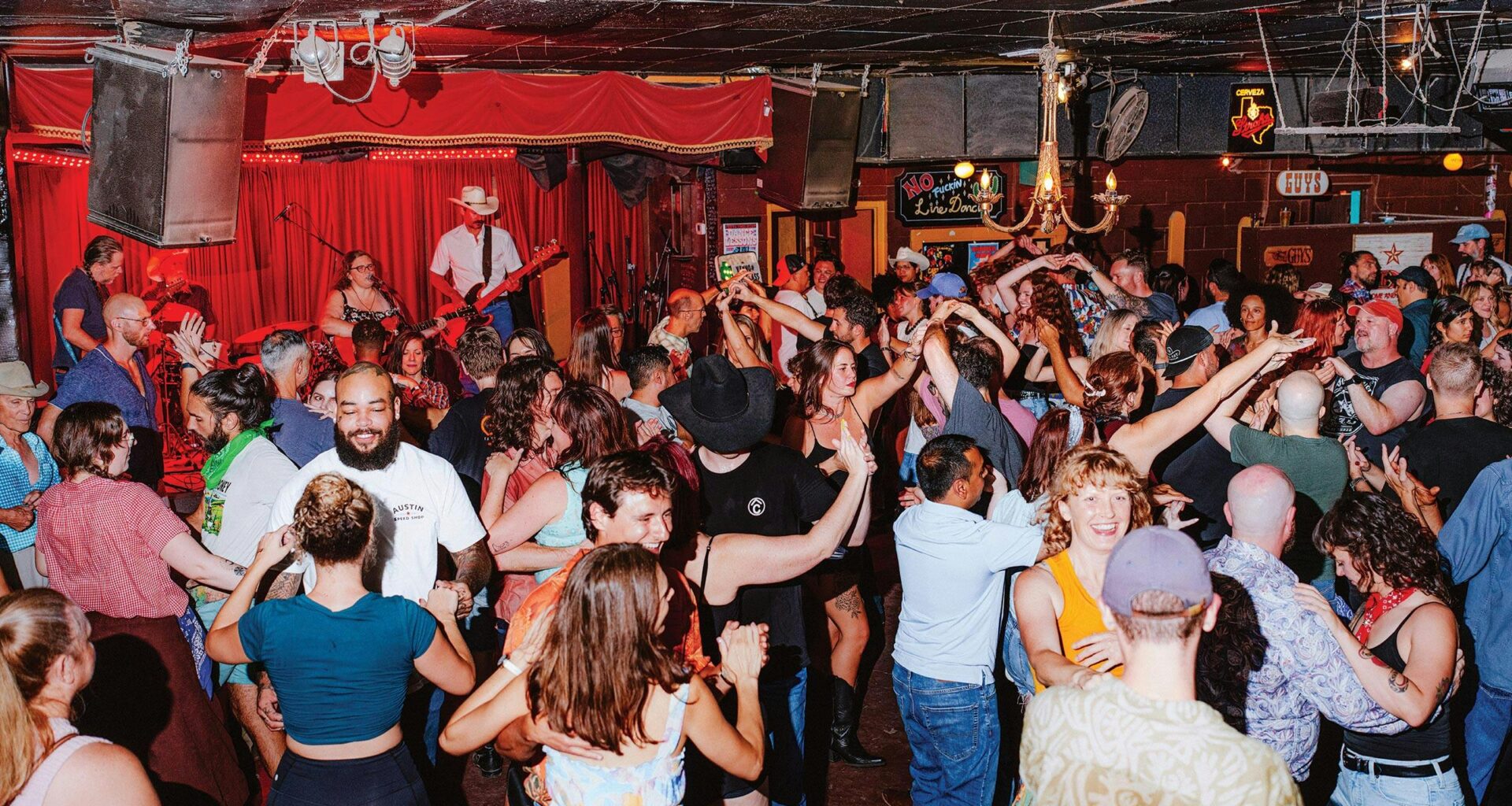
A month later, I walked into the East Austin honky-tonk expecting to see boots, cowboy hats, starched jeans, and a crowd of white faces. Singer-songwriter Devin Jake was onstage with his band—a drummer, a guitarist, and a fiddler—playing loud and fast. The dark dance floor was packed. There were boots, though also quite a few pairs of Converse high-tops, and the room was predominantly filled with white faces—it’s Austin, after all—but nobody was dressed like Woody. I beheld a spinning, bobbing, dipping tapestry of tattoos and cuffed pants, fishnets and ripped jeans, shaggy mullets and pixie cuts. I watched a short guy with long hair dip a leggy woman in a pencil skirt, an old-timer with stiff knees smile as he turned a giggling thirtysomething, a woman with high cheekbones and short pigtails wrap her arms around the waist of another woman who gazed into her eyes, and a skinny Black man twirl his partner so fast and tight that it looked like her feet might drill into the floor.
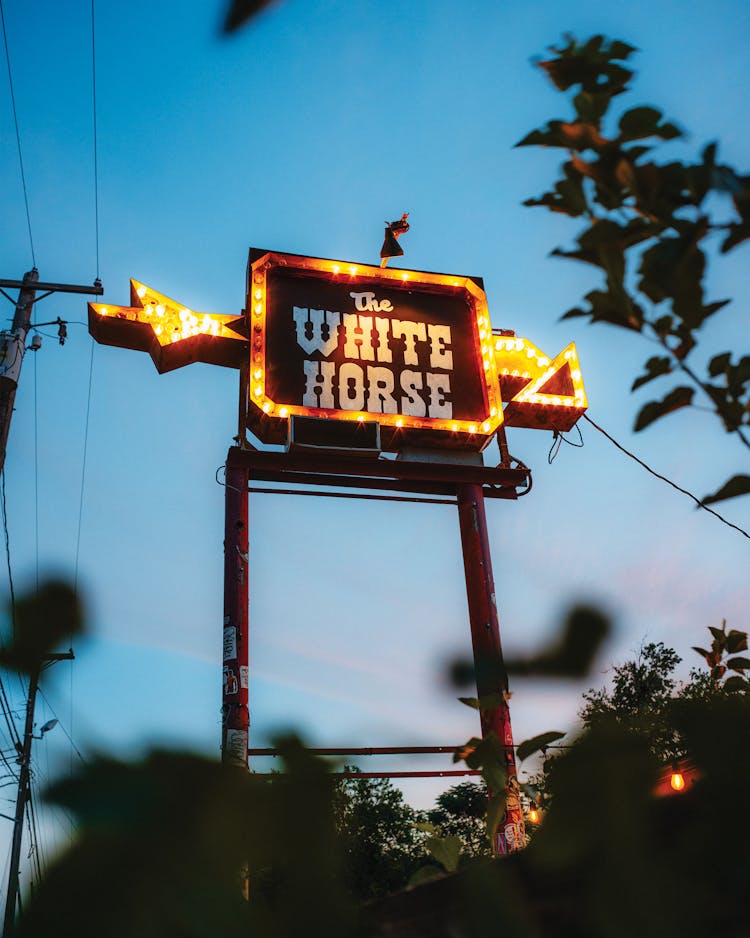 The iconic White Horse sign. Photograph by Chad Wadsworth
 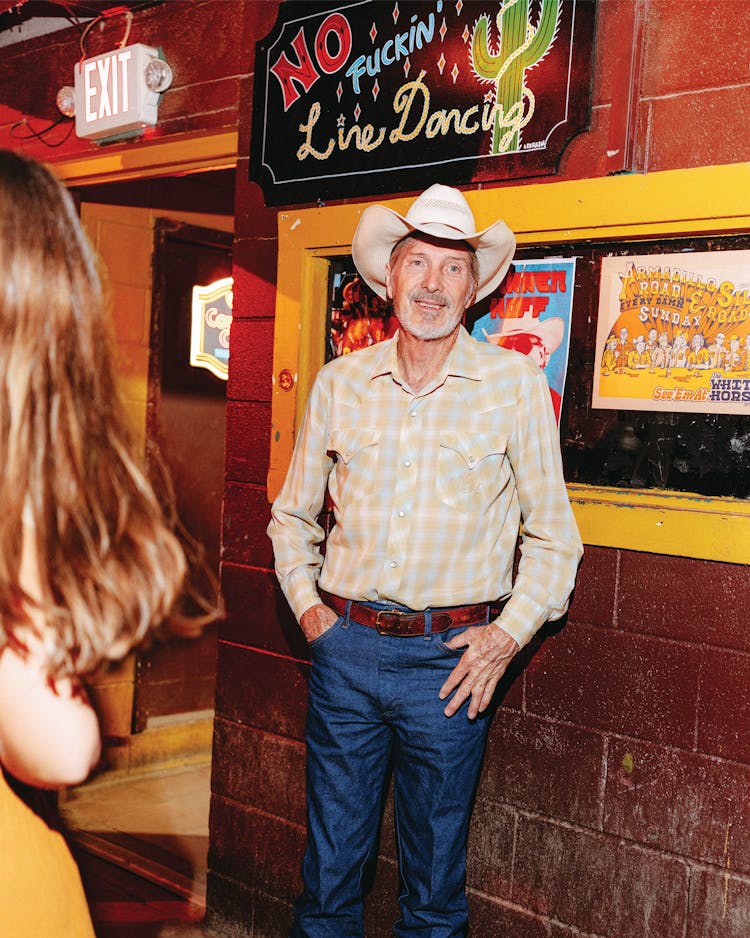 Marshall McHone, co-owner of the White Horse, where line dancing is not encouraged. Photograph by Chad Wadsworth
I asked a woman to dance. Then I asked another and another. I spun around the floor until the place shut down at 2 a.m. I returned the next night and the night after that. For the next year, I danced in Austin’s honky-tonks as often as six nights a week for four to five hours a night. I partnered with and befriended people from all walks of life: native Texans and runaways who’d changed their names, ex-addicts in recovery and hard partiers sneaking bumps between songs, ambitious entrepreneurs and aspiring artists, pining monogamists and choosy polyamorists.
I became a regular. And we regulars, I discovered, were all a little broken. We joked about taking up two-stepping after major breakups—and feeling as if we were reborn on the dance floor. Grasping for connection and emotion in one another’s arms allowed for an affection that was as intense as it was fleeting. Each dance was a chance to plunge naively into the whirl of sights, sounds, and scents, to surrender one’s heart completely to sudden and irresistible joy. That Tuesday at White Horse changed my life. And it wouldn’t be the last to do so.
There’s a sign that hangs in the White Horse that reads “No F—in’ Line Dancing.” At first I thought this was an amusing dig at a hokey dance style. But during my early heady months of nearly nightly dancing, I learned that it’s a polemic—and the manifesto of one side in Austin’s divided two-stepping community.
Exploring country joints in and around the city, I found what I consider three distinct scenes. The one I’m fond of—I’ll call it the honky-tonk scene—primarily exists within the walls of three well-known venues; from north to south, they are the White Horse, Sagebrush, and Sam’s Town Point. There’s the traditional dance hall scene, which persists at the Broken Spoke and at historic Hill Country spots, such as Gruene Hall, in New Braunfels. The third is the country-nightclub scene. It’s headquartered at Maverick’s Dance Hall, which has two locations just outside Austin, in Pflugerville to the north and in Buda to the south.
The music, the people, and the dancing vary from one scene to the next. At dance halls, which are typically larger than honky-tonks, dancers perform a traditional progressive two-step in a counterclockwise lap around the floor. Partners maintain stiff postures and either face each other in a closed position with the lead moving forward and the follow moving backward, or advance in a promenade side by side, moving forward together with hands over shoulders. The dance is a rhythmic walk that follows a quick-quick-slow-slow cadence. Dance hall regulars tend to be older folks who dress modestly. Bands play covers of familiar songs. For the most part, it’s not a singles scene. Married couples are there to dance with each other rather than with multiple partners.
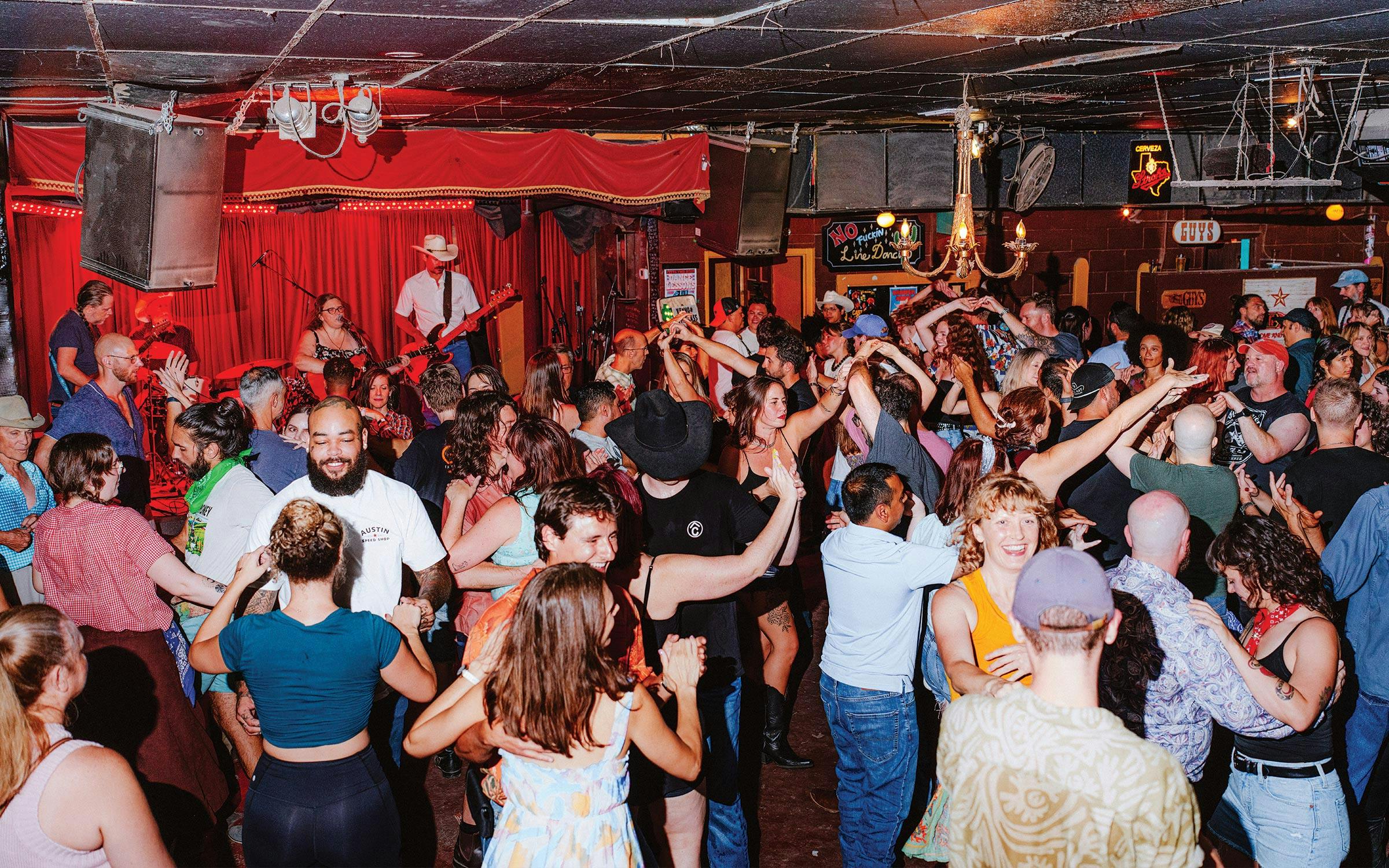 The White Horse’s dance floor is packed on Tuesday nights.Photograph by Chad Wadsworth
The country nightclubs have large dance floors, too, but they’re modern, glossy, and illuminated by disco lights. Dancers there move counterclockwise, but they’re usually younger, in their twenties and thirties, and looking for romance. Unlike in dance halls and honky-tonks, a DJ provides the music, blasting popular country, hip-hop, and, every 45 minutes or so, a couple of line dancing songs. At Maverick’s, the two-stepping can be acrobatic. The nights I went there to dance, I witnessed leads—all of them men, a lot of them bulky from lifting weights or, judging by their square-toed
boots and starched jeans, working on a ranch—twist, turn, and lift their follows in spectacular displays of athleticism. I saw women tossed into the air or rapidly dipped to the point of almost performing backflips.
That style isn’t for everyone. Megan Newman, a 38-year-old honky-tonk regular, has danced at Maverick’s a couple of times. “Guys there don’t take feedback. I feel way more comfortable telling someone at the honky-tonks, ‘Here’s what I want,’ ” she told me. “It kind of drives me insane watching the Maverick’s people dance. It’s like, ‘How many moves can I shove into this one dance while I do everything to break my partner’s arm?’ ”
Like Newman, I prefer honky-tonks, where the dancing is gentler, looser, and, I must say, sexier. Dancers are packed together on the small floors, forcing them to move in place. Knees are bent and hips move freely. There’s still a two-step cadence, but the spins, tucks, and waist wraps are derived from swing. Bands mostly play original songs or put their own twists on classics. The scene attracts a younger, more urban crowd, too, though of a different type than those at the nightclubs. The guys tend to be skinnier and have more facial hair. They dress in hipster Western wear—think vintage tees tucked into jeans or corduroys—and the scuffs on their pointed boots are more likely from shuffling across a dance floor than working outside. There’s an air of freedom in how the women dress, speak, and move. I find it beautiful.
My interest in the origin of the scene that I’d fallen for—the one I’d been dancing in, populated by hipsters, queer people, and the women I find attractive—sent me to Lockhart, where I spoke with Denis O’Donnell, cofounder of the White Horse and Sagebrush. I met the 47-year-old businessman at the bar of the establishment he named after his grandfather, O’Donnell’s Cafe & Pub, on the town’s courthouse square. Like others I spoke to, he was adamant about where young people started putting a new spin on the two-stepping tradition: the Hole in the Wall, a small Austin dive where he once worked as a manager and booker.
To understand how the Hole came to be so influential in today’s two-stepping craze, let’s take a quick jaunt through Austin’s country music history, starting in 1970, when the Armadillo World Headquarters opened. It was from this venue that Willie, Waylon, and other “outlaws” staged a revolt against the so-called Nashville sound, the glossy pop-adjacent music that had dominated airwaves for decades. The outlaws’ grittier music famously brought together two otherwise disparate tribes: the rednecks and the hippies.
By the early eighties, the Armadillo had closed, the hippies were old news, and punk was on the rise in Austin. Meanwhile, the wave of music sparked by the movie Urban Cowboy made traditional country feel old-fashioned by comparison. It was around this time that the Hole, which opened in 1974, started coming into its own and became known as a joint where anyone could play, no matter the genre.
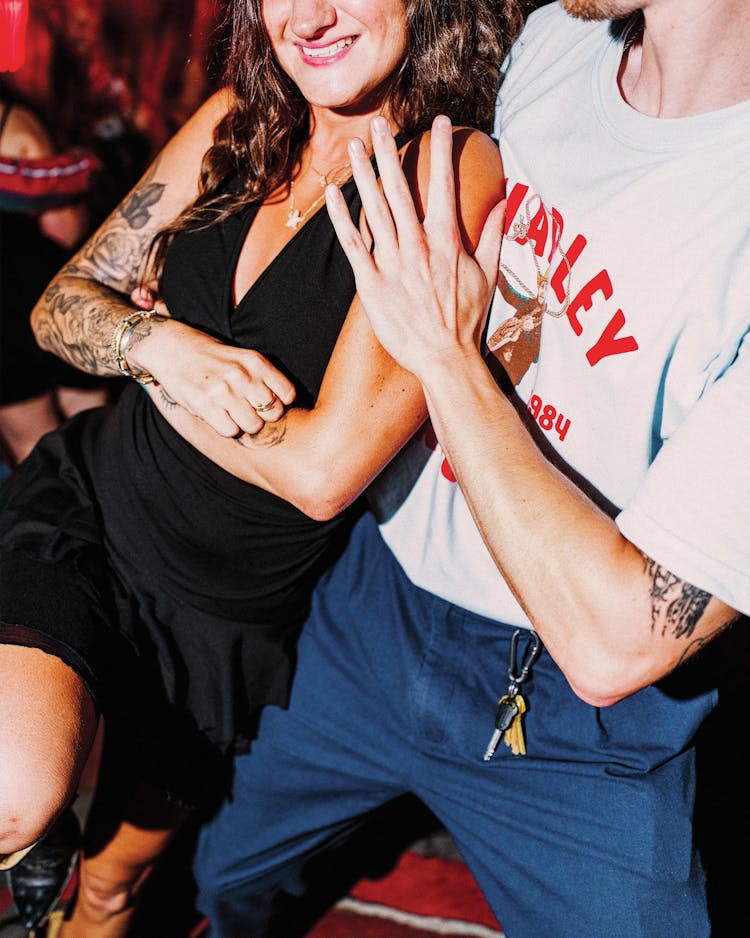 Dancers performing a side dip. Photograph by Chad Wadsworth
 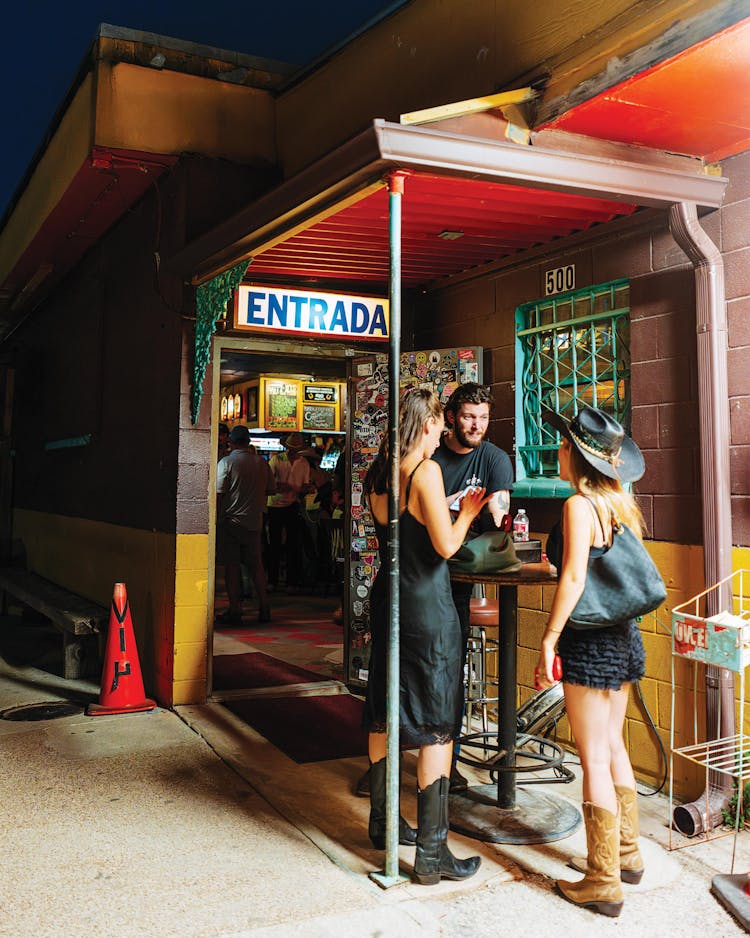 Cowboy boot–clad patrons outside the White Horse. Photograph by Chad Wadsworth
Jeff Hughes, front man of the honky-tonk band Chaparral, hung out there in the eighties as a twentysomething who mostly rocked out at punk shows. He hardly imagined he’d ever start a country group. But that changed when he saw a performance at the Hole by local rockabilly act Teddy and the Tall Tops.
Hughes recalled bartenders clearing tables and stacking chairs so that people could two-step in the space in front of the bar when they played. “It was definitely an alternative crowd. We were of a generation that wasn’t going to the Broken Spoke,” he told me. “There weren’t normies or typical cowboys there.” Hughes credits dancing to the Tall Tops with cementing his love of classic country and eventually starting Chaparral, in 1987. There wasn’t a honky-tonk scene yet—there weren’t legions of dancers or dozens of bands catering to them like there are today—but looking back on it, Hughes thinks of those nights at the Hole as the protozoa that would eventually, after a long, sometimes halting process, evolve into what exists now.
But today’s honky-tonk scene was shaped by a singular phenomenon that began in the early nineties. “Something happened that changed country music forever and for the f—ing worst,” O’Donnell said. “Garth Brooks.” The superstar’s crossover success—Brooks became the best-selling solo artist in American history—ignited a new pop-country explosion that divided country fans, some of whom eventually migrated to different spaces to dance.
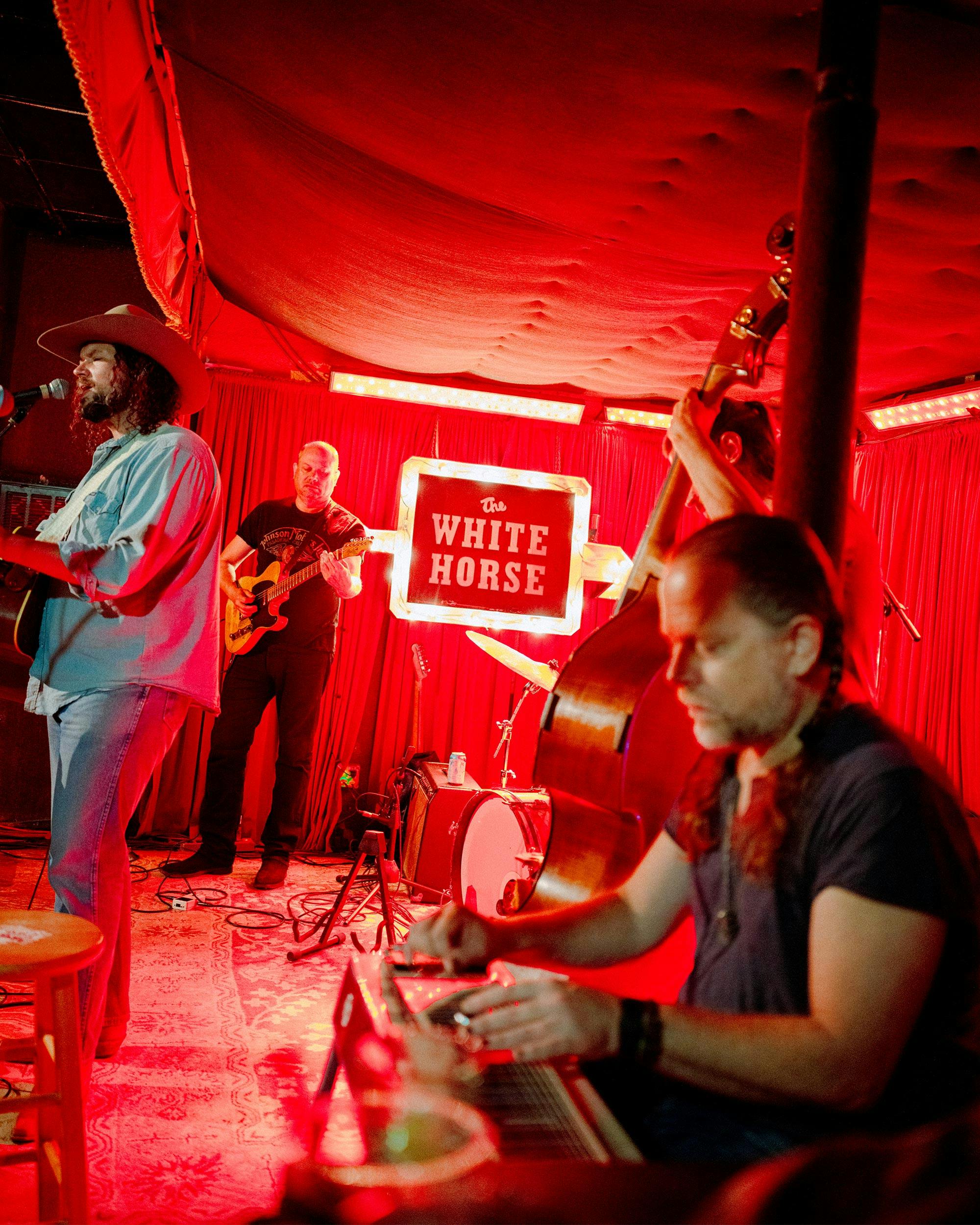 Live music at the White Horse.Photograph by Chad Wadsworth
Pop country wasn’t new, but the nineties were a golden age for the lacquered sound that flowed out of Nashville in Brooks’s wake. O’Donnell bemoaned how a genre that had “always been about the human condition” and focused on themes like “being broke, going to prison, murder” was pushed aside in favor of a less poetic, more marketable pop sound. The typical Hole in the Wall crowd “didn’t like that s—,” he said. “And you can’t dance to it.”
Generations later, the post-Brooks style is alive and well at Austin’s country nightclubs. “What’s really weird is that the rural parts of Texas really attached to that music,” O’Donnell said, adding that the crowd at Maverick’s is made up of “the descendants of the original honky-tonk people, the rednecks in the forties and fifties who listened to Hank Williams.”
Yet it’s easier to imagine a Hank fan from that era feeling more at ease two-stepping to what I’ll call new-roots music in the dark at Sagebrush or Sam’s Town Point rather than under the disco lights of a nightclub. Honky-tonk bands regularly play innovative covers of Hank’s music; you won’t likely hear a DJ queue up “Long Gone Lonesome Blues” at Maverick’s.
That sign at White Horse doesn’t signal a prohibition. There’s nothing to prohibit; no musician booked there plays line dancing songs. It’s a heads-up.
While Nashville chasséd into the new millennium, the Hole in the Wall incubated bands interested in two things: tinkering with roots music and getting butts out of seats.
I recently visited the Hole with Tate Mayeux. He’s 37, one half of the singer-songwriter duo Mayeux & Broussard, and, as I’ve heard him described, “the mayor of Austin country music.” With shaggy curls, jeans, and boots, he’s the picture of a cosmic cowboy. He gestured around the bar. “This is where what we now call the dance scene began.” He came in from San Marcos to Austin in the mid-aughts “so I could see Mike and the Moonpies and the Carper Family,” he said. “That was the very first time I saw what I consider the dancing crowd. It wasn’t Meemaw and Pops at the Broken Spoke. The present-day honky-tonk scene started with what we called drag rats, the guys and girls with rattails who worked as pedicab drivers.”
O’Donnell was booking shows at the Hole by then and noticed a community of regulars beginning to coalesce around local acts like the Moonpies, Jonathan Terrell, and Shakey Graves, who played a millennial take on traditional music. “They didn’t quite fit with other country venues. They weren’t getting gigs at the Spoke,” O’Donnell said. What they were getting was a loyal following. It started small, he recalled, with maybe a dozen dancers. But it grew over a few years to maybe a hundred or so. “It became this hot, sweaty, exciting scene. Everybody knew the words to their songs. Their original songs. They’re shouting it right back at the band while they shuffle and spin.”
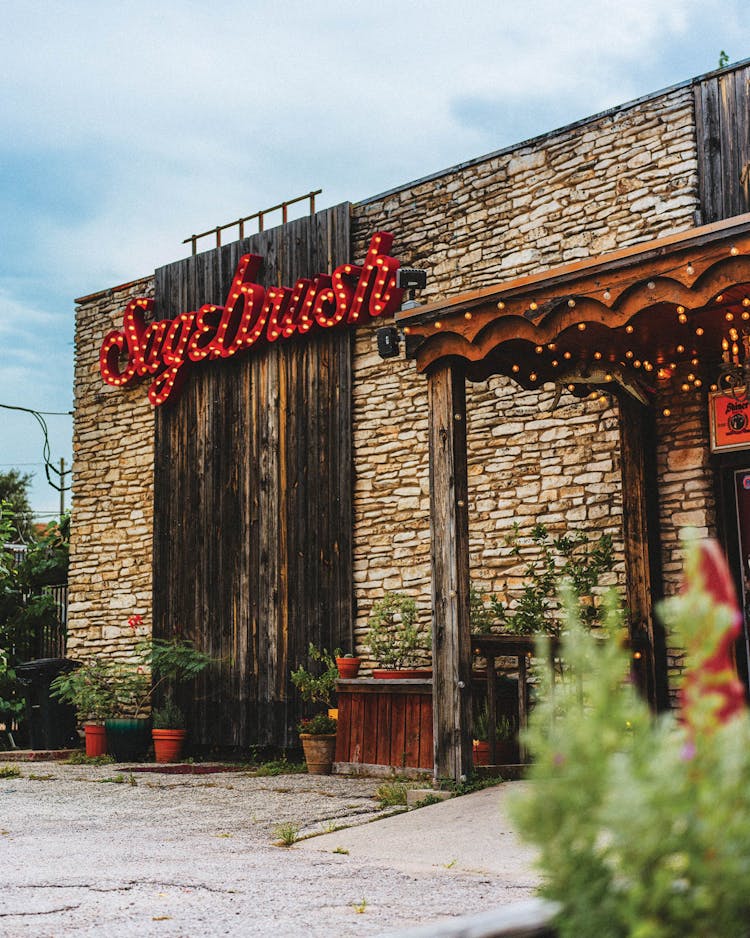 Sagebrush, in South Austin. Photograph by Chad Wadsworth
 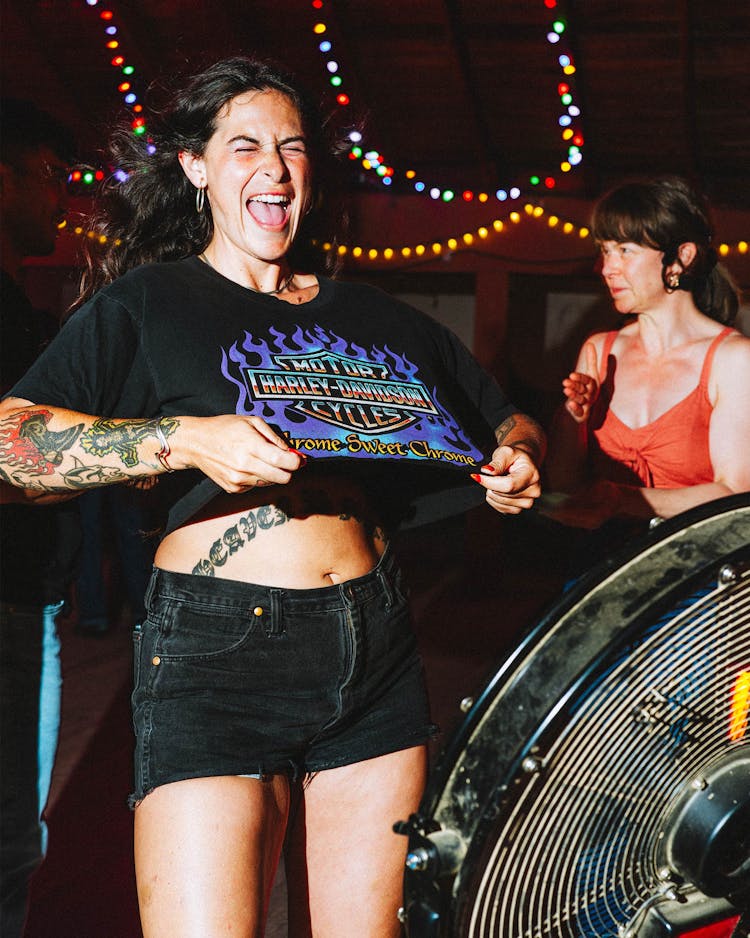 Cooling off during two-step lessons at Sagebrush. Photograph by Chad Wadsworth
O’Donnell sensed an opportunity, and he and some partners opened the White Horse in December 2011. “The first night, the Dallas singer-songwriter Roger Wallace was playing, and we’re jammed full of people,” O’Donnell recalled. “There’s kids in the skinny-rocker jeans and punk rockers and black Motörhead shirts and jean jackets, and everybody’s two-stepping.”
Once Sagebrush opened, in 2020, honky-tonkers had two homes in Austin just miles from each other, making it easy to—if I may coin a phrase—honky-hop. It’s commonplace among the obsessed to start the night in one of the joints with a 9 p.m. band and perform a last dip to the midnight headliner at the other.
But the scene became a damn scene thanks to a sweet-natured Austin native named Vanessa Vaught, founder of Double or Nothing Two-Step, the city’s most popular provider of country-dance lessons. Vaught had been dancing since she was young but began teaching after hanging out at White Horse in its early years. “We’d go over there, and it looked really cool to me how these people were dancing,” she said. “It wasn’t the traditional Texas two-step.” They were dancing in place, swaying closely, rhythmically combining spins and wraps and dips.
During the pandemic, Vaught secured a residency at Sagebrush before it reopened, and she began producing Instagram reels that featured
step-by-step instructions for new spin-and-dip combinations. When the shutdowns lifted, “we were the first ones out of the gate,” she said. Eighty people came to her first lesson, in March 2021.
Vaught also started posting daily lineups for honky-tonks so that regulars could follow bands around town. The feed became essential for the community. And her company became not just the center of the scene but its growth engine. By providing lessons at venues before bands played, she gave newbies a chance to show up alone, meet other beginners, and then cut a rug to live music all in one night. Vaught estimates that over the past four years between forty and fifty thousand people have taken a Double or Nothing lesson.
By organizing an army of cover-paying obsessives, Vaught has juiced a live-music economy that supports local artists like Hayden Butler, a 35-year-old Austin native who’s gone from experimenting with small acoustic sets to booking the coveted 8 and 10 p.m. slots at honky-tonks around town. “Playing country-dance music pays my rent,” he said.
To the memory and knowledge of every longtime Austin musician and dancer I’ve asked, there have never been more dancers and dancing opportunities in the city’s history. With Austin and its honky-tonks in the spotlight, musicians like singer-songwriter Paige Plaisance are gaining wider exposure and getting new shots at touring. She was recently invited to perform at Gottscheer Hall, in Queens, New York, where dancers told her that they’d seen her in Austin. “They were like, ‘We saw you play at White Horse, and we came to your show,’ ” she told me.
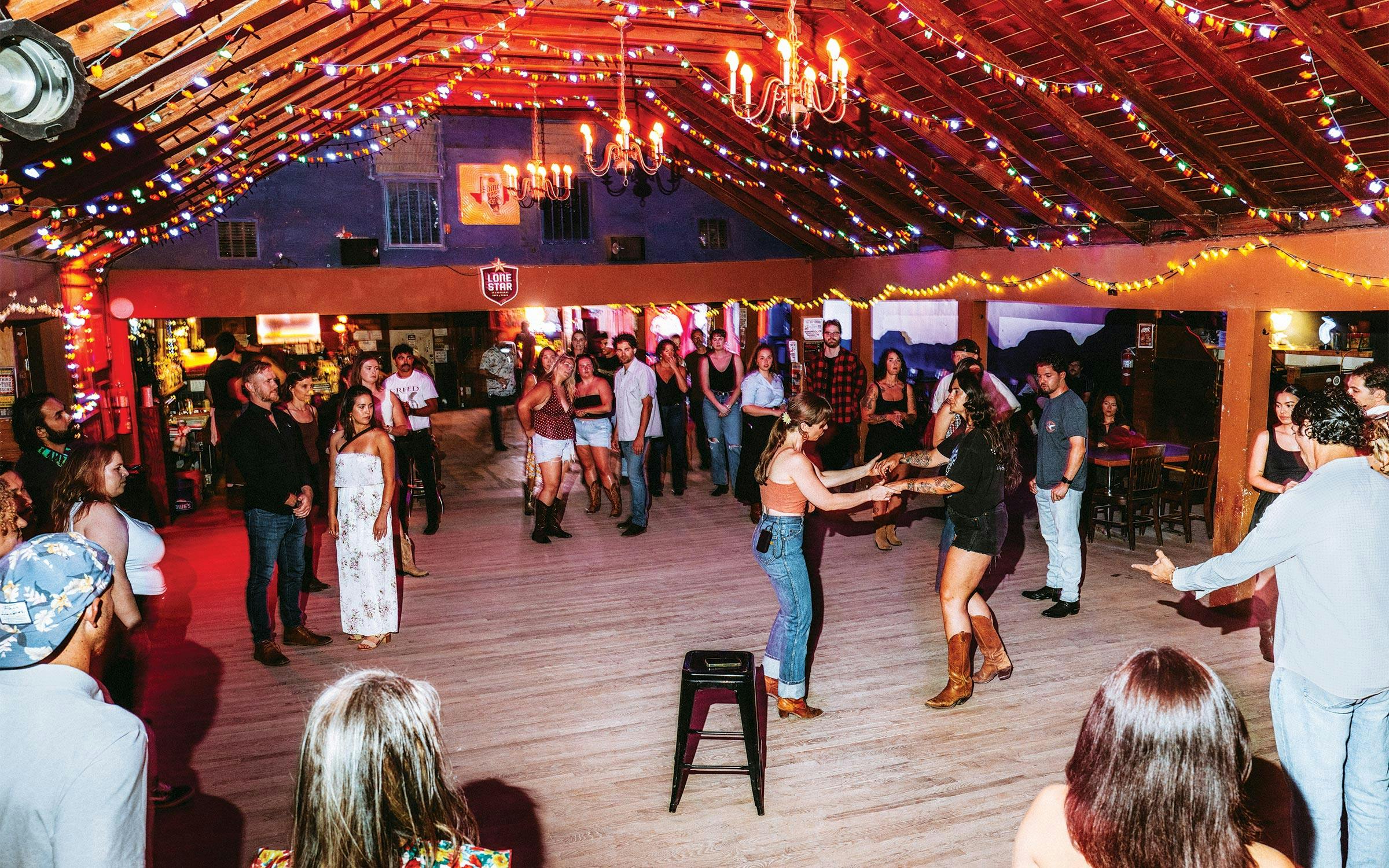 Double or Nothing Two-Step founder Vanessa Vaught giving lessons on a recent Friday night.Photograph by Chad Wadsworth
At honky-tonks that have sprouted in cities across the country, bookers hoping to draw crowds are “definitely looking to Austin,” said Aaron McDonnell, a popular honky-tonk singer who’s performed in Baltimore, Chicago, Philadelphia, and Seattle for audiences that included people who first saw him in Austin.
There are honky-tonks all over Texas, but the Austin scene is unique. San Antonio has the Lonesome Rose, in the Tobin Hill neighborhood, but it’s open for dancing only a few nights a week. Houston also has dance halls and honky-tonks—Tuesdays at the Big Top Lounge, in Montrose, attract a group of regulars—but they’re spread out across the city, which makes it tough to honky-hop. Likewise in Dallas and Fort Worth: There are honky-tonks but not an organized group of locals who reliably fill the floors.
Hearing about the throngs of two-steppers who are creating opportunities for musicians has O’Donnell thinking of grand possibilities. “The dancers in Austin may very well save country music from the three-decade onslaught of Nashville pop and bro country,” he said. “People want to dance to our music. I’m hoping this passion for dancing and real music can teach America a way to party and love each other.” What a powerful antidote to our lonely, alienated times that would be.
On a cold Tuesday night in February 2024, I was going, as usual, to White Horse. I’d come a long way since my first visit. I wore my boots and a pearl-snap shirt with sleeves short enough to show off a new tattoo. A couple of months earlier, on a late-night drive back to Georgetown, I’d realized that Austin was my home after all. I belonged to a community that was part of its fabric. Living outside it had become a barrier to turning acquaintances into friendships—and to love too. Around the same time that I moved back, I realized that I was ready for a new relationship. I knew where I’d eventually find it. Two-stepping proved a better filter than any dating app could provide. I was sure a woman I could love would show up at a honky-tonk.
I saw her as soon as I walked in: a chestnut-haired, green-eyed beauty in boots, jean shorts, and a black one-shoulder top. I asked her to dance. She told me her name was Aly. My life was about to change again.
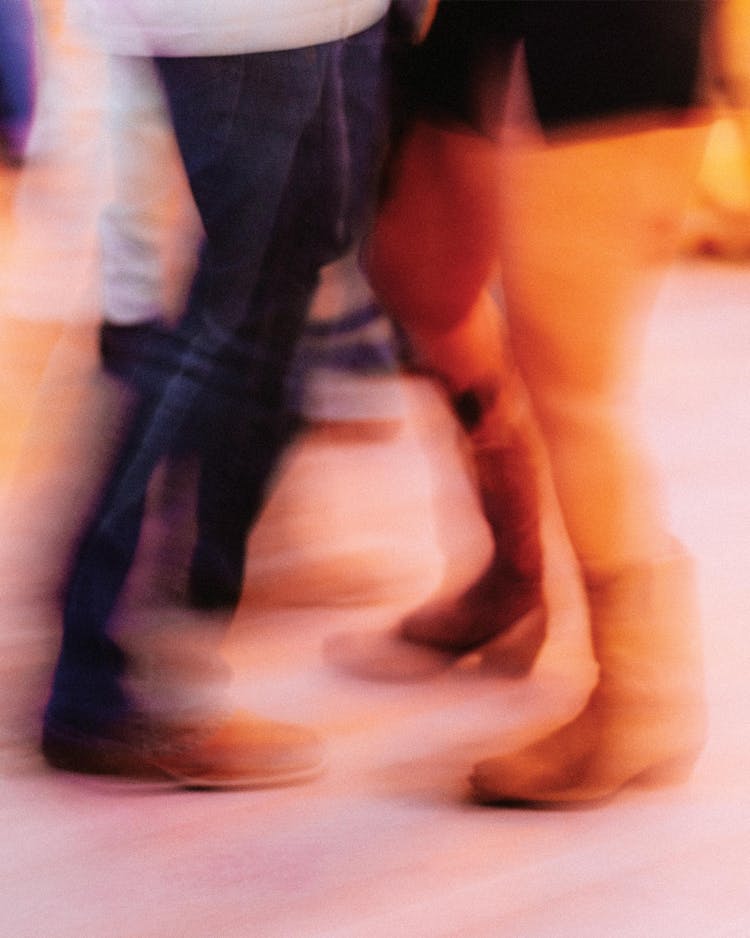 Dancers scooting on Sagebrush’s vintage oak dance floor. Photograph by Chad Wadsworth
 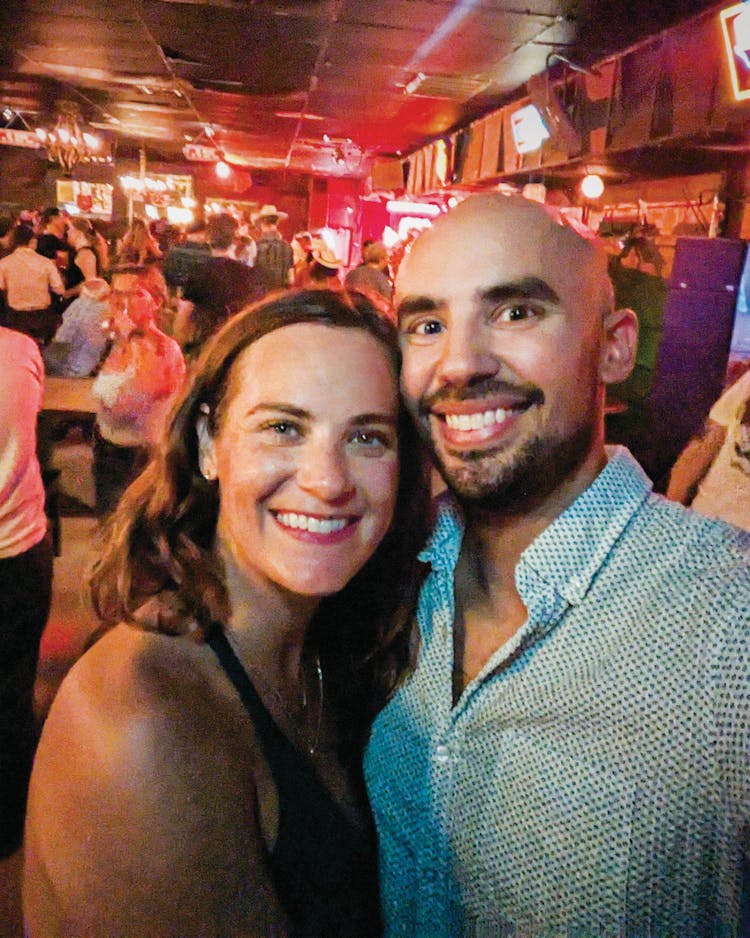 Author Josh Alvarez and his wife, Aly Nielsen. Courtesy of Josh Alvarez
Left: Dancers scooting on Sagebrush’s vintage oak dance floor. Photograph by Chad Wadsworth
Top: Author Josh Alvarez and his wife, Aly Nielsen. Courtesy of Josh Alvarez
I’m sure that Texas is my home now, and it’s thanks to dancing. But I’m not going out honky-tonking as much as I used to. I no longer call myself a regular. Aly and I got together not long after our first twirl, and many of our dates involved two-stepping. But my six nights a week gradually dwindled as we brought our lives together. Last spring I asked her to marry me on her back porch, which I’d converted into a candlelit “mini-tonk” for us to dance on.
We planned on enjoying our engagement for a year before running off somewhere to exchange vows. But two months later we found out we were going to be parents. The past year has been a blur. We eloped to Europe in June, and then a rapid series of celebrations, showers, and doctor’s appointments followed. We still carved out time to go dancing as Aly’s belly grew. We welcomed our daughter on New Year’s Eve, and displayed on a floating shelf near her crib is a tiny pair of white leather boots, hers to wear when it’s time for us to teach her to dance.
On a recent Tuesday, Aly and I went back to where it all began—for me and for us. I looked around the dance floor, but I didn’t recognize anyone. Maybe the regulars I knew had migrated to a different night or other honky-tonks. Or maybe I was among a new cohort whose turn it was to surrender to joy, to love, to keeping this thing alive. To feeling, as I did, that they are exactly where they’re supposed to be.
This article originally appeared in the August 2026 issue of Texas Monthly with the headline “Head Over Heels.” Subscribe today.
Read Next