
Imagine putting together a 1,000-piece jigsaw puzzle featuring the image of a famous artwork—DaVinci’s “Mona Lisa” or Renoir’s “Luncheon of the Boating Party.” There is a moment of satisfaction and excitement—you’ve finished the dang thing! But then what’s to be done with it? After weighing what a frame would cost, most of us will break it into pieces, return the pieces to the box, and put it on a shelf to gather dust, telling ourselves that someday our grandkids might get bored enough…. There’s nothing wrong with decoration, but it’s not like having the real thing or even a print from a Paris vacation’s visit to the Louvre.
“The Girl on the Train,” the Alley Theatre’s current Summer Chills production, is such a jigsaw: a psychological mystery that has a lot going for it and is sure to elicit hearty applause but ultimately lacks substance—something to frame and hang on the wall of your theatre memories. The Texas phrase is “all hat, no cattle.”
Admittedly, this is a high standard by which to measure a thriller, a genre that has, at least since Doyle dreamed up Sherlock Holmes and Watson, been asked to display elements, even phrases, that are listable before the first corpse falls. But the Alley showed in their staging of “Misery” earlier this summer that such an achievement is possible. The difference between the two productions is not in the quality of either source work. Paula Hawkin’s novel from which this play is adapted is a taut, gripping fiction; this production elects to intercut its suspense and tension with splashes of comic irony that momentary shifts the play from a thriller to a parody—not an unforgivable summer sin but a disruptive force.
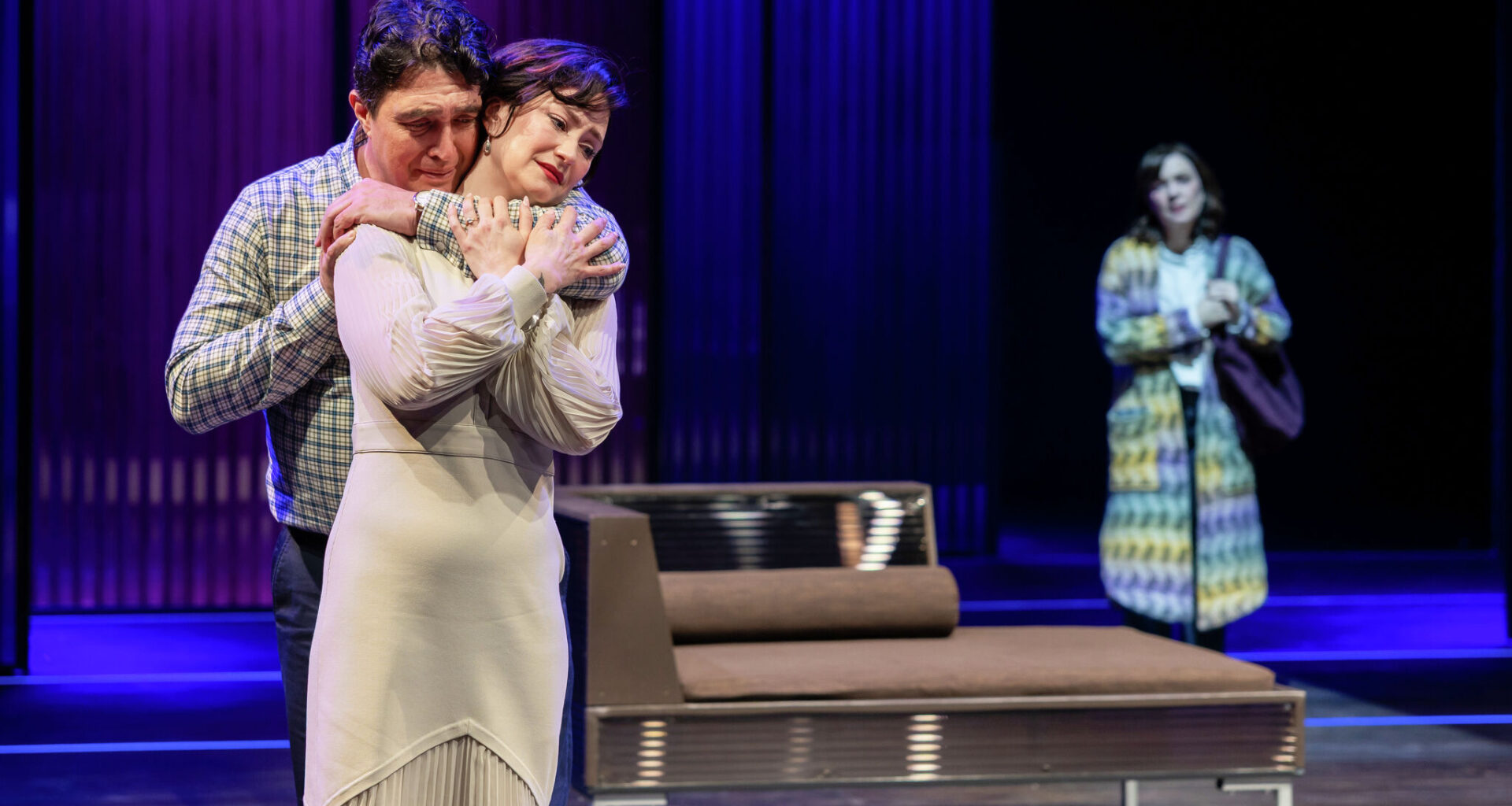
Nevertheless, this production has much to admire—particularly its technical prowess. Klara Zieglerova’s scenic design meshes with Yee Eun Nam’s projection design to bring alive on the stage not just furnished rooms that, with simplicity roll onto or rise from below to create normal living spaces but also moving London suburb trains and platforms that are key to the storyline. Moreover, the use of framing lights to create a boxing effect suggests both the borders of a jigsaw puzzle and the claustrophobic world in which the characters seek to connect missing pieces. With clock-like precision these devices keep the play moving at a fast pace that mirrors the characters’ struggle for time to understand their situations—especially the plight of Rachel Watson, a woman whose divorce has plunged her into alcohol abuse and unemployment, reducing her days to taking the train to London as if she still worked there. It’s on the train that she fascinated by a couple she sees on a platform as her train passes: a loving, seemingly happy pair until Rachel spies the woman kissing a different man. When that woman goes missing, Rachel is both compelled to find her and seen by the police as possibly the woman’s killer.
As played by Alley veteran Elizabeth Bunch, Rachel is a wondrously complex person. Her mind becomes the puzzle whose blank spaces she and the audience must fill with oddly shaped pieces of information haphazardly found. For all Rachel’s flaws, Bunch makes the audience root for her; she is in disarray yet determined to make sense of her experience.
Other performers give equally sharp creations, particularly Chris Hutchison as Tom, Rachel’s ex-husband, Christopher Salazar as the missing woman’s therapist and possible lover, and Dylan Godwin as the missing woman’s husband. But the script gives only Hutchison much development. The other characters, especially the police detective Gaskill played by David Rainey and the missing woman (Megan Hipwell played by Emily Neves) who appears in flashbacks, sidetrack the plot into moments of laughter or remain undeveloped enigmas.
Director Casey Stangl has a great sense of pacing and movement on the stage; she keeps our eyes stretching to take everything in. But she struggles to bring coherence to Rachel Wagstaff’s and Duncan Abel’s adapted script. Only in the climactic scene does a sense of chill rule the stage for this thriller—a wonderfully realized scene but one connected to the whole only by thin plotlines. There is little sense of tension being consistently built.
“The Girl on the Train” has a lot of potential to set the audience chewing its collective fingernails, and the Alley’s team has the talent to bring that chill to life. But this production, for all its exciting technical achievements, leaves a clear, straightforward sense of threat waiting at the station.
Robert Donahoo, Sam Houston State University. “The Girl on the Train” runs on the Alley’s main stage through August 30.