
Jim Duncan is on a roll! For more than a year, we’ve adapted this retired city planner’s sterling research and reporting about Austin businesses. Yet his series on Tex-Mex restaurants has struck the deepest chord in this city where Mexican food is revered. This week, we examine four more such histories, in anticipation of a Tex-Mex bonanza package during Hispanic Heritage Month.

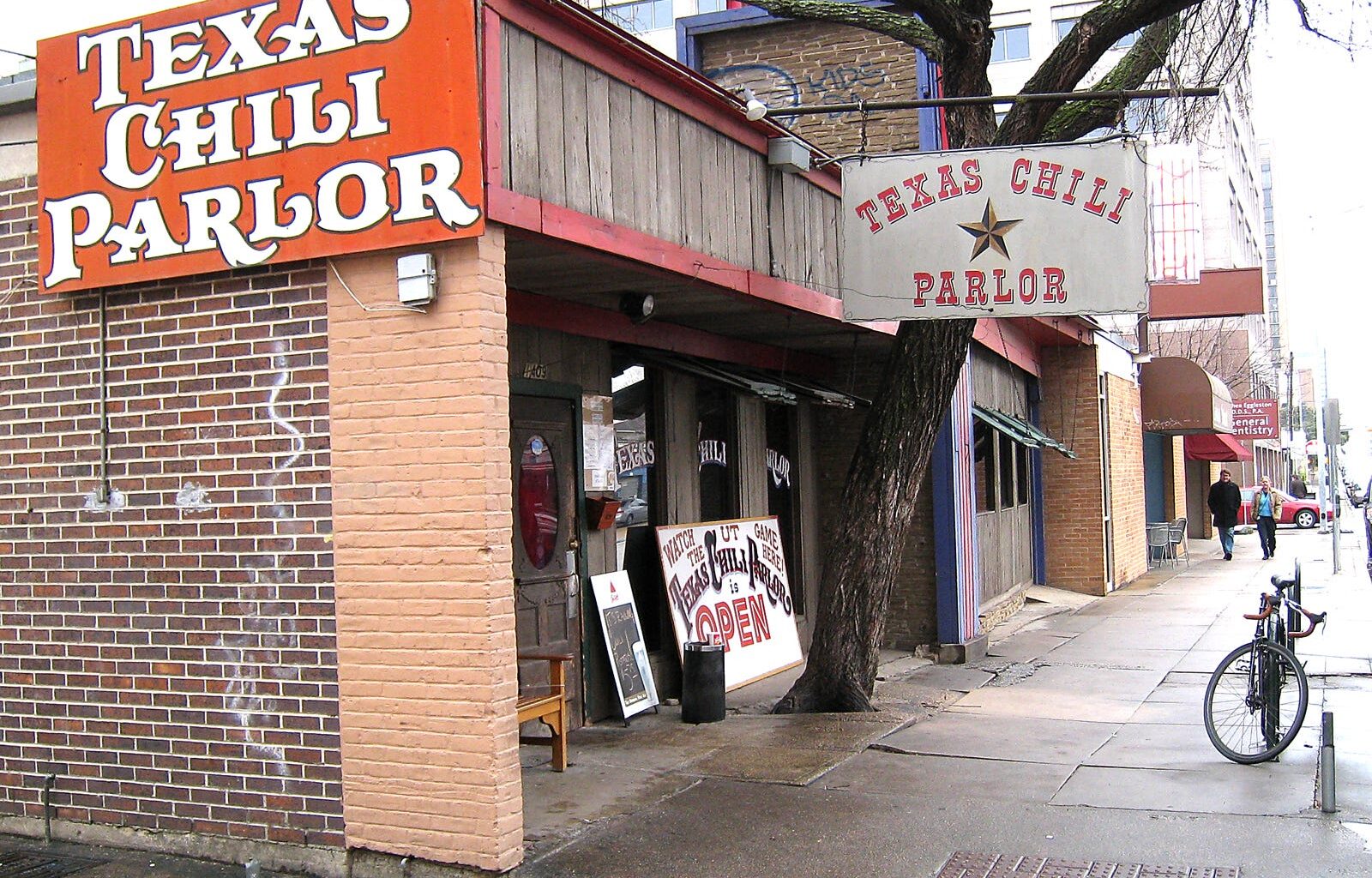
1976: Texas Chili Parlor
The Texas Chili Parlor is an iconic dive bar braced with chili.
AMERICAN-STATESMAN FILE
Specializing in chili con carne, an indispensable part of Tex-Mex food, the Texas Chili Parlor opened in 1976. Its founder, George Evans Lovett, had previously invented Undertakers Chili, won the Howdy Roo Chili Cook-off, and received a city variance for 14 parking spaces.
Article continues below this ad
That same year, chili was named the official state dish by the Texas Legislature.
Later purchased by Thomas Chase and his wife, Margaret, the Parlor was shuttered in 2002 due to $36,000 in unpaid taxes. Regular Scott Dunlap “Zoob” Zublin paid off the debt and assumed ownership.
The air in the Parlor is filled with the smell of chili and booze, and the décor is a mishmash of neon signs, old photos and an obligatory list of dive-bar rules. While enchiladas, tacos, tamales and burgers are available, chili is the most popular menu item.
When ordering chili, the main thing to know is the heat level (mild, medium or hot) and bowl size (taster, small or large).
Article continues below this ad
Among early patrons was a group of local literary luminaries known as the “Mad Dogs,” led by Gary Cartwright. In their honor, the Parlor serves “Mad Dog Margaritas.”
Guy Clark immortalized the drink on his album “Dublin Blues” with the lyric: “I wish I was in Austin in the Chili Parlor Bar / drinking Mad Dog Margaritas and not caring where you are.”
The Parlor was also the setting for Quentin Tarantino’s “Death Proof,” starring Kurt Russell. Lovett died in 2012 and Zublin in 2025.
1983: La Palapa
Founded in Nuevo Laredo in 1971, La Palapa opened in Austin in 1983.
American-Statesman File
La Palapa is unique in that the restaurant, as well as its founder, immigrated to Austin from Mexico. After its founding in the border town of Nuevo Laredo in 1971, La Palapa opened its second eatery in Austin in 1983. A third opened in Laredo in 1998.
Article continues below this ad
In both name and design, the restaurant mimics the huts called palapas found in the fishing villages of southern Mexico, which have thatched roofs made of dried palm leaves.
Located in North Austin at 6640 E. U.S 290, La Palapa has a high interior ceiling that emulates the feel and look of a palapa.
Since it opened, its menu has expanded to include a variety of Tex-Mex favorites, including flaming queso with chorizo. It also offers a huge hamburger inspired by the owner’s love for burgers.
David Allen Mallak joined La Palapa as a managing partner in 1990, and he and his wife Debra purchased the restaurant in 1995. In 2017, La Palapa was acquired by Jearl Dean Ledbetter, the owner of the Short Stop burger chain. Mallak died in 2016 and Ledbetter in 2026.
Article continues below this ad
1984: Fiesta Tortilla Factory
Elvira and Jaime Picos are the founders and owners of Fiesta Tortillas. Their children, from left, Luis Picos, A.J. Picos and Natalia Picos, are involved in the family business.
Jay Janner, Jay Janner / American-Statesman
Fiesta Tortillas produces 2 million corn tortillas and 500,000 flour tortillas each day and serves restaurants and grocery stores throughout the Greater Austin area.
In 1984, Jaime A. Picos and his wife, Elvira, occupied a small space on Briarcliff in East Austin and borrowed machinery from relatives to start their tortilla factory. Their mission was to produce five-ingredient flour tortillas without additives or preservatives.
Article continues below this ad
Jaime’s parents had owned a small tortilla factory in Del Rio, where they mastered the handmade flour recipe. The couple delivered fresh, warm, soft tortillas to grocery stores nearly every day, which eliminated the need for extended shelf life. In 2001, they moved into a new factory at 3800 Promontory Point in Northeast Austin, where they could expand production to serve customers in San Antonio.
Today, they employ more than 100 people and serve clients as far away as New York, where a taco stand wanting “the authentic stuff” pays for Fiesta to fly tortillas overnight to them.
Four more stories in this series
Austin Tex-Mex history: Taco Flats, Las Palomas and Tony’s Tortillas
Article continues below this ad
Austin Tex-Mex history: Güero’s, Mr. Natural and Camino Real have served for decades
Austin Tex-Mex history: Juan in a Million, Manuel’s and other local staples
Austin Tex-Mex history: El Matamoros, Maudie’s, El Arroyo and more
Article continues below this ad
Please send tips and questions to mbarnes@statesman.com