
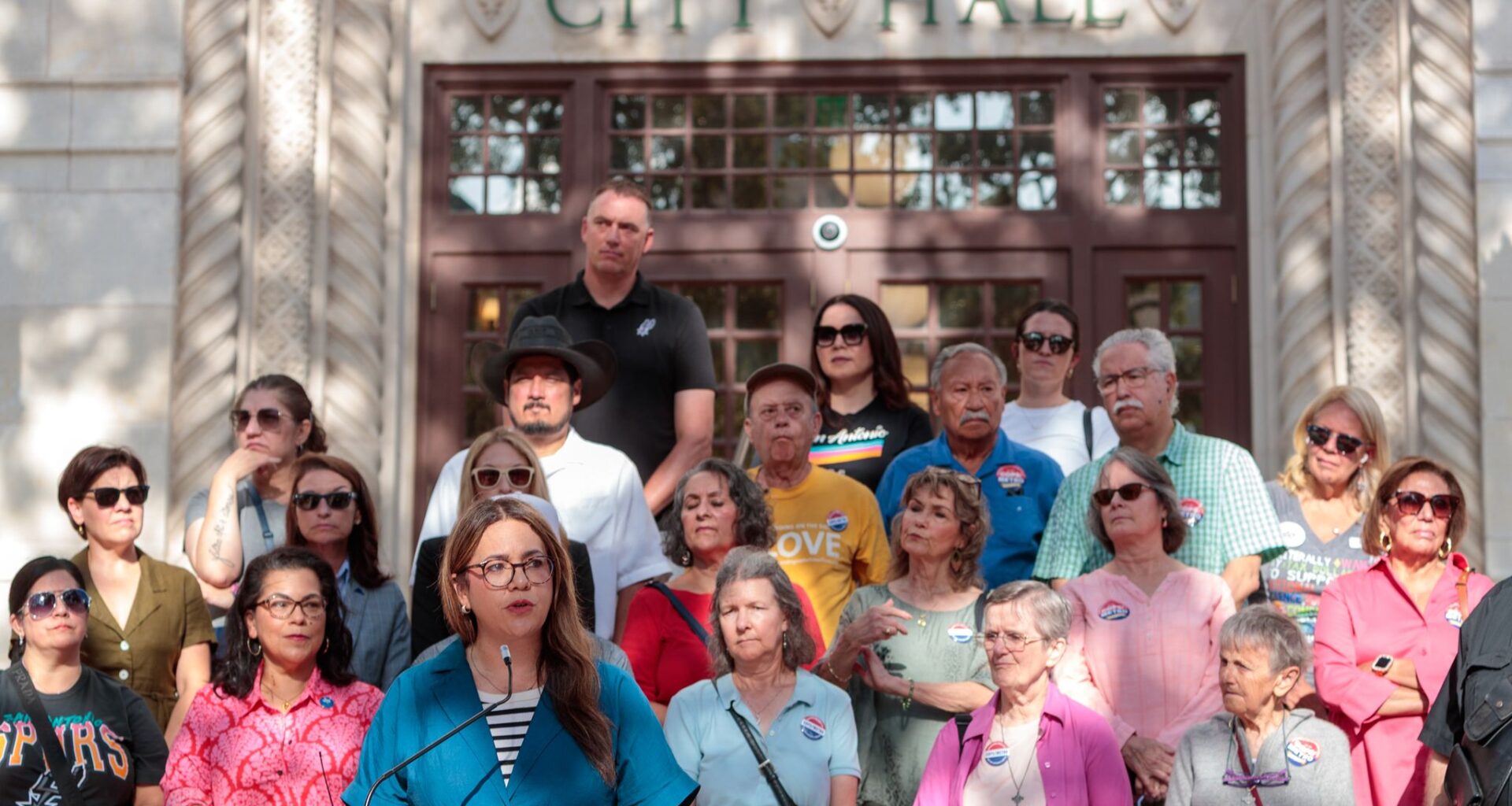
City Council members, chambers of commerce leaders and COPS/Metro Alliance organizers are slamming Mayor Gina Ortiz Jones for trying to put the city’s proposed contribution to a new Spurs arena and the redirection of job-training dollars to a public vote in November.

At a press conference Friday at City Hall, they said San Antonio voters have already approved the Ready to Work initiative and the city’s plan to help finance the $1.3 billion arena, and that new elections aren’t necessary.
A stark fiscal reality looms in the background of the fight over the Nov. 3 ballot: the city is facing a $158 million budget deficit over the next two years — which Jones has cited as a reason to put redirecting Ready to Work dollars and public funding for the arena to a citywide vote.
Article continues below this ad
“The city manager working with our City Council and our mayor, they can close this gap, and not a single penny is needed to be removed from Ready to Work,” said Father Jimmy Drennan, pastor of St. Margaret Mary Catholic Church and a leader with COPS/Metro, one of San Antonio’s oldest community activist groups.
Southeast Side Councilwoman Phyllis Viagran said Jones’ efforts are based on “misconceptions about funding sources,” while North Side Councilwoman Ivalis Meza Gonzalez said spending public funds on more elections would be wasteful.
Some 52% of voters approved Bexar County’s $311 million contribution to the arena last year, and 77% of voters in 2020 OK’d devoting city sales taxes to Ready to Work for a four-year period.
Councilwoman Sukh Kaur said council members are sparring about “the democratic process” rather than focusing on making difficult decisions about budget cuts. City Council is scheduled to adopt next year’s budget on Sept. 17.
Article continues below this ad
“I trust that my residents understood when they went to the ballot box what they were voting for,” said Kaur, who represents downtown and parts of the North Side.
Jones disagrees. She’s seeking a special council meeting to vote on placing measures on the November ballot asking voters whether the city should issue up to $489 million in bonds to finance the arena and divert remaining Ready to Work funds to “qualified projects,” which her office has yet to define.
District 8 Councilwoman Ivalis Meza Gonzalez, flanked by other City Council members, representatives from business groups and COPS/Metro Alliance and Spurs Sports & Entertainment employees, held a press conference Friday in front of City Hall.
Blaine Young/For the Express-News
But Jones doesn’t appear to have the support of a council majority. She’s trying to pressure her colleagues by persuading residents to back her proposals and urge their council representatives to side with her. At a series of “listening sessions,” Jones is making her case for why voters should have a say on city funding for a Spurs arena.
Article continues below this ad
“I don’t think anyone should be afraid of city voters weighing in on their money,” Jones told people who attended the first session Thursday.
Under a draft financing deal a divided council approved last year, the city’s portion was tied to the county winning voters’ approval for its contribution under Proposition B — the only part of the financing requiring a public vote.
There are restrictions on how the funding sources for the city’s contribution can be used.
The city would issue bonds and repay that debt in part with property tax revenue generated by development around the arena — Spurs Sports & Entertainment has pledged to shepherd $1.4 billion worth of new projects. Rent from developers leasing city-owned property to build restaurants, bars, hotel rooms and housing would be another source of repayment.
Article continues below this ad
Rent from the Spurs’ lease of the arena and Texas’ share of hotel taxes would also back the bonds. The state hotel states are limited to the construction and renovation of projects that support tourism and related infrastructure.
Ready to Work is funded by sales tax the city collected from December 2021 to December 2025. The job-training program has struggled to meet enrollment and job placement targets since it launched in 2022 with the aim of helping unemployed and underemployed workers earn industry-recognized certificates or bachelor’s degrees.
The city collected nearly $236 million in sales taxes for the program, and $124 million remains to be spent. Jones initially proposed using that money to plug the budget deficit, but later narrowed it to “qualified programs.”
State law strictly limits how Ready to Work dollars could be spent: on job training, early childhood development, after-school programs, college scholarships and literacy programs.
Article continues below this ad
Déjà vu
The scene outside City Hall Friday morning was similar to one that played out last August, when Jones crashed a press conference hosted by business leaders, bar owners, hoteliers and Spurs superfan “Spurs Jesus” to rally support for the draft financing plan for an arena, which was headed to the council for approval.
Jones attempted to pause approval of the plan, which was largely hashed out behind closed doors by city staff and Mayor Ron Nirenberg. She said the city should collect better data on which to base a major investment and solicit more input from residents.
But Jones couldn’t wrangle enough votes. Council members voted 7-4 to give City Manager Erik Walsh the go-ahead to negotiate the deal with the Spurs organization. Supporters said the arena — the centerpiece of a larger sports and entertainment district known as Project Marvel — would help keep the NBA team in San Antonio and revitalize downtown.
Article continues below this ad
The city’s business establishment gathered again in front of City Hall on Nov. 5, 2025, to celebrate the passage of the county funding measures for the arena and the expansion of San Antonio Stock Show & Rodeo. (Voters also OK’d Proposition A in November, providing tax dollars to upgrade the Frost Bank Center grounds and make way for year-round rodeo events.)
“I’m a little struck by the fact, and really a sense of déjà vu, because we came together, many of us, on these steps probably 10 or 11 months ago to celebrate the passage of Props A and B,” Centro CEO Trish DeBerry said Friday. “It was not to gloat about that passage, but it was to talk about the fact we knew there were different opinions on this topic, but at the end of the day, the community had spoken.”
“This was the time to move forward as uniters, and not dividers. So I am somewhat struck by the fact that we are back here again today, talking about the possibility of a second vote,” DeBerry added.
Roughly a year later, as council members are grappling with a budget shortfall, Jones is relying on the same playbook she did a year ago.
Article continues below this ad
She’s using her official social media accounts to tell residents to call or email their council member if they agree with her position that city taxpayers should have a say on the city’s arena contribution.
At the first of her listening sessions, which her office billed as a chance for her to hear from residents, she spent most of the hour-long event talking — specifically outlining why she thinks residents should be given a say on the arena at the ballot box.
“I know some folks are not supportive of that. That’s on them to explain to you why that is, why someone would be OK signing you up for $489 million but now is not going to give you a formal say in whether or not you actually want to do that,” Jones said.
Aug. 17 is the deadline to place measures on the November ballot. The council will vote on Jones’ ballot proposals during a special meeting on either Aug. 13 or Aug. 17.
Article continues below this ad
While council members have been critical of Ready to Work, many aren’t willing to kill it, especially because it has started funneling more participants into jobs and is part of officials’ pitch to companies deciding whether to relocate to San Antonio.
Jones shrugged off the reality that she doesn’t currently have the council votes to put arena funding or Ready to Work on the ballot. After Thursday’s public meeting, she told reporters she wasn’t focused on “counting votes.”
“I think this is really where the community comes in,” she said. “If the city voters want this, they have to reach out to their council member and let them know where they stand on this.”