
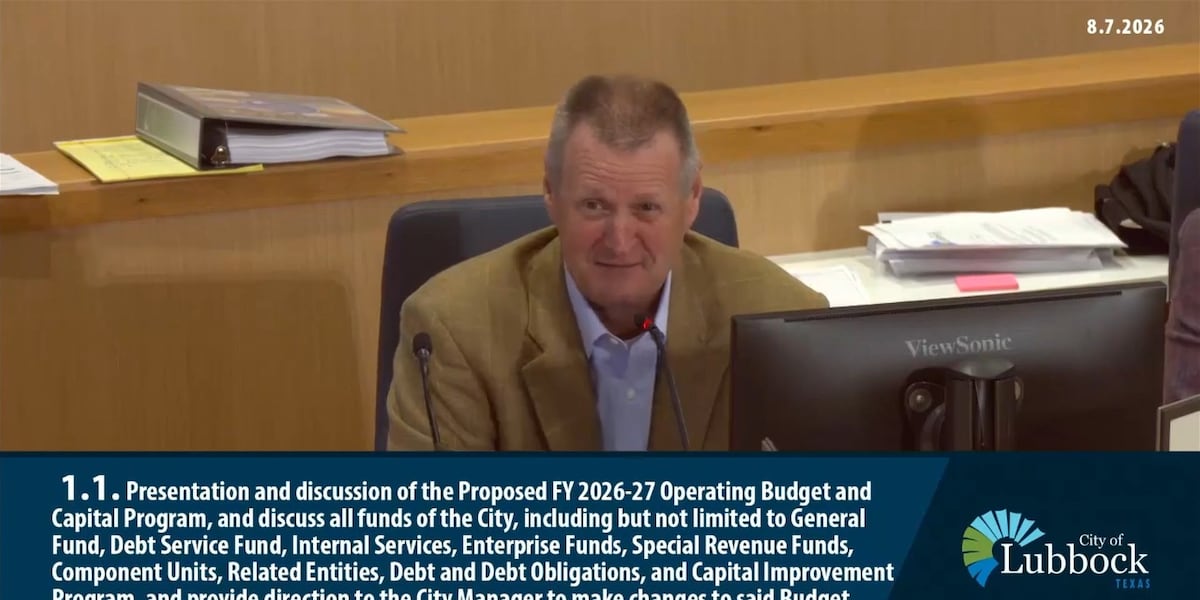
LUBBOCK, Texas (KCBD) – The Lubbock City Council continued its ongoing budget work Friday, with a session addressing employee pay, public safety costs and the city’s proposed tax rate.
RELATED AUG. 5: Lubbock City Council, staff begin budget discussions
Here are some highlights of budget priorities the council earlier presented to the city manager.
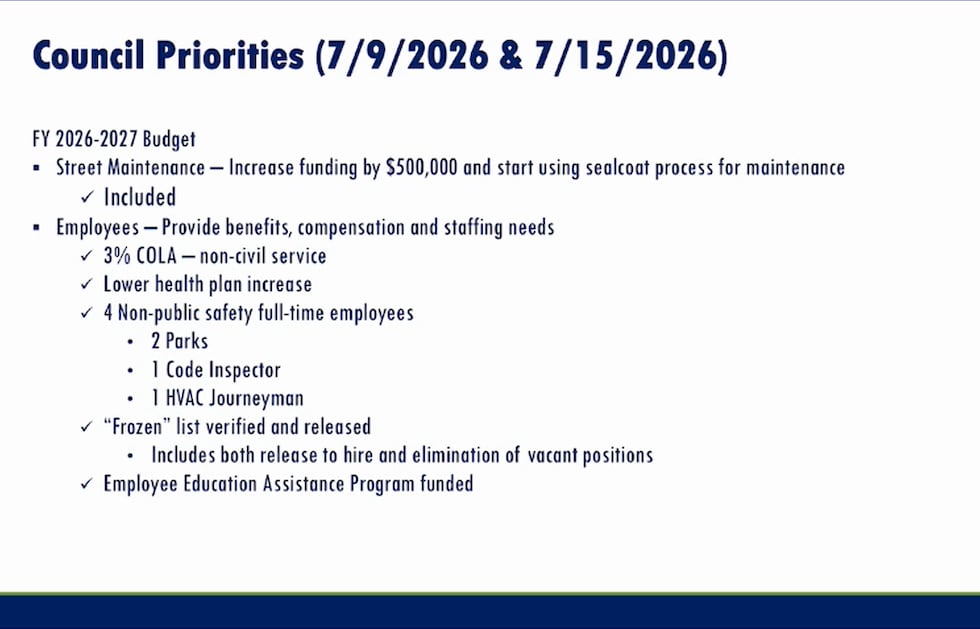 Council’s priorities, based on July meetings – City manager’s presentation Aug. 7, 2026(City of Lubbock)
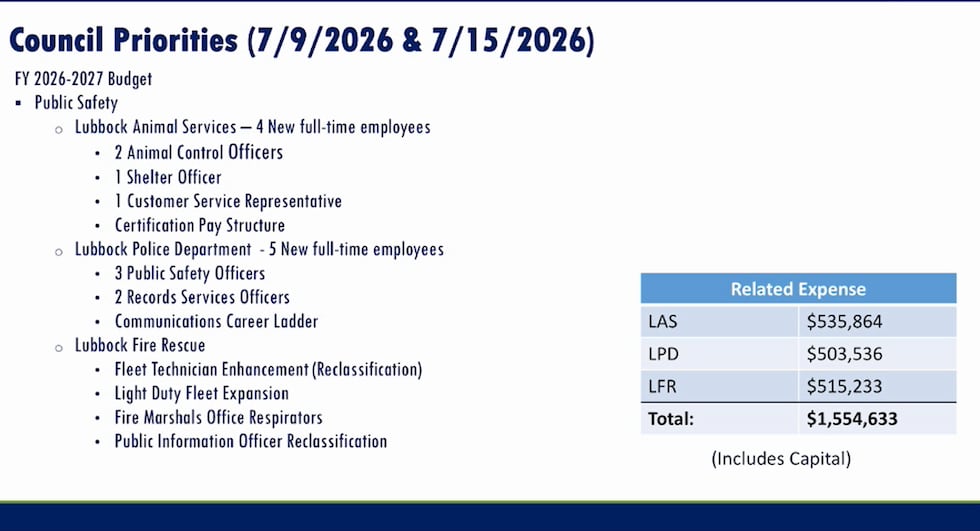 Council’s priorities, based on July meetings – City manager’s presentation Aug. 7, 2026(City of Lubbock)
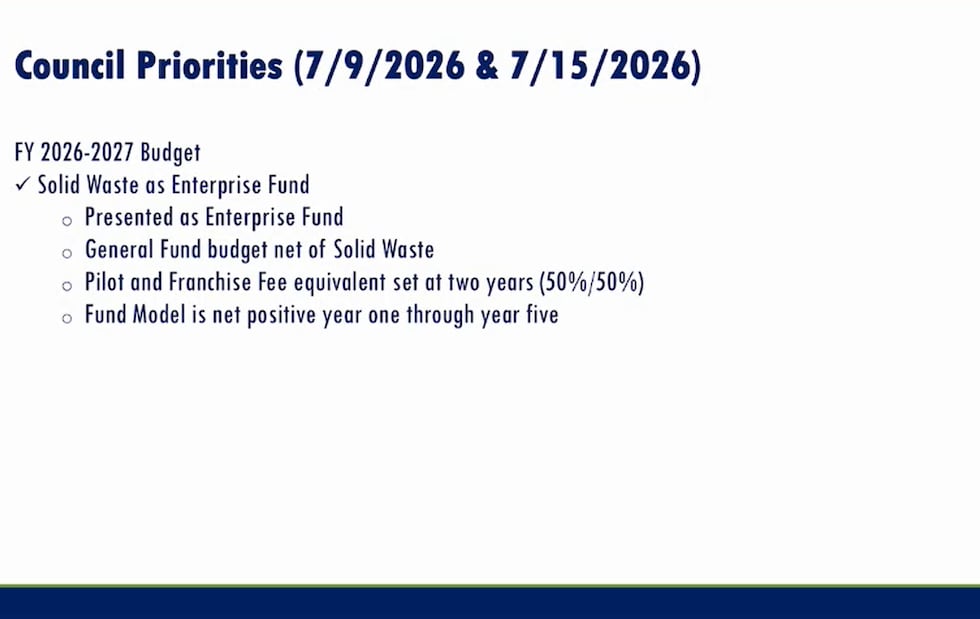 Council’s priorities, based on July meetings – City manager’s presentation Aug. 7, 2026(City of Lubbock)
City Manager Jarrett Atkinson’s budget proposal includes a 3 percent across-the-board cost-of-living adjustment, or raise, for city employees. Government data shows prices have increased more than 3.5 percent since last summer.
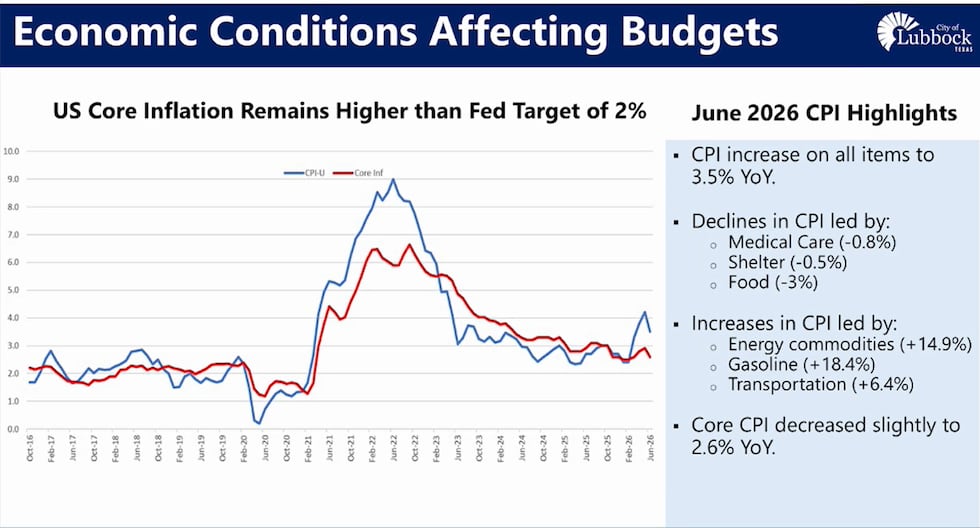 Core inflation stats – City manager’s presentation Aug. 7, 2026(City of Lubbock)
“That is three percent for everybody that is in the general fund. That is not police and fire,” Atkinson said. “If you’re a civilian employee of the city, that is the proposal, and $1.865 million is the cost.”
Proposed property tax rate
The city manager’s budget proposal includes a property tax rate of 48.1206 cents per $100 valuation. It’s important to note this does not include “meet-and-confer” agreements with the police and fire departments, detailed further below.
This is above the no-new-revenue rate of 47.5154 cents, but below the voter approval rate of 51.3447 cents.
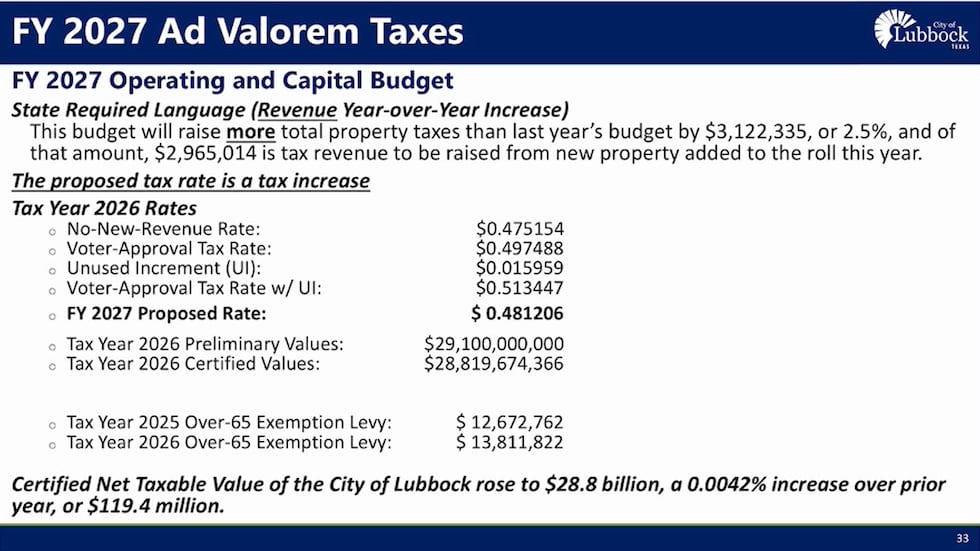 Proposed tax rate(City of Lubbock)
For the average residential home, the bill due to the city for the year would increase $43.42 under this proposal, up from $1,060.55 last year to $1,103.97 for the upcoming year. This math is shown in the graphic below; again, this does not include the additional cost of public safety meet-and-confer agreements.
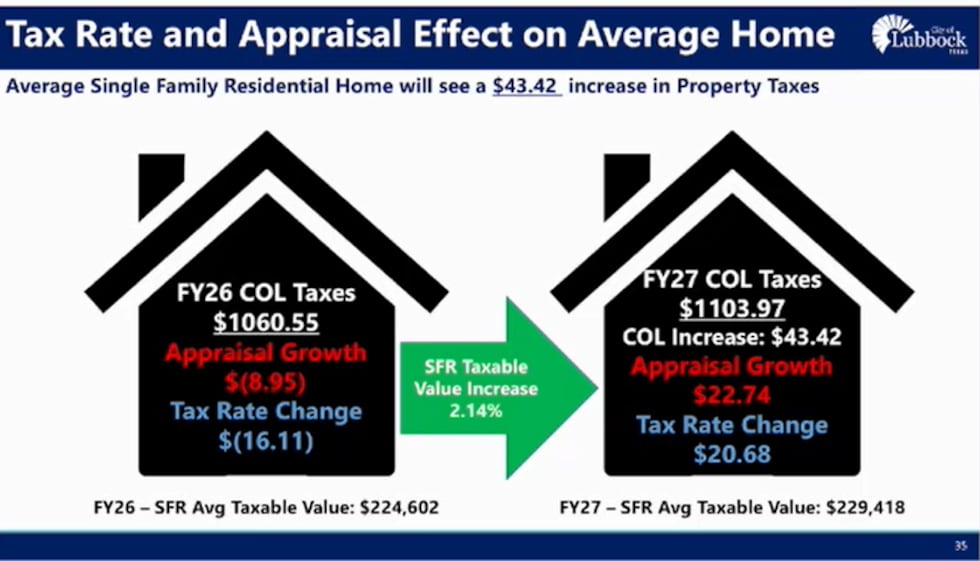 What the proposed property tax rate means for the average property – City manager’s presentation Aug. 7, 2026(City of Lubbock)
The average residential property value in the city increased about 2.1 percent, from $224,602 last year, to $229,418 this year. Atkinson emphasized there is no “average home”, this is a mathematical equation.
But this gives you an idea for how much your taxes would increase under this proposal, based on what your appraisal is compared to the average, and how much your appraisal changed from last year.
If council were to approve meet-and-confer agreements with fire and police as proposed, it would increase the property tax rate by 3.2215 cents, to 51.3421.
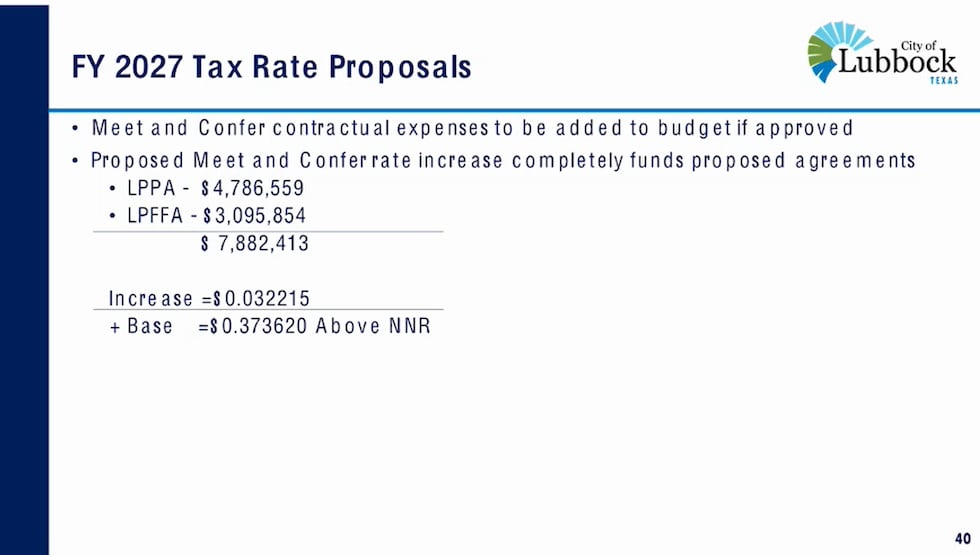 Tax rate including meet-and-confer, presentation Aug. 7, 2026.(City of Lubbock)
For the average taxable property value of $229,418, with meet-and-confer including, it would lead to a property tax bill of $1,177.88 for the year. This would be an increase of $117.33 over last year for the average property.
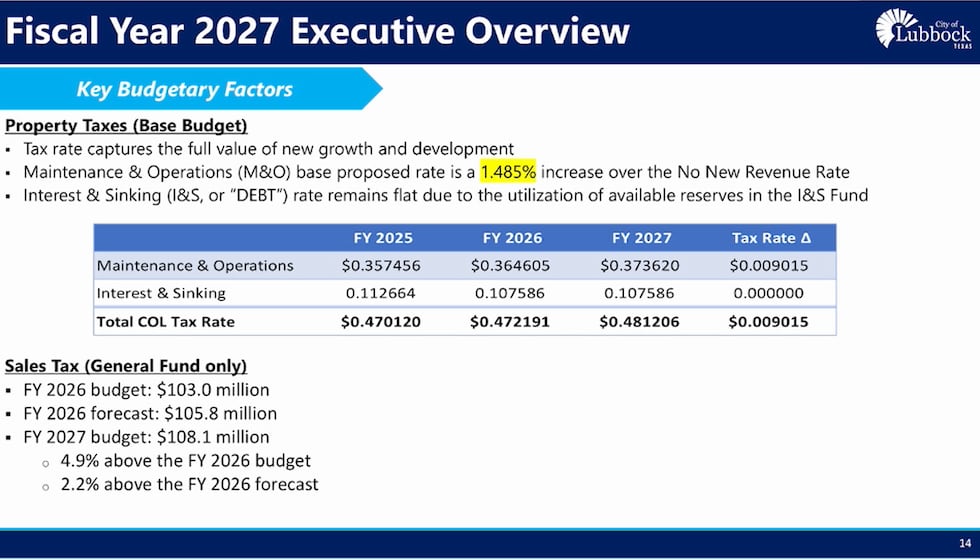 City manager’s presentation Aug. 7, 2026(City of Lubbock)Total taxable value across city
This year there is $453 million additional property value from new properties, along with $163 million gained from annexation. However, the amount of property value lost to exemptions is much more than last year; last year it was $29 million, this year $436 million.
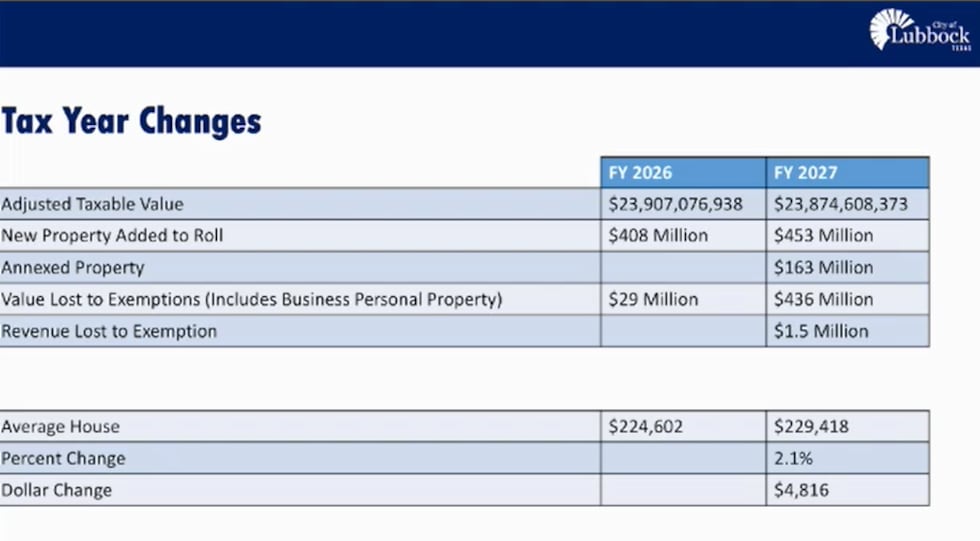 City manager’s presentation Aug. 7, 2026.(City of Lubbock)
Atkinson said most of that is the business personal property exemption. As a result, the taxable value for the entire city decreased from $23.9 billion to $23.8 billion.
“Overall in the community taxable value went up — exemptions and other losses went up enough to overcome that,” Atkinson said. The resulting revenue decrease to the city is about $1.5 million.
Below are proposed fee increases:
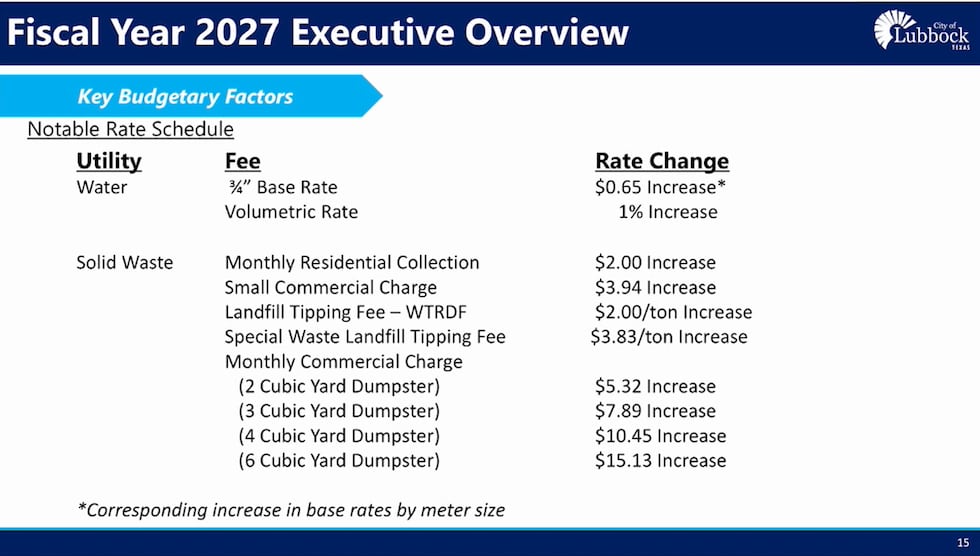 City manager’s presentation Aug. 7, 2026(City of Lubbock)
This figure shows how general fund revenues have tracked compared to five years ago.
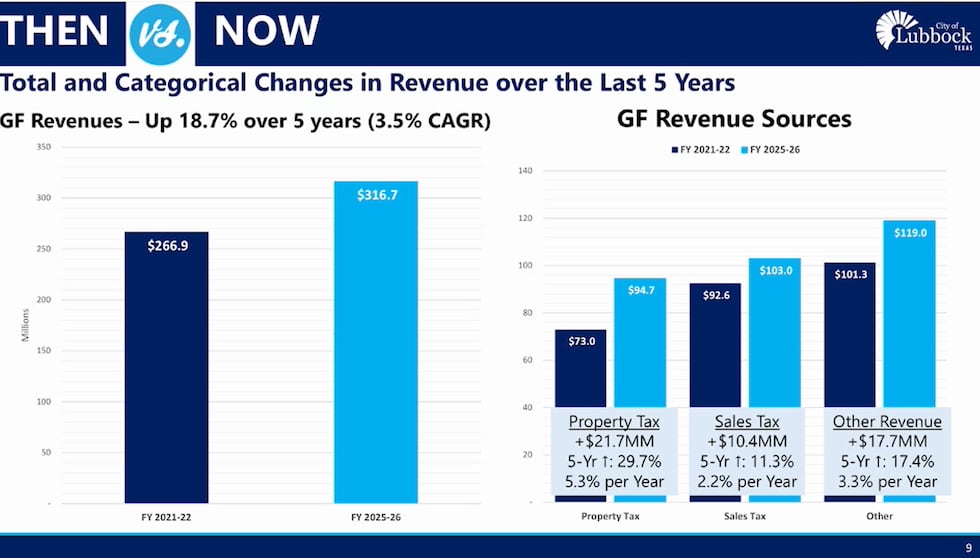 General fund trend(City of Lubbock)
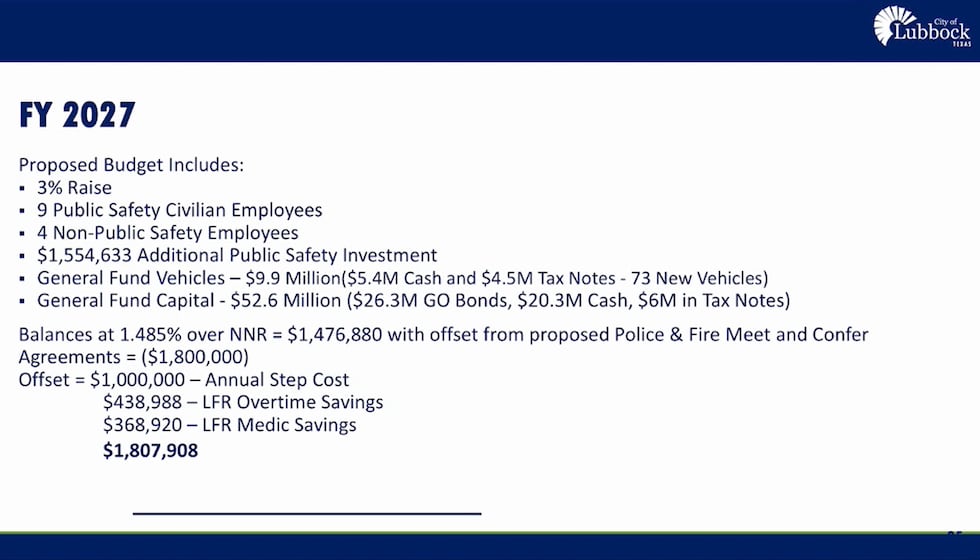 City manager’s presentation(City of Lubbock)No surprise on formula this year
A year ago, a surprise to city staff in calculations from the appraisal district led to a detour on budget work at city hall, and cancelation of a hearing. Read more – on that surprise here. This year, the city manager said they were not surprised by a new formula set by the state, and were able to anticipate the adjustments.
He said last year the council approved a rate that levied taxes to generate $87.1 million. The formula the city must follow then shows $85.9 million was collected, even though it collected the $87.1 million.
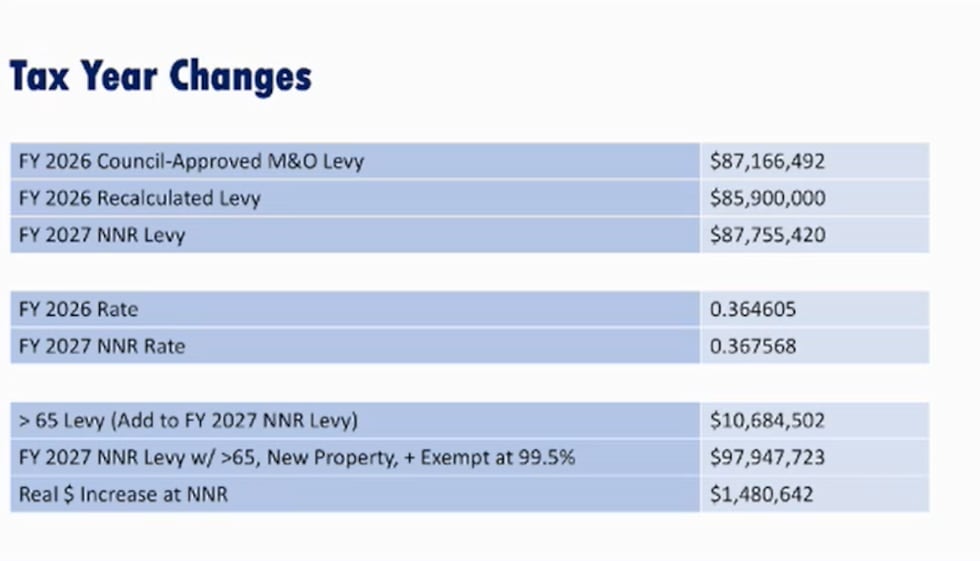 City manager’s presentation Aug. 7, 2026, showing calculations involving the no-new-revenue rate.(KCBD)
As for the upcoming year’s proposed budget, Atkinson showed if the no-new-revenue rate were adopted, it would generate about $1.4 million more revenue to the city than last year.
“No-new-revenue does not mean you don’t get an extra dollar. It means you get the same dollars from the same property year over year, plus the value of growth, the value of new property, minus the exemptions.”
What comes next
The proposal presented Friday is not the final budget plan. Council members may offer amendments and negotiate changes over the next month. The council must pass a budget and a new tax rate by Oct. 1.
Lubbock police, firefighters negotiate new city contracts
Lubbock police officers and firefighters are working toward new collective bargaining agreements with the city, with negotiators spending the summer on proposals that would change pay, schedules, benefits and costs.
The agreements are known as “meet and confer” contracts — a type of agreement that gives civil servants a mechanism to change city policies.
Police agreement
The Lubbock Professional Police Association is considering a one-year agreement that would give all officers a five percent raise and increase staffing levels. The changes would cost $4,786,559.
Firefighter agreement
The agreement with the Lubbock Professional Firefighters Association is more complex. The proposed six-year deal is built around shifting crew schedules to a “24-72” pattern, which would reduce firefighters’ work week from 56 hours to 40.
The department would also hire additional firefighters each year to fill staffing gaps created by the schedule change, and the agreement would make that hiring process easier.
Phasing in the schedule change over six years would save the city millions of dollars. Atkinson said the gradual approach is what makes the deal financially viable.
“Nobody ends up at 24/72 until year six, and all end up at year six,” Atkinson said. “It’s because of not doing that stair-step phase-in that you get those savings that make it affordable once you get past year one.”
The changes would cost $3,095,413.
Police and fire combined total $7,882,413. At the same time, the city manager said if these separate proposals for police and/or fire are not approved, then adjustments will be made to the public safety lines of the overall city budget, since these meet-and-confer proposals lead to savings in the budget he presented.
Next steps
If both associations ratify the agreements, they would go before the city council for approval before being incorporated into the overall budget. As noted above, these police and fire agreements would add 3.2215 cents to the proposed tax rate. For the average home, the cost of the meet-and-confer agreements is about $73.91 for the year.
($229,418 / 100 x 0.032215 = $73.907)
Key tax terms
Here are some key terms when various local governments work on setting a property tax rate.
No-new-revenue tax rate: This takes into consideration how much appraised values have changed, and would provide the taxing entity with roughly the same revenue from properties on the tax rolls for both years. It does not take into consideration new development or other significant changes to property.
If your property’s appraised value change is in line with the average change across your district/city/county, the no-new-revenue rate means your tax bill will be the same as last year.
Voter-approval tax rate: In most cases, according to the Texas Comptroller’s Office, if a government adopts a rate above the voter-approval rate, it triggers an election for voters to approve the tax increase.
A property tax rate does not continue from one year to the next. Taxing entities must set a rate every year.
Exemptions: The Texas Comptroller’s Office has information on the homestead exemption, exemptions for those 65 or older, citizens who are disabled, disabled veterans or their surviving spouses, surviving spouses of first responders killed in the line of duty, and others.
Copyright 2026 KCBD. All rights reserved.