
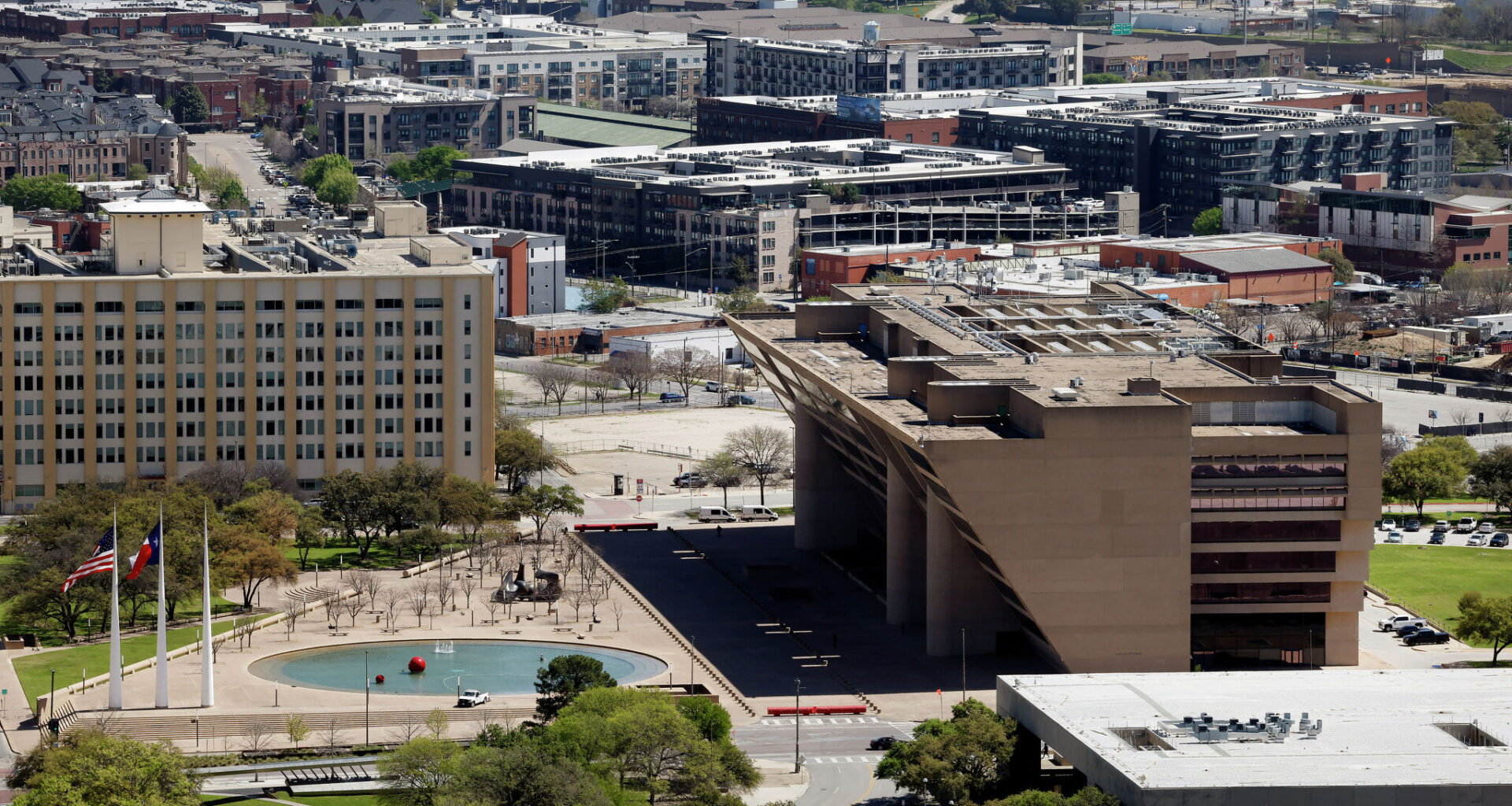
Dallas City Hall (right) and its plaza can be seen from Reunion Tower in downtown Dallas, March 19, 2026.
Tom Fox/Dallas Morning News
Dallas’ largest ever proposed budget relies on job cuts, privatizing services and reducing hours at libraries to offset the rising cost of the police and fire departments.

The city’s $5.6 billion budget proposal would close a projected $51 million shortfall by eliminating 296 positions from payroll and reducing hours and programs at some city facilities.
The job cuts and reorganization alone are expected to save the city $17.3 million.
Article continues below this ad
City Manager Kimberly Bizor Tolbert said the current budget is not a “one-time fix.” Financial forecasts and technology are evolving quickly, forcing the city to adapt its services, she said.
Growing pension payments and rising costs are forcing the city to consider privatizing services, lowering its minimum hourly pay for some custodial or temporary service workers and eliminating the co-pay program offered as part of employees’ healthcare benefits.
The budget proposal calls for a modest tax rate decrease but also includes some increases to fees for certain city services.
And, the city could withdraw roughly $719,000 in stipends and management payments, affecting partners like the Trinity River Audubon Center, Cedar Ridge Preserve, the Dallas Arboretum and the Dallas Zoo.
The City Council will begin discussing the proposed budget Tuesday and will vote on a final plan Sept. 16.
Article continues below this ad
Some council members have shown early support for Tolbert’s proposal, saying they’re pleased no libraries or recreation centers would be closed, though they acknowledge government spending has grown.
The financial pressure is not an isolated issue. Austin, Houston and San Antonio are also short tens of millions of dollars and put the onus of budgetary issues on wage, pension and public safety costs.
Council member Paula Blackmon said people are feeling uneasy about the economy.
“We’re not exempt from those prices going up either,” she said.
Private sector services
City government is evolving and Tolbert said the city was prioritizing services such as infrastructure and public safety that ranked high in the recent community survey.
Article continues below this ad
The city’s budget proposal calls for more funding for the fire and police departments, and less for libraries as the city seeks to privatize or outsource services.
Library programs such as adult GED learning classes and citizenship classes would be turned over to private partners. And city staffers are looking for private operators for the Cedar Crest Golf Course and Southern Skates Roller Rink.
“Instead of looking at who’s delivering that service, look at it as — is the service going to be interrupted?” Blackmon said.
The proposed budget also slashed other programs that were deemed to not be part of the city’s core services.
The municipal court’s underutilized Public Inebriated Sobering Diversion Program was cut. The Arts and Culture department lost 12 positions, including one that was transferred to convention services and three cuts in the public arts program.
Article continues below this ad
The housing and community empowerment department’s budget was reduced. The IT department’s budget went down by $8 million. The city saved another $16.22 million in future replacement costs by removing 164 underutilized vehicles.
Though Dallas plans to keep all 29 library branches open next fiscal year, the budget proposal eliminates 72 library positions and restructures services around five flagship locations with extended hours and programming.
“No one wants to see employees lose their jobs, and I regret that those reductions were necessary,” council member Kathy Stewart said.
Taxpayer impact
The tax rate might have seen a slight decline, but some fees could increase.
Article continues below this ad
The city’s proposal cuts the property tax rate by 0.10 cents per $100 of assessed value, a move that will save the median homeowner $62 next year.
The reduction only impacts the account used to pay off the debt, and would result in $2.3 million in foregone revenue. The rate the city relies on for operating dollars remains unchanged in the draft budget.
But true savings for taxpayers are uneven, partly due to different fee rates households will incur based on whether they have curbside or alleyway trash pickup.
If you’re among the 64% that has curbside trash pickup, you may save about $19 next year. If you have an alley pick up, you’re going to pay a premium — $41 more.
Starting February next year, the curbside collection fee would decrease by about $2 to $37.76 and alley service will go up to $45.22.
Article continues below this ad
Stormwater, ambulance, fire inspection and permitting fees went up substantially to help pay for department operations and infrastructure projects.
Council member Lorie Blair said residents wanted tax relief.
“You can’t provide more with less,” she said.
Budget winners
Every department was asked to prune their expenses, but some fared better than the others.
Funding for the police and fire department grew at 6.9%, outpacing the general fund’s 4.1% growth.
Public safety costs typically rise with every budget cycle and come largely from pension payments, overtime laws and compensation.
To get out of that bind, the draft recommends asking voters to approve $500 million in pension obligation bonds, with the hope that investments will get a higher rate of return. Experts say the measure should be a last resort.
The city’s transportation department funding also grew, with more investments in pavement markings and bridge maintenance.
Tolbert’s proposal adds $142.8 million in funding to repair and maintain 800 lane miles, a jump from 759 miles. The plan increases funding for deferred maintenance at city-owned facilities, continued funding for the bike plan and will add 50 extra traffic signals for safer roads.
The proposed budget increased the parks and recreation budget by about $2 million to $119.3 million. But the extra funding also included cutting 30 positions to preserve recreation centers, pools, park maintenance and safety operations.
Park Board member JR Huerta said people value parks more than ever now and if council members try to take money away from them, people are going to be upset.
A park is “the simplest thing you can give to a resident,” Huerta said. “You can always give them a nice park.”