
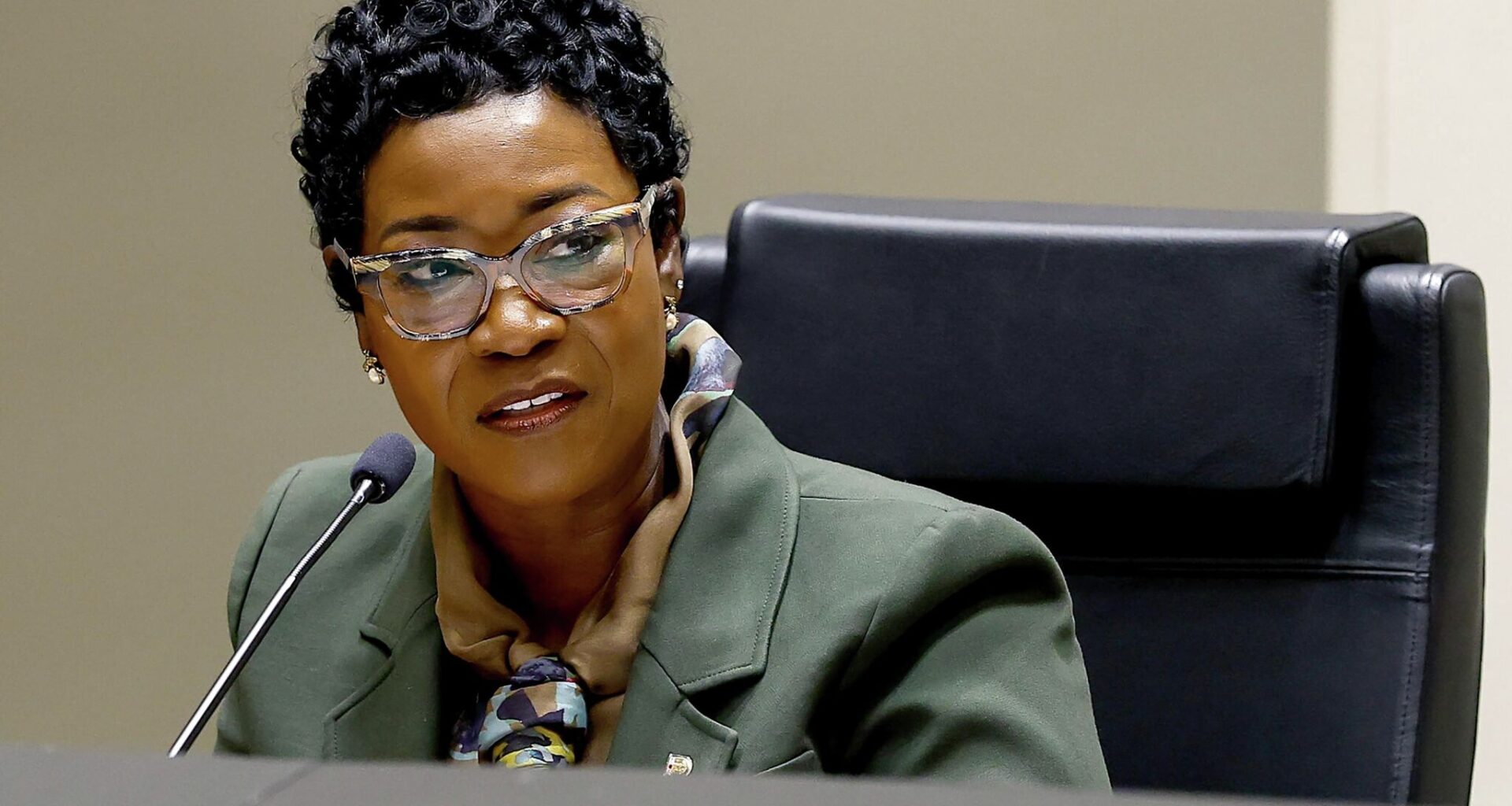
Dallas City Manager Kimberly Bizor Tolbert speaks to a packed house about repairs on the aging Dallas City Hall. Dallas City Council members held a meeting, Wednesday, May 20, 2026 at Dallas City Hall, to hear plans for two methods on the repairs.
Steve Nurenberg/The Dallas Morning News
Dallas is not unlike many of its peer cities in Texas. The cost of government has grown too high for the tax dollars coming in to cover it.
It’s a song played on repeat, but it’s getting worse with each spin. Public pensions are eating more revenue; inflation is driving up the cost of every employee, every piece of equipment and every necessary repair; and city councils keep promising more while refusing to face the fiscal reality that there just isn’t enough money.
Amid these challenges, we think City Manager Kimberly Bizor Tolbert has presented a serious budget proposal that could still use some work in seeing additional costs removed from the bottom line.
Article continues below this ad
She has fulfilled two important goals — delivering a balanced budget (as required by state law) and more or less holding the line on the city’s tax rate (she’s proposing a symbolic 0.1-cent reduction).
Tolbert’s challenge in doing both is significant. Additional costs are now baked into Dallas’ annual budget in the form of rising costs to pay more police officers and to increase the salaries of those we already have, as required under Proposition U. And then there is the bottomless pit of public safety and civilian employee pensions.
Public safety and pension costs alone explain why every other service the city provides is now and will remain under financial stress for the foreseeable future.
Tolbert understands this. We were pleased to see she has made a real cut to the size of the city’s staff. As of this writing, she is planning to pull 296 positions out of the organization. That includes both open roles and roles with people in them.
No one likes to see someone get a pink slip. But city management and the council failed to control bloat during and after the spend-a-thon that was the pandemic. That was a mistake, and Tolbert has rightly acknowledged it cannot continue.
Article continues below this ad
“We have to continue to look at ways to be more efficient,” Tolbert told us. “We have to improve our service delivery models. We’ve got to continue to employ innovation. We can’t throw positions at problems. … We know that that is not the way of the future.”
That goes for new programs too, she said.
We have long argued that City Hall cannot be the solution to every social ill Dallas has. Mission creep has defined every level of government for too long. Basic services are too costly now just in themselves. We strongly urge council members to not only support Tolbert’s philosophy but to enhance it by finding more ways to get back to basics.
Even doing that, the cost of City Hall will continue growing. The planned general fund spending on public safety alone is proposed to grow from $1.34 billion in the coming budget to $1.4 billion in 2027-28.
We are also worried that the city is edging ever closer to making fiscally risky decisions, like planning for what are known as pension obligation bonds to cover rising costs of the public safety pension.
Article continues below this ad
Pension costs are a structural fiscal problem for Dallas. These costs must be addressed through deep and painful reform. That can start with the city’s civilian pension. Defined benefit plans have become a threat to the financial health of too many government systems. Taxpayers are not in a position to fulfill the promises made to public employees in perpetuity. Someone has to have the courage to put forward a plan that will address this problem for future generations.
Meanwhile, we strongly urge Tolbert and the council to closely examine rising costs in places like the fire department. Residents demanded the police department grow through Prop U. But the growth in the fire department has been explosive as well, with little savings realized on overtime spending that we can see. It’s time to ask hard questions in this area.
Tolbert’s planned budget gets a lot right. But no city manager can face the long-term budget challenges facing cities without councils that are willing to accept change has to happen.
The state has stepped in to prevent cities from using rising property taxes to cover up their ballooning costs. The best option is to embrace new growth.
Sadly, many Dallas residents are too quick to oppose any development near them. The NIMBYism that now defines local zoning debates too often comes from people whose property taxes are frozen. Meanwhile, they want the same or improved services.
Article continues below this ad
The only way that can happen is for Dallas to grow. And Dallas has to grow in the most desirable areas for development.
It’s not cuts or growth. It’s got to be cuts and growth to pay for basic services. That’s just the fiscal reality.
For now, we have to get through the next couple of years of slower revenue growth and rapidly rising costs. Tolbert has us off to a good start. There is more to be done.
Have thoughts about this? Send a letter to the editor using our letters form or email letters@dallasnews.com. Letters should be no more than 200 words and include the first and last name of the writer and city of residence.