
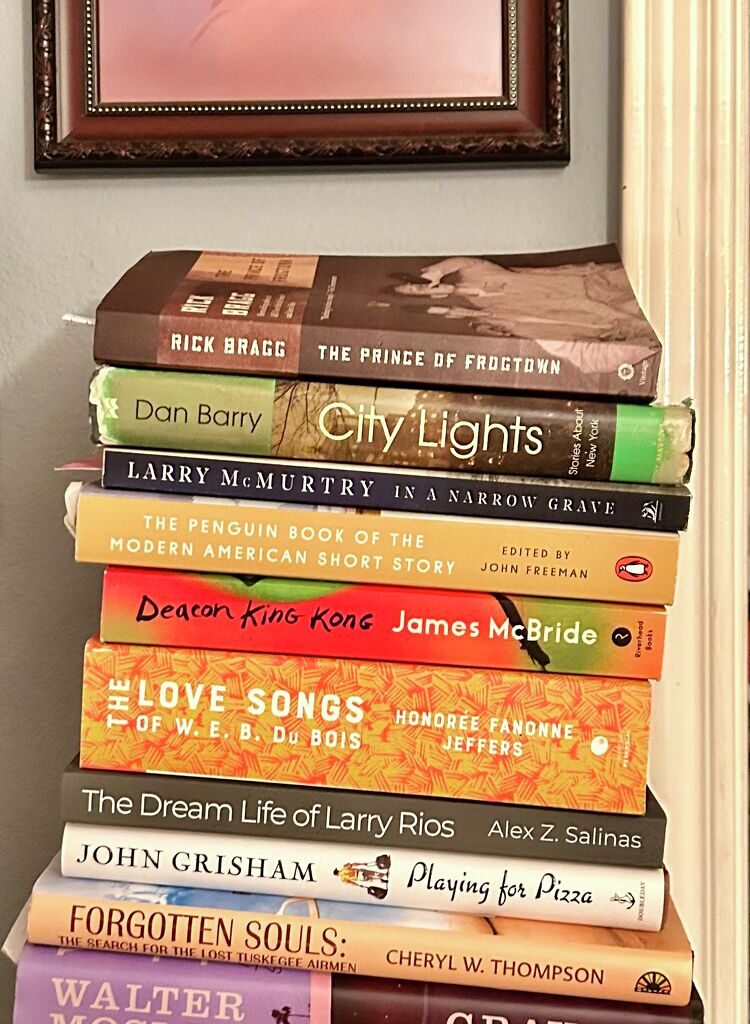
More than a dozen books stacked on Vincent Davis’ work desk waiting to be read. The tales include forgotten Tuskegee Airmen, the history of El Paso and a Prince of Frogtown, all beneath a portrait of his mother, Valeria Cordona-Trinidad, who inspired him to read.
Vincent T. Davis/San Antonio Express-News
Each week, during the summer of 1968, I’d trek to a nearby convenience store for my literary fix. I’d walk from our single story, ranch-style house on Reefridge Place, near Five Palms Drive, to the cool-aired store on Military Drive, clutching sweat-slicked coins to buy comics for 12 cents.

Once inside, I passed packs of bubble gum cards bearing images of the 1960s pop band, “The Monkees” and the aliens attacking earth TV show, “The Invaders.” A turn led to a Slushie machine that spewed red and blue raspberry slush that froze your brain after a sip.
Article continues below this ad
Then I made a beeline to the spinner rack, stacked with comics, that squeaked with each turn. Like cell phone gazers of today, I’d walk back home, head down, eyeing hyper-muscled super heroes battling maniacal villains panel to panel, page to page.
Those weekly trips were part of an ongoing journey that began more than six decades ago, when no-nonsense nuns at Mother Mary Mission in Phenix City, Alabama, taught me to read at an early age. They taught us phonics, how to sound out words using vowels and consonants.
The lessons opened a world of possibilities.
The gift of literacy
My mother Valeria Cardona-Trinidad and great-grandmother Willie Lou Martin ensured I received the gift of literacy.
Article continues below this ad
In the early 1960s, when I’d get home from school, she’d call her friends at the Buena Vista Estates apartments in Columbus, Georgia. I would pore over Gold Key books to and from school on bus rides across the Chattahoochee River Bridge that connects Columbus and Phenix City.
The women would circle around me, sitting in folding chairs on our front porch, as I read about toy soldiers, a dog named Spot and Jack and Jill tumbling down a hill.
Hearing me and other kids read was more than entertainment to the women. It was witnessing the promise of a life they never had. Many like my great-grandmother, affectionally called Madea, didn’t finish school. They instead had to work to help their household.
That’s why they were insistent that our generation have the educational tools to succeed, a benefit bestowed from their toil and sacrifice.
Article continues below this ad
She only read one book consistently. saying it would never go out of style: The Holy Bible.
In 1969, we moved from San Antonio to Omaha, Nebraska, and I graduated from the “Bam! Smack! Pow!” of comics to reading paperbacks. An eclectic array of stories captured my attention every moment, not studying or doing chores.
In high school, my friends and I frequented a newsstand, run by two brothers, that anchored a downtown corner near the bus stop. We read “The Autobiography of Malcom X” and “Brian’s Song,” the story of friendship in the mid-1960s between Chicago Bears teammates Gale Sayers and Brian Piccolo.
My thirst for reading grew stronger when I enlisted in the U.S. Air Force in September 1975. There wasn’t any recreational reading during basic training, just instructional modules. Nor was there time for fiction, just studies while attending logistics technical school at Lowry Air Force Base in Denver, Colorado.
Article continues below this ad
In February 1976, I arrived at Ramstein Air Base, Germany, wide awake after midnight with jet lag. In pre-dawn hours, I binged J.R.R. Tolkien’s “Lord of The Rings” trilogy, following Frodo Baggins on his quest to destroy the One Ring in the smoldering fires of Mount Doom.
By 1978, I had moved from paperbacks to hardback novels. My first hardcover book was Alex Haley’s “Roots.” It still sits on my bookshelf today, tattered cover and all.
Waiting to be read
Throughout my 22-year military career, we kept our various homes like my mother, an avid reader. Growing up, our home resembled a mini library, with stocked bookshelves and living room tables lined with magazines about Black culture and good housekeeping.
Article continues below this ad
We still follow her example. Books are prominently displayed in our home, lining shelves of a wall unit in the living room and five shelves of another bookcase in our den.
On the top shelf of the wall unit, Mother Abagail, a 108-year-old African American woman, enters a battle of good versus evil against The Walkin’ Dude, a demonic being, in Stephen King’s novel “The Stand.”
A few books away, in “Devil in a Blue Dress,” Walter Mosley’s street detective, Ezekiel “Easy” Rawlins, trawls the byways of 1960’s Los Angeles solving mysteries and dealing with “stay in your place” cops.
Further down, the Don of the Corleone crime family, Michael Corleone, settles scores with New York’s five families in Mario Puzo’s “The Godfather.”
Article continues below this ad
On a lower shelf, Woodrow F. Call, Augustus McCrae and band of cowboys blaze a long, costly cattle trail from Texas to Montana in Larry McMurtry’s “Lonesome Dove.”
And in the den, more than a dozen books are sitting on my work desk, waiting to be read. The tales include forgotten Tuskegee Airmen, the history of El Paso and a Prince of Frogtown.
All of those books are stacked beneath a portrait hanging on the wall of the one who began my literary journey – my mother.
Article continues below this ad