
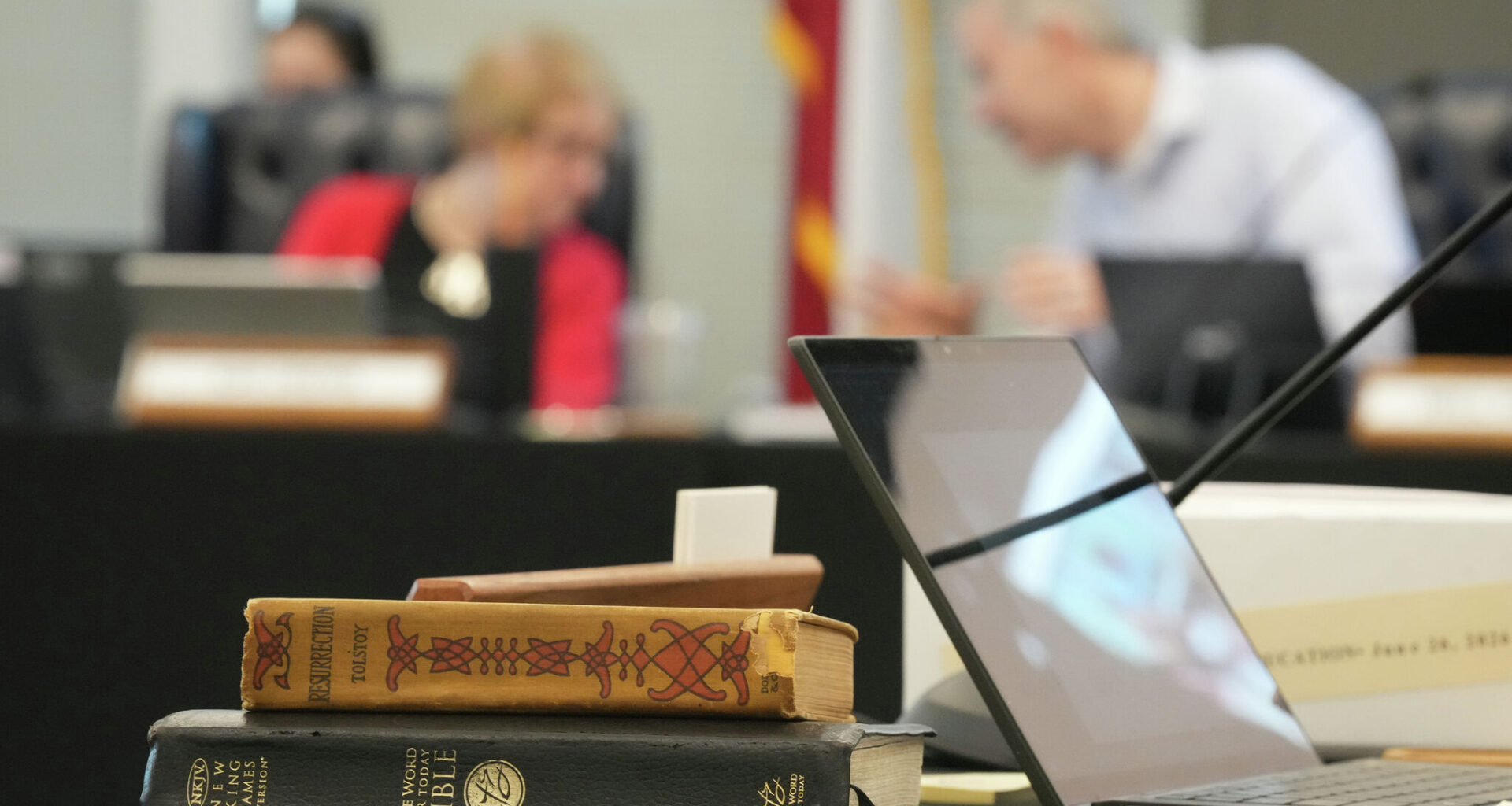
A Bible and Resurrection by Leo Tolstoy sit on the desk of State Board of Education member LJ Francis during a meeting on proposed social studies standards at the Barbara Jordan Building in Austin on Monday, June 22, 2026. The board is considering revisions that would place greater emphasis on Christian history and biblical content in public school classrooms.
Jay Janner/Austin American-Statesman
Texas students will see more religion in their classrooms this year and beyond — from required Bible readings to the Ten Commandments posted on the walls — thanks to a suite of new laws and programs heralded by Republican lawmakers.
Perhaps the biggest is the new statewide private school voucher program, which has already awarded 85,000 Texas students state funding for private school tuition and homeschool expenses. Many of the Houston-area schools approved to receive the public funds are religious and predominantly Christian.
More local school districts, including Houston ISD, are also ordering the state’s free Bible-infused curriculum, known as Bluebonnet. Districts can receive up to $60 per student incentive in additional state funding for the materials — they just have to print them on their own dime.
Article continues below this ad
SURVEY: Did you receive a Texas school voucher? Tell us how you’ll use it.
Then there are laws that gave school districts more options on daily prayer and hiring chaplains to help, or in some cases, replace school counselors, although most districts didn’t sign up.
Here are six ways religion may show up in your child’s Texas classroom going forward.
State Board of Education reading list
In June, Texas became the first state in the country to mandate that students read parts of the Bible through a brand-new book list.
Article continues below this ad
The list, greenlit by the Republican-led State Board of Education, cements a unique approach by introducing the same literary texts to all students statewide. School districts and publishing companies will now scramble to train teachers and procure thousands of titles before the lists become mandatory in the 2030-2031 school year.
At least a dozen of the nearly 200 titles total are Bible passages and stories, from David and Goliath in second grade to the Book of Job in tenth grade. The list is the first of its kind among statees; activists have signaled the plan will face constitutional challenges in court.
Read the list: See the Bible verses and books Texas public school students will now be required to read
Social studies curriculum rewrite
The State Board of Education also approved an overhaul of Texas’ social studies standards from kindergarten to eighth grade. Biblical concepts and figures are embedded across nearly all grade levels, making the overhaul among the most aggressive efforts to mandate the teaching of Christianity in the country.
Article continues below this ad
The standards will form the backbone of textbooks and annual exams. Schools will begin using them in phases, beginning with elementary grades in the 2030-2031 school year.
Republicans trumpeted the new standards as a victory for Judeo-Christian values and classical ideals. Proponents say that Bible-infused provisions, including required lessons on Jesus, Abraham and Moses, are not designed to evangelize, but to help children develop a moral compass and appreciate American exceptionalism.
Critics, meanwhile, say the state board has pursued a narrow view of history and literature through the lens of Christianity, at the expense of racial and religious diversity, as it eliminated a world cultures course and cut down on lessons on the stories of Blacks, Hispanics and other minority groups.
Bible-infused Bluebonnet curriculum
Texas is the only state in the country to own and publish its own line of textbooks and lesson plans. The program, called Bluebonnet, is currently optional for districts, though those that participate receive extra state funding.
Article continues below this ad
Just under a third of the state’s 1,200 districts were using Bluebonnet last school year, which so far covers elementary-level math and English. But that list has grown, including in Houston ISD, which adopted the program in June.
RELATED: One third of Texas school districts ordered Bible-infused lesson plans. Is your school on the list?
The textbook line is also set to expand. The Texas Education Agency said that a $67 million contract it signed last year with Florida-based company MGT Solutions includes the development of new Bluebonnet materials for new literature, social studies, science, and other subjects for grades K-5.
Bluebonnet, spearheaded by Education Commissioner Mike Morath since 2024, is meant to bring standardized, “high-quality” materials to schools, including more fleshed-out lesson plans and teacher scripts to ease the workload for classrooms. The state has spent at least $100 million to develop the curriculum so far. Leaders in other conservative states, including Florida and Alabama, have attempted, but so far failed, to replicate the Texas model.
The curriculum has been controversial, particularly among Democrats, for including Christian themes as well as thousands of grammatical, copyright and other errors that will cost the TEA $8.4 million to correct.
Article continues below this ad
Ten Commandments posters
Students in public schools across the Houston area may continue to see Ten Commandment posters on classroom walls this year. Last year, a new law mandated the placement of the King James version of the Ten Commandments in every classroom in Texas, if a school receives posters by donation. Before the law went into effect last year, a group of parents sued the state and 11 school districts to block the law from being administered in those classrooms. The districts included Houston and Cy-Fair ISDs.
NEWS: New lawsuit claims law requiring Ten Commandments in schools violates Texas’ parental rights
The lawsuits initially resulted in an injunction, meaning the posters could not be displayed in those districts for most of the school year, but the U.S. Fifth Circuit Court of Appeals ruled this spring that the law was constitutional and did not violate the First Amendment.
But this summer, a new legal challenge against the law emerged, when a new group of parents sued the state and three Houston-area school districts, arguing that the posters violate the Texas Religious Freedom Restoration Act of 1999 and a clause in Texas’ new Parental Bill of Rights.
And the law has triggered more legal action. Last October, the Galveston ISD school board voted not to display the posters, and in May, Attorney General Ken Paxton sued the district for not complying.
Private school vouchers
This school year marks the start of the rollout of Texas’ long-awaited $1 billion school voucher program, where the state gives money to families to pay for all or part of their private school tuition. Lawmakers created the program in 2025; however, applications for families and schools didn’t get off the ground until early this year.
As part of the program, parents could be eligible for $10,500 to use toward private school tuition or $2,000 for homeschool curriculum or materials. Parents of children with disabilities could receive even more, up to $30,000 to pay for disability-specific private schools or private virtual schools. More than 85,000 of the 275,000 applicants have been funded for the program, meaning private schools across the state are accessing a completely new funding stream.
NEWS: Texas promised children with disabilities up to $30K vouchers. Fewer than 30 got the full amount.
Still, the program hasn’t come without controversy. The Chronicle reported earlier this summer that fewer than 30 families actually received the full amount of $30,000 for students with disabilities, and the voucher awards for these students varied more by the size of their zoned public school district than the intensity of their needs. Plus, the program strained public schools this fall, when families not enrolled in public schools flocked to their doors for special education evaluations in order to try and secure as much funding as possible for their children.
It’s unclear at the moment how this program, of which the majority of participating schools in the Houston area are religious schools, will impact the area’s public school districts. Recent reporting in the Chronicle showed how nearly half of the state’s districts have no idea how large the impact of vouchers will be on their enrollment, because the Comptroller’s office has masked data sharing beyond 30 students.
Prayer in schools
In the 2025 legislative session, lawmakers passed a proposal giving districts the option to create periods of daily prayer for students who wanted to exercise their religious freedom. The law required all school districts to vote by March 1, 2026 on whether to approve the law and create a policy based on it.
RELATED: Houston-area school boards vote to reject daily prayer periods: ‘A logistical nightmare’
Opponents of the law were concerned about the pressure it would put on staff, tasked with helping with students’ religious expression, and administrators weren’t sure how they could comply with the law while also respecting students who practiced different faiths.
Most districts in the state rejected the law — many specifically because of the logistical and funding challenges — but a select few districts across Texas opted in, including Magnolia ISD in Montgomery County.
Any district that voted against enacting the law in their schools could reconsider their stance.