
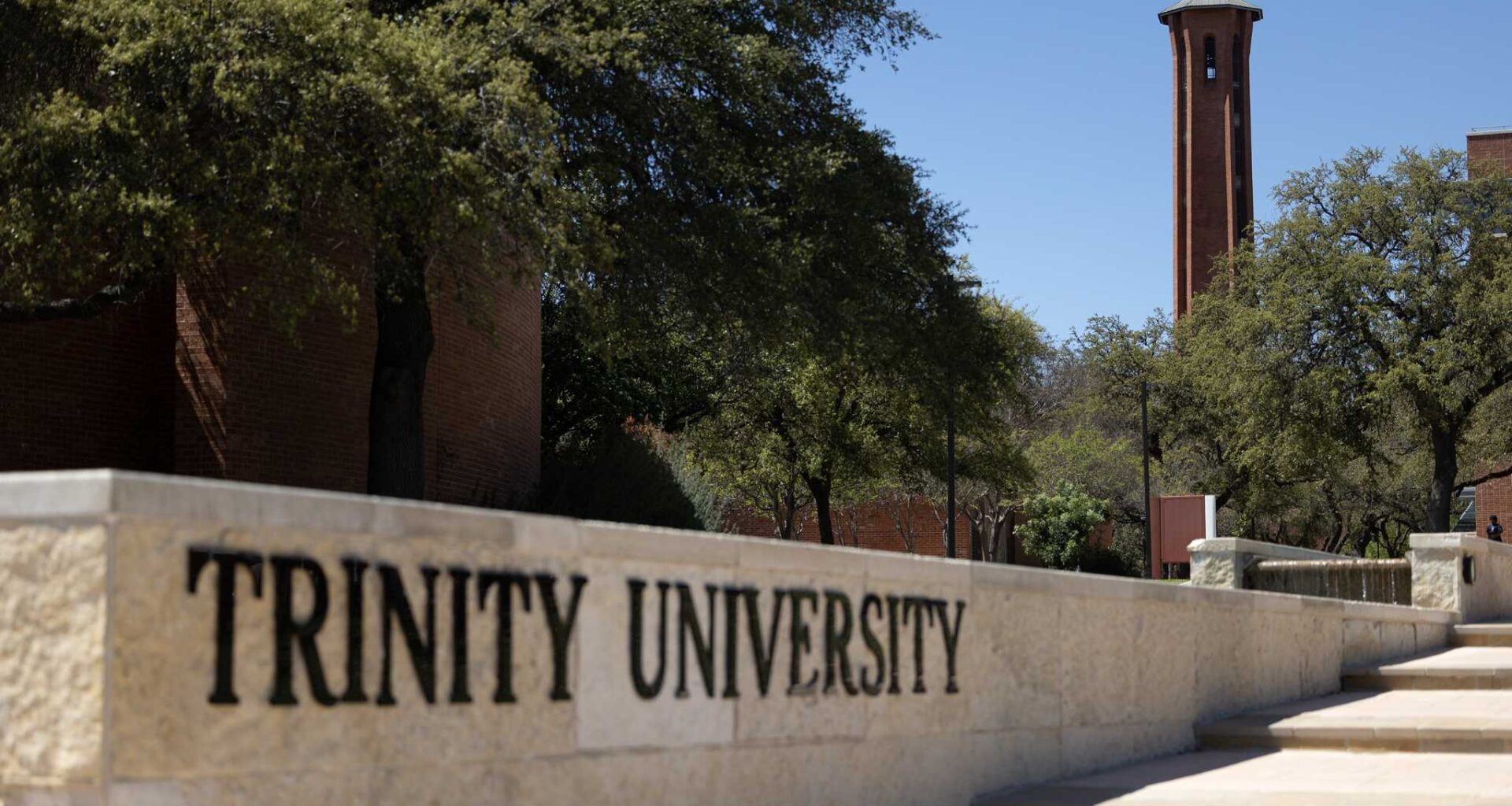
Murchison Tower rises above Trinity University’s hilltop campus in San Antonio. University officials said they underestimated how strongly alumni identified with the landmark before removing it from the university’s primary academic logo. Alumni will now help shape what comes next.
Jessica Phelps/San Antonio Express-News
When Trinity University unveiled a sweeping rebrand on July 30, the redesigned website drew praise. The new sunburst logo did not.

Alumni derided the symbol as generic and corporate and objected to losing Murchison Tower in their university’s emblem. Their opposition ignited a public-relations crisis and unraveled the logo rollout within five days.
Article continues below this ad
Last week, university officials announced they would pause the rebrand and instructed Trinity departments not to order materials bearing the new symbol. An Aug. 24 brand-launch celebration was postponed.
In separate interviews, Alumni Association Board President Paul Hensley and Tom Evelyn, Trinity’s vice president for strategic communications and marketing, provided a detailed account of the calls, meetings and internal discussions that led Trinity to pull the logo. Their accounts show how a design process lasting more than a year failed to anticipate the scale of alumni opposition.
University officials initially stood behind the sunburst, saying they expected criticism. The weekend after the university unveiled its new emblem, graduates flooded university inboxes with complaints and social media with comments demanding the tower’s return.
While he was on vacation in Florida, the complaints kept reaching Hensley, a 1987 Trinity graduate, senior vice president for HOLT Group and university trustee. Alumni board President-elect Barbara Poenisch heard them, too.
Article continues below this ad
Hensley requested a meeting with Evelyn. On Aug. 3, Hensley and Poenisch spoke by phone with him and Ryan Finnelly, Trinity’s senior director for alumni relations and the board’s university liaison. Hensley said board members delivered a direct request.
“We really think we ought to pause and take a step back,” Hensley said.
The next afternoon, after weighing that call alongside emails, social media posts and other conversations, Trinity pulled the logo from use and paused its rollout. For now, the redesign remains in limbo.
READ MORE: Trinity University backs off new sunburst logo after fierce alumni backlash
Article continues below this ad
Trinity University used Murchison Tower in its primary academic logo, top, from 2003 until July 2026. Its proposed replacement, bottom, features a 24-ray geometric sunburst. Trinity paused the rollout after officials acknowledged that their redesign process failed to anticipate alumni love for the tower.
Trinity University
From research to failed rollout
Trinity began researching a rebrand in April 2025. Leaders wanted a new look that would showcase the university’s growth and appeal to prospective students. The project included a redesigned website, new messaging and visual elements.
Trinity, a private school enrolling 2,600 students, has declined to disclose what it spent on the redesign and did not provide a breakdown showing how many people participated in each phase or how their feedback affected the final design.
Article continues below this ad
The university says more than 300 students, alumni, faculty members, employees and trustees offered input across 19 focus groups and interviews, at least nine concept-testing sessions and at least a dozen presentations.
Evelyn said about 75 alumni participated in focus groups, interviews, concept testing and presentations before the launch. All saw the sunburst or other concepts or were asked to evaluate them at some point, he said. Trinity counts more than 30,000 alumni worldwide, including more than 8,000 in San Antonio.
The university also formed a group of 16 “brand ambassadors” to gather and relay feedback from staff and provide updates about the redesign in preparation for the launch, Evelyn said. He added that the number involved in the yearlong rebranding effort was likely higher than the university’s estimate of 300.
Evelyn said feedback from a state of the university presentation and an anonymous form was largely positive. Some comments focused on the sunburst’s shape, but he said no emails received before the July 30 launch urged Trinity to reject it.
Article continues below this ad
Trinity chose the sun because it has appeared on the university seal since 1870. Its 24 rays were intended to reflect campus architecture and distinguish Trinity from other colleges with tower logos.
The tower had its own detractors. University trustee April Ancira previously said alumni had joked that it looked phallic. Poet Naomi Shihab Nye, who graduated in 1974, recalled similar crude jokes and found the sunburst more memorable. Former Mayor Ron Nirenberg, a 1999 graduate who teaches at Trinity, called the tower iconic and said he missed it, but cautioned that initial reactions to logo changes do not always last.
The university’s 29-member Board of Trustees, which serves as the governing body of the university, discussed the project in May and September 2025 and in February and May 2026. At the May 2026 meeting, trustees voted unanimously to endorse the full rebrand package, including the messaging, visual elements and new website. They did not vote separately on the sunburst.
The 36-member Alumni Association Board, an advisory group that represents graduates and promotes engagement between alumni and the university, saw the rebrand in February and June 2026. The first presentation came about 10 months after the work began. Hensley said members saw Trinity’s selected direction, not competing designs. The advisory board did not vote at either meeting, but Hensley said it was his impression that more members opposed the logo than supported it.
Article continues below this ad
“We weren’t given any choices,” Hensley said. “It was like this is what we’re going with.”
Hensley said Trinity relied too heavily on people already close to the university, like staff members. He compared them to the inner rings of a bull’s-eye. Graduates outside those circles felt the logo had come “out of left field,” he said.
Evelyn acknowledged two shortcomings.
“We probably could have brought the alumni board in sooner,” he said.
Article continues below this ad
He also said Trinity misjudged the tower’s importance to graduates.
“We probably underestimated the affiliation that so many of our alumni have for that tower symbol, and so that’s why we’re looking forward to continuing the conversation and thinking about how we can incorporate that feedback going forward,” Evelyn said.
Pressure builds
Trinity publicly defended the logo July 31, one day after its debut.
Article continues below this ad
“We expected this,” spokesperson Clinton Colmenares said at the time. “It’s difficult for some people, but this is something that’s positive for the university, and we’re behind it.”
But the volume of negative feedback grew. From Friday through part of the weekend, Evelyn estimated that 100 to 120 messages reached him, Trinity’s general inbox and other university addresses. Social media comments skewed heavily negative, Evelyn said.
Evelyn said the Aug. 3 call with Hensley and Poenisch influenced the university’s pause. University leaders also weighed emails, social media posts, phone calls and other conversations.
“I think it was all the feedback combined in different ways that it came in,” Evelyn said.
Article continues below this ad
Evelyn declined to identify who made the final decision to freeze the new logo’s rollout or describe their discussions.
Hensley said some major donors had encouraged Trinity to pause, but Evelyn said he knew of no such requests. The marketing vice president said leadership acted on the broader response and said that many major donors remained supportive throughout the controversy.
Alumni will shape next steps
On Aug. 6, two days after the pause, about 25 of the Alumni Association Board’s 36 members met with Evelyn and Michael Bacon, Trinity’s vice president for alumni relations and development. Hensley said at least 80% of the board had attended or provided feedback through the Aug. 6 meeting, emails or text messages.
Article continues below this ad
This time, members sought a more direct role in shaping the logo rather than reacting to a finished design.
“The Alumni Association needs to be in this from the beginning,” Hensley said.
Trinity plans to form a committee of alumni with professional experience in marketing, branding, design or related fields. The group will work alongside university officials to develop possible changes. Some alumni volunteered after contacting Trinity with feedback on the sunburst logo; officials identified other prospective members because of their expertise.
“We will work side by side with them to come up with whatever may be the next iteration,” Evelyn said.
Article continues below this ad
The working committee will remain separate from the Alumni Association Board. Evelyn said Trinity will keep the board involved and seek its response to new concepts.
Trinity has not assembled the committee, set a timetable or selected who will execute another design. Its partnership with E&A Collaborative, the firm that created the sunburst and other visual elements, is complete, Evelyn said.
The university also has not decided whether to modify the sunburst, restore the tower or pursue an entirely different design.
Article continues below this ad
“We don’t want to presuppose anything with that group,” Evelyn said.