
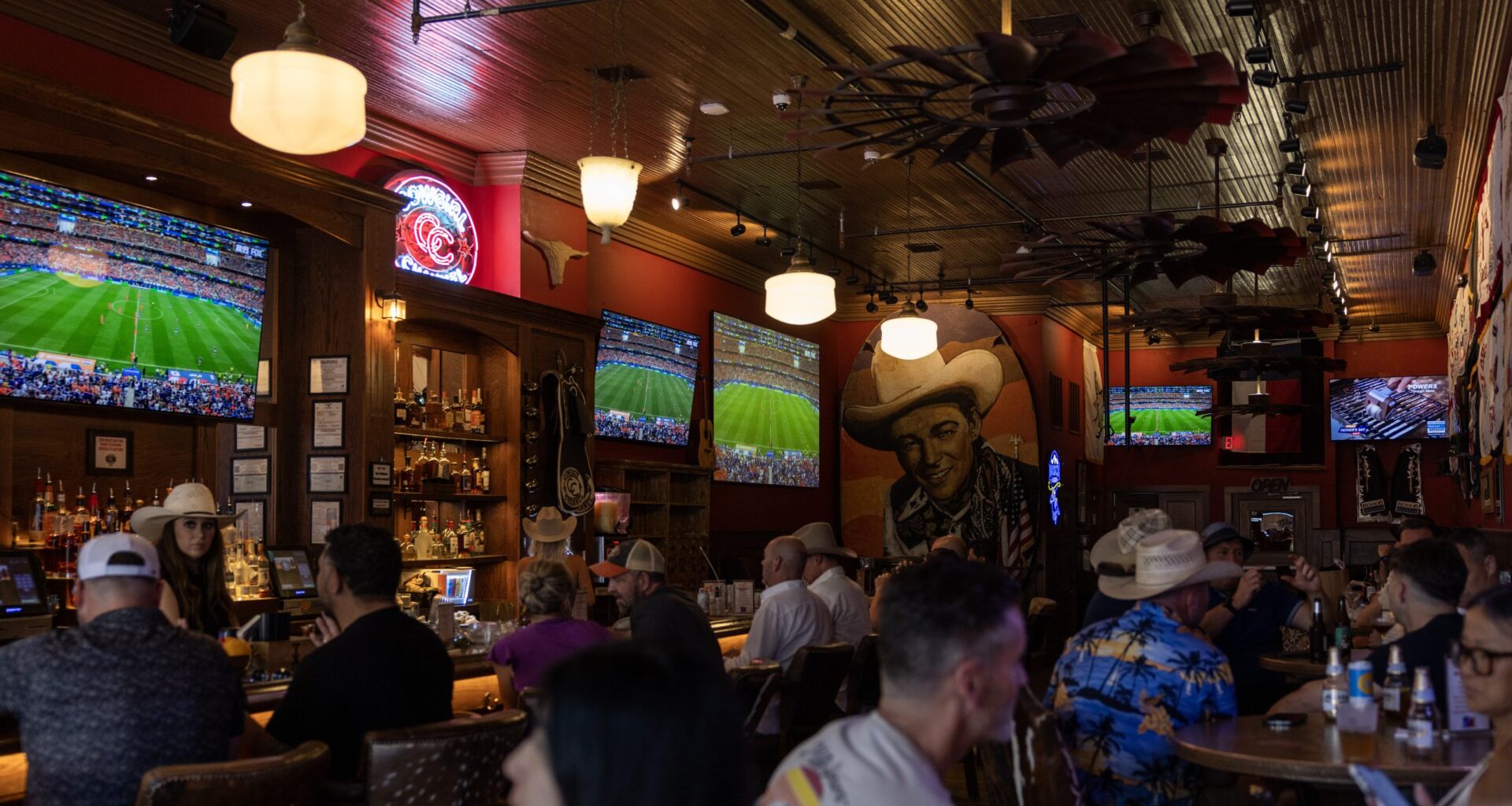
How did Fort Worth and area hotels do during the recent World Cup in North Texas? Results varied across the region, but Drew Hays, executive director at the Fort Worth Sports Commission and vice president of sports at Visit Fort Worth, is sure the city did well.
“We’re trending to have one of the best hotel revenue years in Fort Worth history,” he said.
Along with record revenue, Hays said the marketing exposure for Fort Worth was invaluable. For example, the city received 85 media and filming requests during the World Cup, he said.
“That’s 17 times our normal average,” Hays said. “We were able to showcase Fort Worth in the national spotlight. It was huge for us.”
The latest data from Dallas-Fort Worth hotels suggests room revenues received a solid kick from World Cup visitors. However, not all parts of North Texas tallied high scores from the nine area matches.
Arlington hotels certainly got a bicycle-kick boost. Hotels there generated a record $31.5 million in room revenue in June 2026, surpassing the previous monthly record of $23.6 million set in November 2024, according to the Arlington Convention & Visitors Bureau.
The June 17 England-Croatia group stage game gave the city’s hotels a jolly old time, setting a new single-night hotel room revenue record of $2.17 million. The Jordan-Argentina match played June 28 also ranked among the top-five hotel revenue nights in Arlington history, generating $2.1 million.
It was the largest tournament in FIFA history, spanning 39 days and 16 host cities across the United States, Canada and Mexico. The nine matches at AT&T Stadium, which included a semifinal, were the most of any host city, spread out from June 14 to July 14.
Ahead of the tournament, officials with the North Texas FIFA World Cup Organizing Committee commissioned a study that estimated a total impact for the region of between $1.5 billion to $2 billion. The actual economic impact numbers won’t be tabulated for several months.
Hotels were initially expecting a windfall from overseas fans flocking to the games, but those expectations were beginning to dim as early as April. That was when FIFA, the game’s governing body, canceled hotel block reservations in Dallas, Fort Worth and Arlington.
The American Hotel & Lodging Association in May found that anticipated demand had not translated into strong hotel bookings and that domestic travelers were outpacing international visitors. FIFA room block cancellations, international travel barriers and rising costs were identified as key drivers of softened hotel demand, according to the association’s report.
Still, Traci Mayer, executive director of the Hotel Association of North Texas, said, initial numbers and anecdotal information from their members point to a win for the hotels and for the area.
“Our industry spent years preparing for this moment, and North Texas delivered,” she said. “They came for soccer and left loving Dallas, and that impression will pay off for this region long after the tournament.”
Mayer said international flight bookings into Dallas Fort Worth International Airport and Dallas Love Field Airport paced more than 78% ahead of last year during the early stretch of the tournament. The organization’s member hotels reported international guests staying roughly two and a half nights on average, a slight bump over the normal pace, with some extending their trips to explore the region.
Nationally and in Texas, results varied game to game and city to city, said Jan Freitag, national director of hospitality analytics for the commercial real estate data firm CoStar.
Higher room rates, rather than dramatically fuller hotels, drove the gains, as they had predicted, Freitag said.
 Fans fill The Londoner Pub before the England vs. Croatia World Cup game June 17 in Arlington. (Christine Vo | Fort Worth Report)
That England-Croatia game kicked up occupancy to 76%, an 11% increase over the previous year in Fort Worth and Arlington, while Dallas saw 77% occupancy and a 7% year-over-year increase, according to CoStar. That sent revenue per average room rate up 78% in Fort Worth-Arlington and 43% in Dallas, according to the organization.
Other games had a different result. The July 30 game between Ivory Coast and Norway saw occupancy and revenue per room fall from the previous year.
“We knew there would be some drop in occupancy, but we felt like many hotels would make that up in room rates, and that is generally what happened,” Freitag said.
Examining the numbers more geographically, San Antonio’s Source Strategies, a data analytics company, broke down various submarkets in June to compare with year-earlier results.
Arlington took home the win for the area, with a 45% increase in revenue per room in June. According to Source Strategies, Arlington’s 77 hotels reported $33.8 million in revenue during the first month of the games.
The 38 hotels in Fort Worth’s central business district reported a 30% increase in room revenue over the previous June, according to the group. But other areas of Fort Worth showed varying results for the month.
Respectively, north Fort Worth’s 78 hotels reported a 17% increase in room revenue; south Fort Worth’s 64 hotels saw a 27% increase; and west Fort Worth’s 80 hotels booked an 18% increase.
“Location to the games and transportation played a big part in what areas did better in drawing visitors,” said Paul Vaughn, director of data operations at Source Strategies. “Generally, the farther away you were the less impact you saw.”
Equally surprising was that many of the cities that did not have World Cup games saw an increase in business. CoStar’s Freitag speculates that a key factor was businesses, conferences and travelers wanting to avoid World Cup sites.
Fort Worth had an advantage there. The city hosted no games, with Dallas and Arlington getting most of the limelight. Because of that, Fort Worth was able to continue with its usual events, even hosting an FFA convention the week leading to the games.
“Being able to keep that baseline piece of business going in the lead-up to the World Cup and also during the World Cup really helped boost tourism,” Hays said. “There was the incremental impact we got from the fans coming in as well.”
Short-term rentals score
For short-term rental companies like Airbnb, the tournament delivered, according to Linda Rollins, an analyst with AirDNA, a data analytics firm for short-term rental owners.
Across the 16 North American host cities, short-term rentals generated $1.33 billion in total revenue during the World Cup from June 10 to July 19, a 26% increase over the same period last year.
Much like the hotels, the short-term rentals didn’t necessarily fill more rooms, but they were able to charge more, Rollins said.
“For hosts, the World Cup was less a demand event than a pricing event,” said Rollins.
Dallas-Fort Worth was one of the largest of the short-term rental markets, accounting for $26 million in revenue during the tournament. As with the hotels, demand during certain games was higher than others, Rollins said.
For the June 22 Austria-Argentina group stage game in Arlington, fans booked far in advance for a chance to see superstar Lionel Messi play. Short-term rental bookings made more than 90 days in advance saw a 152% year-over-year increase, making up nearly 30% of all bookings for the match. Last-minute bookings within a week of the game saw only a 2% year-over-year increase.
For the July 14 France-Spain semifinal, though, fans waited for the matchup to be decided before booking. Short-term rental bookings within two weeks of stay increased 25% year-over-year, and last-minute demand didn’t make up the difference, Rollins said.
“Those games that allowed fans to book in advance did much better,” she said.
Hays, the Fort Worth Sports Commission director, said the World Cup was an experience they will continue to learn from as more data becomes available.
“I think we’ll be evaluating for a number of years what we learned and what we need to do better,” he said. “I think being able to adjust on the fly as a team was crucial for us. We didn’t have a really good case study on how to operate around this World Cup, but the experience was invaluable.”
Bob Francis is business editor at the Fort Worth Report. Contact him at bob.francis@fortworthreport.org.
At the Fort Worth Report, news decisions are made independently of our board members and financial supporters. Read more about our editorial independence policy here.
This <a target=”_blank” href=”https://fortworthreport.org/2026/08/10/hotels-check-in-with-solid-gains-during-world-cup-but-results-are-mixed/”>article</a> first appeared on <a target=”_blank” href=”https://fortworthreport.org”>Fort Worth Report</a> and is republished here under a <a target=”_blank” href=”https://creativecommons.org/licenses/by-nd/4.0/”>Creative Commons Attribution-NoDerivatives 4.0 International License</a>.<img src=”https://i0.wp.com/fortworthreport.org/wp-content/uploads/2021/04/cropped-favicon.png?resize=150%2C150&ssl=1″ style=”width:1em;height:1em;margin-left:10px;”>
<img id=”republication-tracker-tool-source” src=”https://fortworthreport.org/?republication-pixel=true&post=721158&ga4=2820184429″ style=”width:1px;height:1px;”><script> PARSELY = { autotrack: false, onload: function() { PARSELY.beacon.trackPageView({ url: “https://fortworthreport.org/2026/08/10/hotels-check-in-with-solid-gains-during-world-cup-but-results-are-mixed/”, urlref: window.location.href }); } } </script> <script id=”parsely-cfg” src=”//cdn.parsely.com/keys/fortworthreport.org/p.js”></script>