
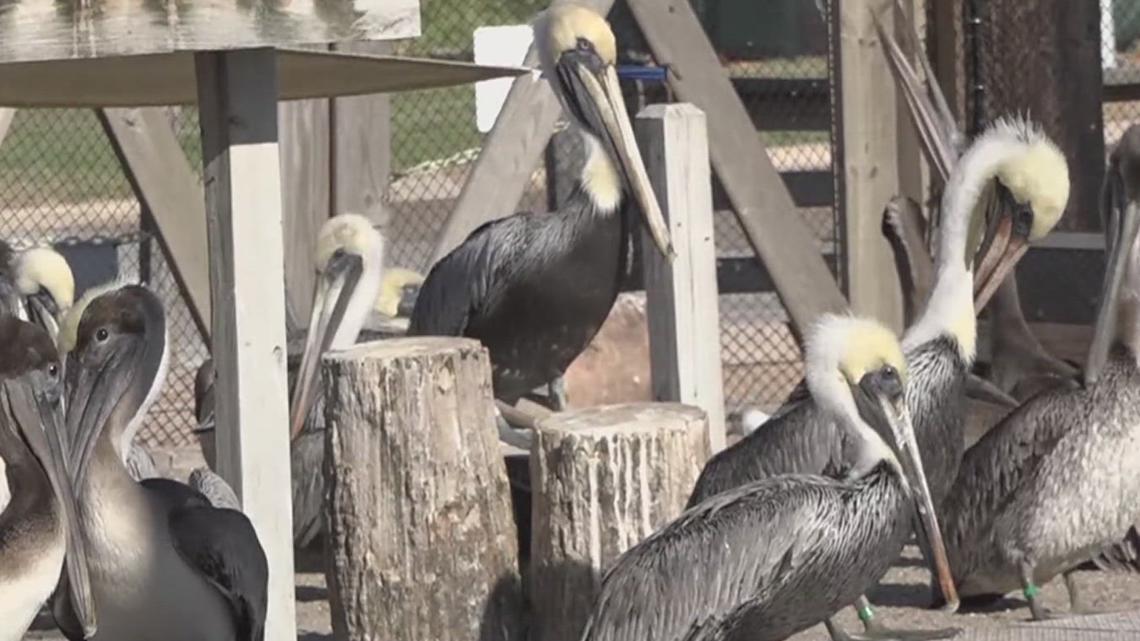
The number of injured birds taken in at the ARK has now risen from 150 to 350, prompting wildlife organizations from across the region to rally in support.
CORPUS CHRISTI, Texas — What began as a severe hailstorm last weekend has now turned into a wildlife crisis across the Coastal Bend. Following the storm, shocking images showing hundreds of dead and injured birds circulated on social media, a sobering reminder that the impact extended far beyond property damage.
RELATED: Hail damage repairs keep auto shops busy from Portland to Corpus Christi
Leaders at the Amos Rehabilitation Keep (ARK) say this is the first time they’ve seen a mass event of this scale affecting local bird populations. The number of injured birds taken in has now risen from 150 to 350, prompting wildlife organizations from across the region to rally in support.
“I mean, cold stunning events with sea turtles,” said Andrew Orgill with the ARK. “But definitely never with a mass stranding of brown pelicans that we’ve ever experienced.”
According to Orgill, the hailstorm, with baseball-sized hail reported in some areas, may have injured or killed an estimated 2,000 birds along the Gulf Coast. Many of the affected birds were brown pelicans nesting on Shamrock Island Preserve, a key rookery in Corpus Christi Bay.
“Shamrock Island Preserve is basically our pelican breeding island, our main rookery island in Corpus Christi Bay,” Orgill said. “So that whole island getting completely covered by that hailstorm was definitely… It was a tragedy for the birds that were on it. We’re just hoping that we can at least save enough of them to try to save that population.”
Brown pelicans were once listed as an endangered species, making this event a major setback for their ongoing recovery efforts.
At the forefront of the rescue operation is Dr. Shayna Whitaker, who has been examining each injured bird one by one.
“You can see the bruising all up here and even some bleeding and lacerations,” Dr. Whitaker said. “We’ve also had a lot of eye injuries, where the hail probably hit them on the head or in the eyes.”
Dr. Whitaker explained that birds’ lightweight bone structures make them especially vulnerable to strong impacts.
“Just palpating down every bone to see if we feel any fractures, if they’re big and obvious, we can make decisions,” she said. “Otherwise, we do have an X-ray machine and they’ll get X-rays taken.”
While some of the injured birds are showing signs of recovery, many others have not survived.
“Taking care of each one individually has definitely not been easy,” Orgill said. “It was a devastating loss to the colony. The birds that we’ve had come in, a lot of them unfortunately have been really badly injured.”
Still, the ARK team remains hopeful as they continue their work.
“They’re not able to be rehabilitated unfortunately, so at least they’re here, we’re able to end their suffering and give them some peace at the end,” Orgill said. “But thankfully, there’s also a large portion of them that we think will do okay.”
If you’d like to help, visit ARK’s website to get involved.