
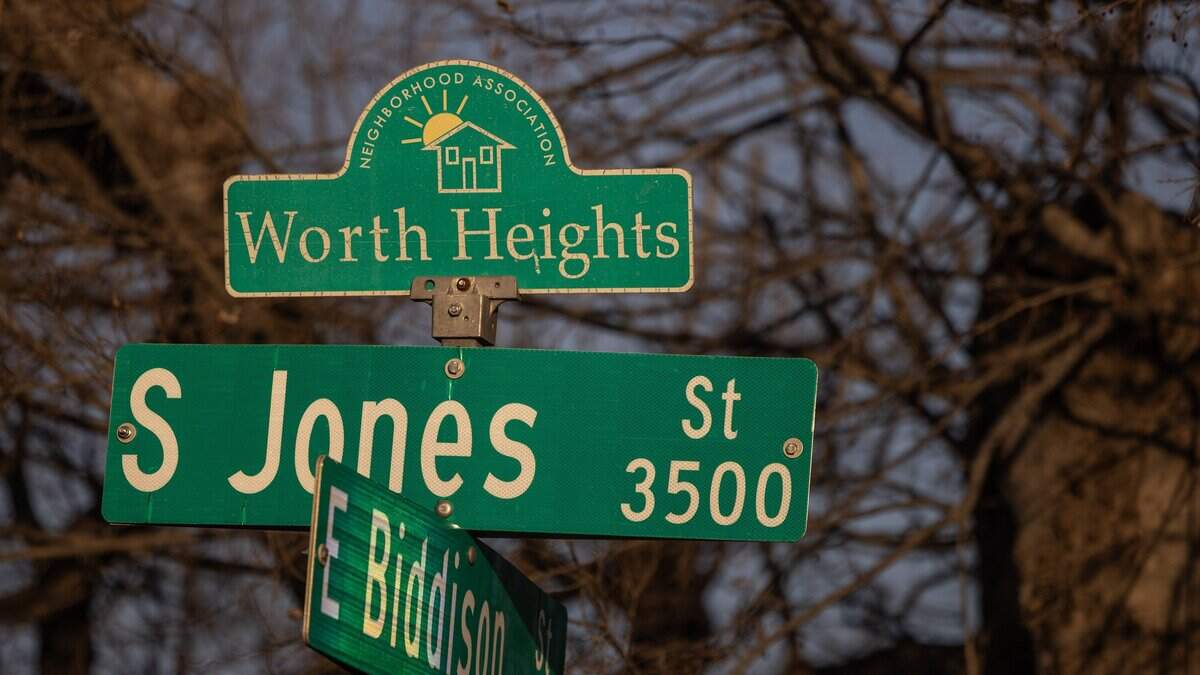
A Worth Heights Neighborhood Association sign is put on top of the street sign at the intersection of South Jones Street and East Biddision Street in Worth Heights on Wednesday, Feb. 14, 2024.
Chris Torres
ctorres@star-telegram.com
A Fort Worth program for funding projects in underserved neighborhoods has about $800,000 to spare — where should the money go?
On Aug. 8, Worth Heights residents had the chance to vote on three proposals for the re-allocation of roughly $800,000 that was slated for the demolition of a grain elevator at 3700 Alice St. that has been an eyesore and a headache for the neighborhood and the city.
The money came from the Neighborhood Improvement Program, a city-run program that targets a neighborhood each year for infrastructure improvements designed to boost safety, aesthetics and investment.
The city issued a demolition permit for the grain silos in 2024, but the price tag to tear them down — $1.4 million — was too expensive even with the funding from the NIP. The city would still be roughly $600,000 short, a spokesperson told the Star-Telegram, making demolition “unfeasible at this time.”
Here’s what the city proposes spending the money on instead, according to materials presented to residents on Aug. 8 at a back-to-school event in Worth Heights:
Roughly $876,000 could be spent on “pavement rehabilitation for Dickson Street, Bryan Avenue, and St. Louis Avenue.”Roughly $215,000 could be spent on a “five-person UpSpire cleanup crew for a one-year term.” UpSpire is a litter cleanup service.Roughly $30,000 could be spent on “improving the basketball/tennis court at Worth Heights Park.”
One option that was not on the table — to the dismay of some residents — was the former site of the Seminary South branch of the Fort Worth Public Library, which serves as the Fort Worth History Center at 501 E. Bolt St.
The library closed in 2022 and relocated to La Gran Plaza in south Fort Worth, but some residents have said that the new location does not meet the community’s needs. They want the library back at the old location with improvements.
At the Aug. 8 event, some residents were petitioning for the NIP funding to be used to improve the library, but the city did not present it as a possible option.
A spokesperson for Fort Worth’s neighborhood services department told the Star-Telegram that in 2025, budget limitations forced libraries to be removed from the allowed list of uses for NIP funding. The decision, the spokesperson said, was disseminated to residents informally during meetings — not announced in a document or formal settings.
Fort Worth voters approved a proposition in the city’s bond election in May that dedicated $14 million to fix up two libraries and move the History Center collection to the old City Hall building, 200 Texas St.
On Thursday, Aug. 12, the city said the library will reopen with the furniture and collection from La Gran Biblioteca.
“The Seminary South Library will be reopened to the public as a library,” a city spokesperson said. “The building is in good condition and paired with the relatively new items from La Gran Biblioteca, it will make an attractive space.”
The spokesperson did not specify when the library would reopen.
Vicki Bargas, president of the Worth Heights neighborhood association, said that she was not told about the decision to remove libraries from the allowed uses of NIP funds.
“I, as a resident who wants to use the library, am not satisfied with that,” Bargas said. “I guess they just changed their minds, and we’re supposed to just live with it.”
Bargas said that she would still like to see some of the remaining NIP funds spent on the library, if the city can find a way.
“It seems to me that they’re not trying very hard to work with us on this, and if the money is there, I don’t understand where the shortfall is,” Bargas said.

Fort Worth Star-Telegram
Emily Holshouser is a local news reporter at the Fort Worth Star-Telegram.