
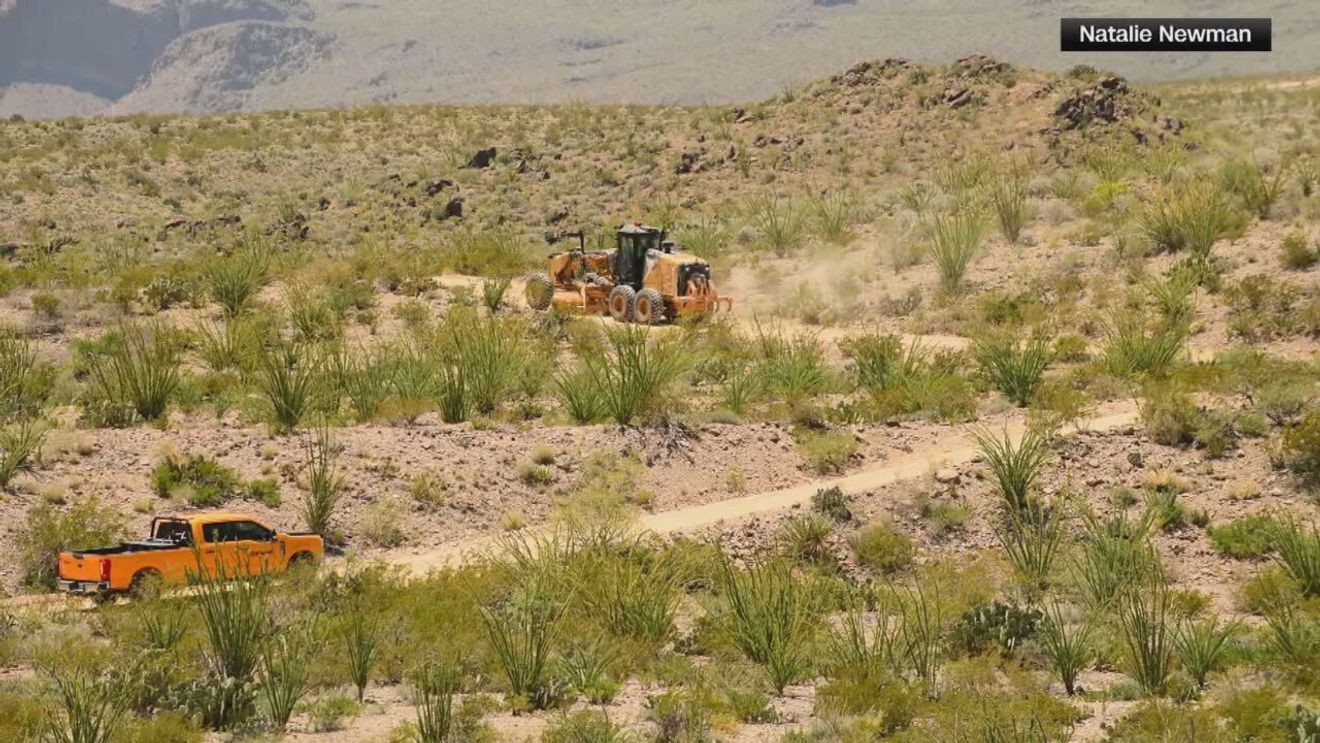
San Antonio, Texas — Heavy equipment is moving through Big Bend National Park as conservation advocates raise new questions about how much of the protected landscape could be disturbed by planned border infrastructure.
The National Parks Conservation Association says it has not received detailed plans from U.S. Customs and Border Protection showing exactly what will be built or where construction will take place.
“We have not seen specific plans from CBP on what they’re wanting to do,” said Cary Dupuy with the National Parks Conservation Association.
Dupuy said the most detailed information publicly available to her organization is a federal “Smart Wall” map indicating vehicle barriers and paved roads are planned in portions of the region. She said the precise locations remain unclear.
The equipment already operating inside Big Bend has heightened the group’s concerns because Dupuy said her organization understands the current activity is related primarily to surveying and planning.
“If this is the damage that’s being incurred right now from planning and surveying, what does that look like when you’re getting to paving roads, building those vehicle barriers, and doing more construction?” Dupuy said.
Dupuy said her organization has followed border wall construction across the Southwest for years and has seen the environmental effects of similar projects in Arizona.
“We have actually seen and are seeing right now in Arizona in our national park sites at Organ Pipe — actually, mountains are being blasted to build in roads,” Dupuy said.
She said some areas generally identified for roads in the Big Bend region include rugged canyons and mountainous terrain.
“From an engineering perspective, there you would assume that there would need to be some blasting in roads,” Dupuy said. “We have definitely seen in other national park sites with border wall construction that mountains have been blasted. Extensive damage has been done that cannot be restored whatsoever.”
The National Parks Conservation Association is also concerned about the amount of water major construction could require in one of the driest regions of Texas.
“A lot of the construction that we anticipate would need to be done will also need to take a lot of water, and you question where that water is coming from in a very, very, very water-stressed region,” Dupuy said.
She said construction traffic and bulldozing could also produce significant dust and affect wildlife and the park’s internationally recognized dark skies.
“You have trucks coming in and out with lights on at night, and that’s just the tip of the iceberg as well,” Dupuy said. “There are so many other impacts.”
Dupuy said the concerns are not limited to Big Bend National Park.
According to the National Parks Conservation Association, five border infrastructure projects are planned across the broader Big Bend region, stretching from Fort Quitman, west of Presidio, to Amistad National Recreation Area.
“Environmental and historic preservation rules have been waived for all of those areas,” Dupuy said. “There are so many protected and preserved and special areas that are being impacted by this border construction.”
She said the waivers mean projects can proceed without complying with some environmental and historic preservation requirements that would normally apply.
“It’s very, very concerning, the impacts that can happen that just are not going to be able to be reversed,” Dupuy said.
Former Big Bend National Park Superintendent Bob Krumenaker, who now chairs Keep Big Bend Wild, is also criticizing the work.
Krumenaker said the activity he is seeing does not match assurances he says federal officials have made about minimizing environmental damage and using natural terrain where possible.
“We are hearing from CBP that they are going to be very sensitive to the environment, they will use natural terrain wherever it exists, they will coordinate with locals,” Krumenaker said. “None of that is true.”
Krumenaker described the construction as a betrayal of people who believed Big Bend’s landscape would remain protected.
“This is a betrayal of the United States government against its citizens who thought that they were setting aside one of the most beautiful and pristine and biologically important places in the United States,” he said.
Construction is already affecting visitor access
The concerns are no longer limited to what could happen in the future.
Dupuy followed up with FOX San Antonio after her interview to point to areas of Big Bend National Park that have already been closed to visitor and recreational access during the ongoing work.
The National Park Service is posting current closures and conditions on its [Big Bend National Park Alerts & Conditions page]https://www.nps.gov/bibe/planyourvisit/conditions.htm?utm_source=chatgpt.com).
During her interview, Dupuy said those closures illustrate another consequence of construction.
“There are not only impacts to the landscapes, but there are impacts as people are wanting to come out and explore these places that they are not able to come and hike and enjoy them,” she said.
Dupuy also pointed to Organ Pipe Cactus National Monument in Arizona, where the National Park Service is posting current alerts and closure information
The Arizona site is significant because Dupuy says her organization has watched border construction there and believes it provides a warning about what could happen as work progresses in the Big Bend region.
For Dupuy, seeing bulldozers inside Big Bend has made tangible the concerns her organization has raised for months.
“It’s unbelievable that it was happening,” she said. “Just heartbreaking recognizing that this special place is now being bulldozed over. That something that’s so important to so many people and myself, including, could be changed forever as well.”
She said images of semitrucks, worker camps and other construction activity are also raising concerns about what comes next.
“That gives an idea of what is to come,” Dupuy said. “We’re very concerned, and just think, and are calling for this to be stopped at this point before any further damage is done.”
The National Parks Conservation Association is calling for the work to be halted while federal officials provide more information about what is planned and consider other ways to address border security.
“We just don’t know the details of what the plans are,” Dupuy said, “and we need to stop and have a conversation about what’s being planned.”