
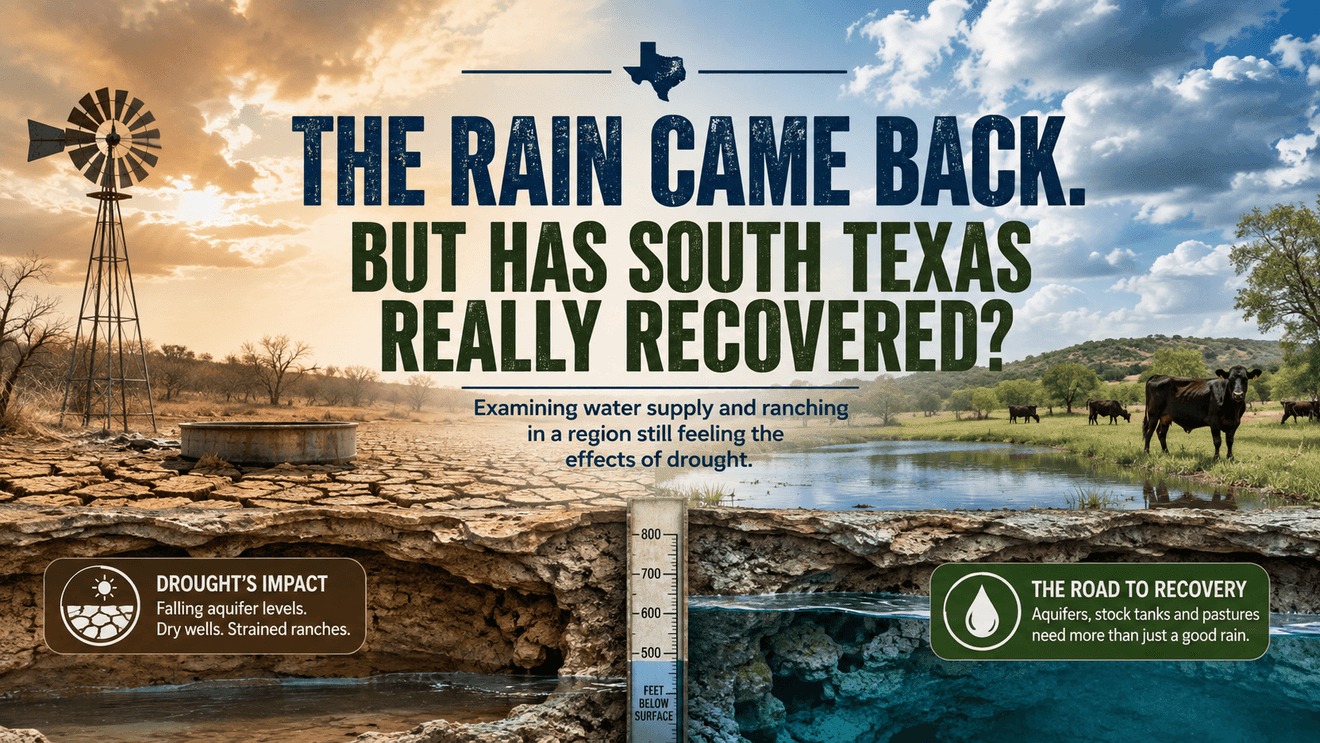
SAN ANTONIO – Recent rain has transformed parts of South Texas. Aquifers are rising, pastures are greener and stock tanks have recharged but after years of drought, the region’s water supply and ranching economy are telling a more complicated story.
If you judge drought by the color of the countryside, South Texas looks considerably better. Pastures that were brown and stressed are green again. Soil moisture has improved in many areas, and runoff has put water back into some creeks, lakes and stock tanks.
But underneath all that green, South Texas is still recovering. You’ll need to look hundreds of feet below your feet to find the best evidence of that.
The Edwards Is Rising — But We’re Not Back to Normal
The Edwards Aquifer has responded dramatically to this year’s rainfall. The Bexar County J-17 index well at about 651 feet above mean sea level on Aug. 13, with Comal Springs flowing above 200 cubic feet per second. The aquifer responds relatively quickly when significant rainfall reaches its recharge zone. July rains were right on target.
But there’s an important distinction between “recovering” and “recovered.”
The San Antonio Pool remains under critical-period pumping restrictions based on worsening aquifer conditions. The Edwards Aquifer Authority (EAA) has declared Stage 2 Critical Period Management (CPM) for Edwards withdrawal permit holders in the San Antonio Pool of the EAA’s jurisdiction, which includes Medina, Bexar, and parts of Atascosa, Caldwell, Guadalupe, Comal, and Hays counties.
The July rains temporarily helped the aquifer recover enough to ease pumping restrictions to Stage 1. But hotter, drier weather has caused water levels to fall again. That means permitted Edwards Aquifer pumpers are now subject to a 30% reduction in their authorized pumping, adjusted for the amount of time Stage 2 remains in effect.
Why is this important? It tells us the improvement from July’s rainfall wasn’t enough to end the region’s longer-term water problem. That tells us something important about drought. One wet month can help the Edwards Aquifer considerably, but it doesn’t erase several years of drought.
A drought can disappear from the landscape faster than it disappears from the water supply.
The Ranch Doesn’t Recover Overnight
Rain can change the appearance of a pasture surprisingly quickly. Recovering the productive capability of that pasture can take much longer. A pasture can be green without being ready to support the same number of cattle it carried before a prolonged drought.
That distinction matters.
Then There’s the Cost of Drought
Drought isn’t just a weather event for a ranch. It’s a business event. When grass disappears, ranchers may have to buy hay and supplemental feed. When stock tanks dry up, water may have to be hauled. When forage can no longer support the herd, cattle may have to be sold. Rebuilding that herd isn’t necessarily cheap.
Texas cattle prices remain historically strong in 2026. That’s good news if you’re selling cattle. It can be a very different story if you’re trying to rebuild a herd. A rancher who reduced cattle numbers during drought may now face high replacement costs at exactly the moment conditions finally look favorable enough to begin rebuilding.
So drought recovery isn’t simply meteorological. It’s hydrological. It’s agricultural, and financial.
The Green Can Fool You
That’s probably the most important lesson from what we’re seeing right now. Rainfall can erase the visual evidence of drought remarkably quickly. But it doesn’t instantly refill every aquifer. It doesn’t restore every stock tank. It doesn’t repair years of stress on native grasses. It certainly doesn’t replace cattle sold when there wasn’t enough forage to support them.
South Texas has unquestionably received some badly needed help from Mother Nature. The Edwards Aquifer has responded. Pastures have responded. Ranch country has responded. But recovery from a multi-year drought is a process, not a rainfall total.
Two South Texas Water Worlds
There is also a larger story unfolding around San Antonio. More than 2 million people depend in some way on the Edwards Aquifer system, which extends beneath roughly 8,800 square miles of South-Central Texas. Yet the people above that aquifer don’t all experience water shortages the same way.
Inside San Antonio, decades of investment have created a diversified municipal water system. Outside the city, a ranch may still depend heavily on groundwater beneath the property and rain falling from the sky.
Same weather. Same drought. Very different vulnerabilities. That may become increasingly important as South Texas continues to grow.
For now, the rain has bought the region something extremely valuable: time to recover. The recovery time it appears is short-lived. Long-range models show no signal for significant rainfall into September.