
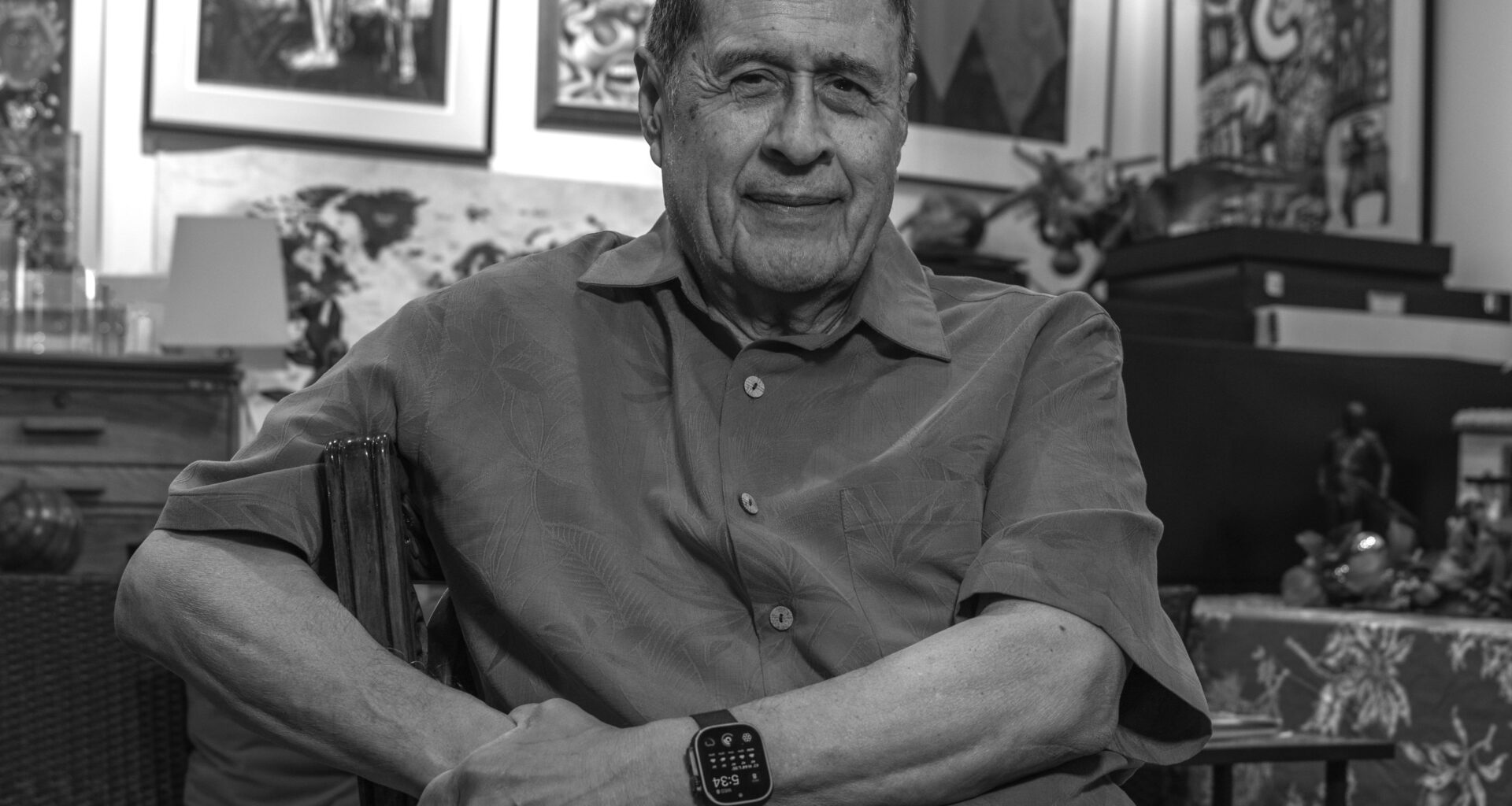
For decades, Gilberto Cárdenas worked at the intersection of Latino culture, scholarship and community engagement, and he sought to elevate the profiles of Latino artists through a variety of avenues, including creating a national gathering devoted to studying and advancing U.S. Latino visual art.
Later in his career, Cárdenas taught Latino studies at the University of Notre Dame, where he was the founding director of the university’s Institute for Latino Studies. He was also assistant provost at Notre Dame, and he later served as the executive director of Notre Dame’s Center for Arts and Culture.
Cárdenas was also a major art collector. He and his wife donated thousands of works to various museums, including about 2,000 works to Chicago’s National Museum of Mexican Art, on whose board he served. He also donated artwork to the Snite Museum of Art at the University of Notre Dame, as well as to museums in Texas and Washington, D.C.
“He was instrumental in ushering in a new era where Latino and Chicano art are part of the canon of American art,” said retired Smithsonian Latino Center director Eduardo Diaz, a longtime friend and colleague. “That wasn’t really the case before.”
Cárdenas, 79, died of complications from cancer on July 26 at his home in Austin, Texas, Diaz said. He previously had lived in South Bend, Indiana.
Born in San Gabriel, California, in 1947, Cárdenas was the son of a single mother who worked as a secretary. Growing up near Los Angeles, Cárdenas was, by his own reckoning, a gang member as a teen. After graduating from East Los Angeles College in 1967, he earned a bachelor’s degree from California State University in 1969. During college, Cárdenas took a keen interest both in Mexican American student organizations, as well as in documenting the Chicano movement of Mexican American identity through photography.
Cárdenas earned a master’s degree in sociology from the University of Notre Dame, and in 1975 a doctoral degree from Notre Dame. While at Notre Dame, Cárdenas assisted Notre Dame professor and Latino studies pioneer Julian Samora on “Los Mojados: The Wetback Story,” a seminal 1971 nonfiction book published by the University of Notre Dame Press that explored immigration to the U.S. by undocumented Mexicans and dissected the various dynamics at play in migrant workers’ lives.
After graduate school, Cárdenas began teaching sociology at the University of Texas at Austin, where he earned tenure and taught for more than two decades. As a scholar and educator, Cárdenas built a Mexican American studies program at the U. of Texas, and he also researched and wrote on topics such as immigration, labor, race, ethnicity and border communities.
“We’re trying to use the whole educational process to improve society,” Cárdenas told the Indianapolis Star in 2001. “I want to motivate and train a new generation of scholars — to make them more aware of (Latinos).”
Though a sociologist by training and profession, Cárdenas found himself more deeply drawn and connected to the work of artists. During his years in Austin, he became an enthusiastic collector, advocate and champion of Latino art. In 1986, he founded Galería Sin Fronteras in Austin, a gallery and gathering place for artists, scholars, activists, collectors and those in the community. Cárdenas — who often quipped that the often cash-strapped facility should have been named “Galería Sin Dinero” — prided himself on nurturing artists whose work had been overlooked by mainstream institutions.
Starting in 1995, Cárdenas spent 18 years as the executive director of the Inter-University Program for Latino Research, a New York-based collaborative of 21 university-based Latino research centers, departments and programs across the country that sought to define the national research agenda for Latino studies. Cárdenas’ specific interest in art led to his 2005 creation of a national gathering of U.S. Latino visual art, called “Latino Art Now!”
In 1995, Cárdenas left the University of Texas to join his alma mater, Notre Dame, as a professor, assistant provost and as the founding director of its Institute for Latino Studies. The university asked Cárdenas to open the institute in 1999 as a way to demonstrate a stepped-up commitment to the (predominantly Catholic) Latino community.
Cárdenas also served on the Smithsonian Institution’s task force on Latino issues, which led to increased Latino representation throughout the Smithsonian. He also spearheaded the creation of a national Latino museum studies program, and in 1994 he was the founding executive director of the nationally distributed “Latino USA” radio program that shared Latino voices and stories on National Public Radio.
Throughout his working life, Cárdenas invested well financially, allowing him to assemble a massive personal collection of nearly 20,000 pieces of art from Latino artists. After retiring from Notre Dame in 2018, he focused on donating thousands of pieces from his art collection to various museums.
In 2023, Cárdenas and his wife donated more than 7,000 works of art from their collection to the Blanton Museum of Art in Austin, Texas. Cárdenas previously had gifted prints to the Blanton in 2019 that had been produced at a landmark printmaking workshop in Los Angeles. That earlier gift dovetailed with his past work with printmaking, including establishing a consortium of Latino printmaking workshops across the U.S. in 2000 that came to be known as Consejo Grafico Nacional.
Cárdenas also donated about 2,000 works to Chicago’s National Museum of Mexican Art in Pilsen. The National Museum of Mexican Art president emeritus and founder Carlos Tortolero called Cárdenas “one of the most important and impactful Mexicans in U.S. history.”
“He was a Renaissance man,” Tortolero said. “In the arts, education, social justice and the list goes on, Gil was both a Mexican and American leader. In gratitude for his art, the National Museum of Mexican Art named a gallery for him and his lovely wife.”
Cesáreo Moreno, the visual arts director and chief curator at the National Museum of Mexican Art, said in a statement that Cárdenas “believed deeply in the power of art to preserve history, shape identity and inspire change.”
“Gil moved with ease among artists, entrepreneurs, scholars and politicians, always making the case that the arts deserved greater equity recognition and investment,” Moreno said. “He possessed a rare ability to connect people and ideas, bringing enthusiasm and generosity to every endeavor. Many of us will miss Gil — his gregarious laugh, his playful skips and little dances whenever he was excited about a new idea, a remarkable acquisition or simply a wonderful meal shared with friends. Those moments reflected the joy with which he embraced life and the people around him.”
Cárdenas also donated artwork to the Snite Museum of Art at Notre Dame and to the Smithsonian American Art Museum in Washington.
“He was an extraordinarily generous man,” Diaz said. “He had the ability with his collection to make a difference.”
Cárdenas rediscovered his religious faith in the mid-1990s, and he long had viewed his work as part of his faith and the quest for freedom, opportunity and racial equality.
“For me, the idea of the American dream is the dream for equality,” he told the Indianapolis Star in 2001. “It’s important for us to have values and pursue them in ourselves. I want to see us fulfill the values of our society.”
A first marriage ended in divorce. Cárdenas is survived by his wife, Dolores Carrillo Garcia; two sons, Xoan and Alessandro; a stepdaughter, Jessica Duarte; two stepsons, Jason and Jon Paul; nine grandchildren; and two brothers, Frank and Robert.
A celebration of life service is being planned.
Bob Goldsborough is a freelance reporter.