
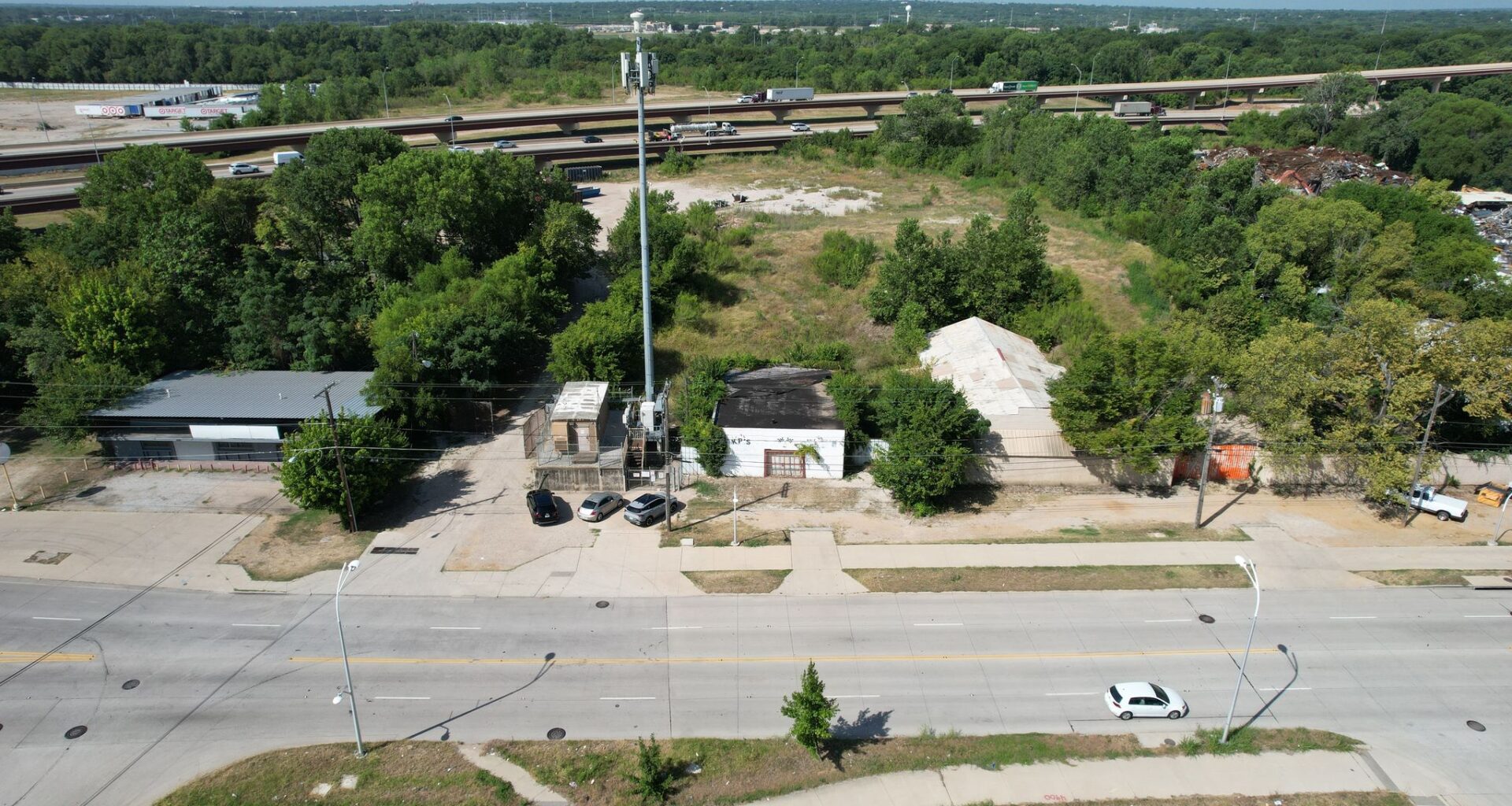
Aerial view of four neighboring properties in south Dallas, that are the subject of a multi-year lawsuit filed by the city.
Courtesy of Robert Wink
Realtor Robert Wink (right) opens the front garage door to Michael Williams’ South Dallas industrial property, Tuesday, July 21, 2026.
Juan Figueroa/The Dallas Morning News
A hill made of illegally dumped dirt slopes down towards Michael Williams’ South Dallas industrial property Tuesday, July 21, 2026.
Juan Figueroa/The Dallas Morning News
Dried mud left from flooding is photographed on the floor of Michael Williams’ South Dallas industrial property Tuesday, July 21, 2026.
Juan Figueroa/The Dallas Morning News
Michael Williams motions to the back of his South Dallas industrial property where a hill made of illegally dumped dirt slopes down towards the building, Tuesday, July 21, 2026.
Juan Figueroa/The Dallas Morning News
Michael Williams paused outside the building he bought more than a decade ago, unsure whether he could even get inside.

Overgrown grass swallowed the property. Inside, dried mud coated the floor where floodwater had repeatedly seeped into the building. Behind it, a 30-foot mound of dirt towered over the back of the property, sloping toward the building.
The mound of dirt — placed there in an attempt to prevent flooding without Williams’ knowledge — has rendered the vacant property on Botham Jean Boulevard essentially unusable over the past decade.
Article continues below this ad
Williams hoped he could rent the property to generate income. Instead, it has generated something quite different: a maddening and protracted legal battle that has involved Williams, his one-time business partner, a neighboring property owner, the city of Dallas, a city-appointed receiver, four courtrooms and at least five judges.
Nine years later, the pile of dirt that is the point of contention remains.
For Williams, the mound is a reminder of everything he hoped the property would become — and everything it never did.
“When I started this I was 57 years old,” he said. “I’m 71 years old and I’m still dealing with this issue.”
The thousands of tons of fill dumped without permits across four properties, totaling over 8.1 acres, including Williams’, in a FEMA-designated floodplain in South Dallas. The main legal contention is who should be responsible for removing it and restoring the properties to compliance.
Article continues below this ad
Over the course of the nine-year legal battle, the city has pursued enforcement action against Williams, his former business partner Keith Poole, and Neil Goldberg, the neighboring property owner.
Poole and Goldberg both told The Dallas Morning News that Poole brought the fill onto the properties to address frequent flooding. Goldberg said that he had no idea that Williams co-owned the property with Poole during that time.
Who’s responsible for the cleanup depends largely on whom you ask. City inspectors first documented the illegal dumping violations in 2017. Judges since have repeatedly ordered the fill removed to no avail.
Multiple rounds of mediation involving Williams, Poole, Goldberg and the city failed to produce a resolution. As such, last year a Dallas County judge appointed a receiver to oversee cleanup — an extraordinary legal remedy used when traditional code enforcement fails.
In a statement to The News, the city said it has pursued multiple enforcement measures, including seeking the receiver “to take control of the properties, evaluate the feasibility of all options and undertake the work necessary to address the violations.”
The city said it continues working with the receiver and property owners to bring the properties into compliance “as efficiently and expeditiously as possible.”
Article continues below this ad
None of the characters in this drama view any of this as efficient or expeditious.
“If people really wanted the fill removed, it would be gone already,” Williams said. “It wouldn’t take all these years or court orders to have this settled and squared away.”
The dirt isn’t the only thing that has piled up. So, too, has the cost.
It is unclear how much it would cost to remove the dirt but Goldberg believes it would exceed the value of the properties, which is estimated at more than $500,000. In addition, the court-appointed receiver has accumulated more than $47,000 in fees – and growing.
The lawsuit filed by the city against Williams, Poole and Goldberg is scheduled for trial Nov. 10.
Article continues below this ad
Williams says he neither authorized nor knew about the dumping until after it occurred and is unable to sell the property despite his efforts to hold someone responsible and bring the property back into compliance.
“It’s mind-boggling that this is being done and nobody’s doing anything about it,” he said.
Why removing the dirt isn’t simple
The properties named in the lawsuit were in violation of several code compliance issues. They range from overgrown grass, graffiti, tire storage, trash and the most pressing one: unpermitted dirt or fill on a floodplain.
Under city code, permits are required before fill can be placed or removed on a floodplain. which is federal designation . Coordination and approval from the city’s floodplain management department is also required.
Article continues below this ad
Those requirements mean removing the thousands of tons of fill isn’t as simple as loading it into dump trucks and hauling it away.
Before any dirt can be removed, engineers typically must survey the property, evaluate soil conditions and analyze how removing the fill could affect flooding on surrounding properties, said Edwin Ochieng, a certified floodplain manager who has no involvement with the properties in the lawsuit.
“Flooding doesn’t stop at your property line,” Ochieng said. “If you’re fixing one spot, you might just push the water somewhere else.”
Large amounts of unpermitted fill can change how stormwater moves through a floodplain, increasing the risk of flooding elsewhere.
The technical complexity of removing the fill helps explain why cleanup could take months. It does not, by itself, explain why no engineering plan had been submitted years into the lawsuit.
Article continues below this ad
Court records suggest the delays extended beyond engineering challenges.
In 2022, Goldberg, the owner of three of the four properties named in the lawsuit, entered into an agreement with the city that gave him time to work with an engineer on a proposal for the site.
Court records later show the city repeatedly informed the court that no engineering plan has been submitted by Goldberg and his engineer, nor have any permits to remove the fill been sought.
Goldberg told The News he hired an engineer but he believes the city is unwilling to negotiate with him because of the lawsuits filed by Williams.
A business deal unravels
After being introduced through a mutual friend in 2014, Williams and Poole purchased the property together. According to court filings, the agreement called for Poole to operate an auto repair shop on the property while making monthly payments to Williams.
Williams said those payments never came.
In 2016, he sued Poole, seeking full ownership of the property. It was over the course of that three-year legal battle that Williams said he first learned the city had cited the property for code violations involving large amounts of dirt, debris and other fill material that had been placed not only on his property but also on three neighboring properties owned by Goldberg.
Ultimately the court awarded Williams 99% ownership of the property and Poole 1%, a decision Williams believes prevented Poole from avoiding responsibility for the violations remaining on the property.
The city separately filed its lawsuit against Williams, Poole and Goldberg seeking removal of the dirt and remediation of the property.
In 2021, a Dallas County court held Poole responsible for removing the dirt. He was held in contempt twice for failing to comply with the court order and ordered to serve 90 days in the Dallas County jail.
Poole told The News that he believes his inability to afford a lawyer impacted the outcome of the lawsuit and resulted in him being jailed.
Whether Poole remains responsible for removing the dirt is an open question because of further legal action in the case.
When enforcement escalates
The city’s lawsuit against all three property owners resulted in mediation and the appointment of the receiver.
“The defendants have been at an impasse,” the city’s filing states. “The numerous violations of the Dallas City Code remain — no engineering plans for rehabilitation have been submitted and no permits to remove the unpermitted fill material have been applied for or issued.”
The court appointed Texas Receivership Group, led by Perry Kilgo, and authorized an initial $40,000 receiver’s certificate to stabilize the properties and begin the process of bringing them into compliance.
Kilgo declined to comment.
Receivership is one of the most aggressive civil enforcement tools available to cities.
Typically, code enforcement begins with notices of violation and repair orders. If property owners fail to comply, the city can seek court orders requiring corrective action. A receiver is generally appointed only after those efforts have failed, giving an independent third party authority to manage the property, hire engineers and contractors, and take whatever steps are necessary to restore compliance.
Houston commercial trial attorney Jason Williams, who is not involved in the case, but has handled code enforcement cases, described receivership as a drastic step.
“This is an extraordinary remedy,” he said. “It gives the receiver a lot of power here.”
He said receivers are tasked with bringing the properties back into compliance and they “take over” the entire asset. For commercial properties that means receiverships are entitled to the income generated from business operations.
And receivers don’t work for free.
Every inspection, engineering consultation, court filing and meeting with city officials adds to the receiver’s bill.
Unlike ordinary invoices, those costs become liens against the property itself. If the fees go unpaid and the property remains out of compliance, a receiver can ultimately ask the court for permission to sell the property to recover those costs, Jason Williams said.
Years of litigation, no resolution
Despite years of litigation, there are still no signed court orders allocating responsibility among the property owners for removing the fill or determining how cleanup costs should be divided.
Michael Williams believes Goldberg should pay the majority – if not all – of the fees associated with bringing the properties into code compliance because Goldberg owns four of the properties that house the majority of the dirt.
Goldberg’s role in the litigation has also shifted over time.
Court records show the city initially sued Goldberg, in 2020, over the code violations. That led to yet another delay.
During court proceedings, the city requested that the presiding judge Staci Williams be recused because she previously sued the city. After an independent review, the city’s request was denied.
This process took almost an entire year, while the underlying case continued.
The city eventually dropped its lawsuit against Goldberg and instead added him to the lawsuit it had filed against Williams and Poole.
Williams said he spent years presenting evidence to the courts that he believes demonstrated a business arrangement between Goldberg and Poole.
Goldberg disputes Williams’ characterization of the case.
He told The News he has continued working with the city in an effort to bring the properties into compliance. Goldberg also said discussions involving the city, the Trinity River Authority and the city’s floodplain administrator ultimately stopped after they “stonewalled” him but did not dislcose details.
The city did not respond to The News’ follow-up questions about the case.
Goldberg challenged the court’s appointment of a receiver and later sought review in the Fifth Court of Appeals. The appeal was dismissed after court records show filing deadlines were not met.
Nine years later
For Williams, the legal battle has become about more than a vacant building.
“Going in and illegally bringing in dirt to raise the floodplain is definitely against FEMA, Texas Center for Environmental Equality and the Trinity River Valley Authority,” he said. “ I mean there’s just so many entities that it goes against and it’s being done as though none of these rules and regulations exist.”
He says the lack of progress has delayed his plans to move on with his life. Instead, the building has remained largely unusable and the financial costs have piled up.
Williams says he doesn’t plan on giving up.
“It has been extremely stressful to be involved in a situation like this where I basically dotted all I’s and crossed all T’s,” he said.
His property on Botham Jean Boulevard remains both an eyesore and a visible reminder of a legal quagmire that has gone on far longer than he could ever imagine.
He hopes the Nov. 10 trial finally resolves the matter — and not simply begin another chapter in a dispute entering its second decade.