
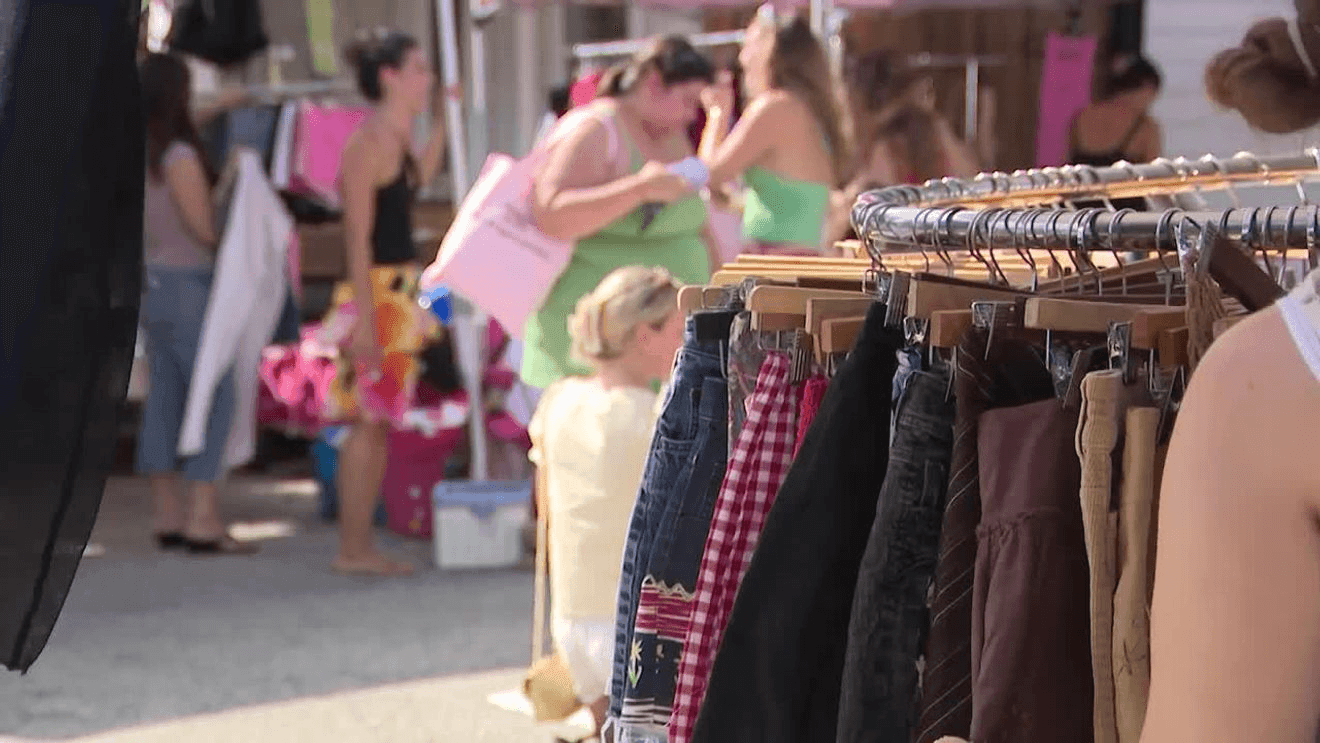
AUSTIN, Texas — As the day winds down in East Austin, a narrow road leads pedestrians toward the sight of colorful tents and the sound of upbeat music. Tucked into the side of the street is the Spoiled Night Market, a vintage thrift market that only does business once a month.
The Spoiled Night Market is only one of the many pop-ups that are beginning to decorate Austin’s business scene — from matcha stands to secret apartment restaurants — many small businesses are choosing to start without permanent storefronts.
“Obviously every vintage shop owner’s dream is to open your own storefront,” said Morgan Ledenko, founder of the Spoiled Night Market. “But sometimes the overhead becomes a lot more expensive.”
About 44% of pop-ups cost less than $5,000 to open, compared with an average of $40,000 for a traditional retail store, according to a Capital One shopping report from June.
Ledenko founded the Spoiled Night Market because she saw that Austin was lacking a curated space for women-owned vintage businesses. She started one herself a year ago using a pop-up format.
“I feel like it gets people excited; there’s more incentive to come shopping,” Ledenko said. “It gives each vendor an opportunity to really curate what they want for a month straight.”
The market offers everything from clothing to shoes and jewelry — and there’s even a matcha stand hidden away in the corner.
Mori Matcha’s mobile cart can be seen all around Austin. For co-founders Tiffany Nguyen and Aaron Perez, the pop-up format gave them room to grow.
“It was less commitment to go this route, which is why we started as a pop-up,” Nguyen said. “It’s less risk.”
ALSO| Fort Hood identifies two pilots killed in Apache helicopter crash near Salado
Early shipment issues made getting the business off the ground difficult, Perez said. But their pop-up model lent them the flexibility to work out those challenges.
“We’re also able to focus on the quality of our matcha just because not a lot of that cost is going into getting things up and running,” Nguyen said.
Over time, the couple realized that moving around the city didn’t keep them from building a loyal following.
“The number of times that we see regular faces is something that I’ll never get used to,” Perez said.
That community has also spilled into Austin’s neighborhoods.
Hannah Gustafson founded her business “The Tiny Project” by starting a jam stand in her own front yard, which eventually bloomed into a mini farmer’s market she calls “The Tiny Farmer’s Market.”
“I made a little Instagram account for it, and it just blew up,” Gustafson said. “I just kept inviting people. And now we consistently meet once a month, and there are 30 to 35 vendors.”
Having grown up in Austin, Gustafson said she is happy to see pop-ups make use of spaces that might otherwise be overlooked.
“It’s really cool to see people use, like, a backyard, or a backyard space of a small business,” she said. “And it’s a unique way for people to attend an event without a massive venue overhead cost.”
Some business owners are even running operations out of their own apartments.
Tanner Tran, a student at the University of Texas at Austin, occasionally turns his apartment into a craft ramen restaurant to serve the student community.
For Tran, who is a full-time student, the flexibility a pop-up offers is appealing – but the model comes with its own challenges.
“It would be easier if I had brick-and-mortar because then you have overflow that you can carry in,” he said. “Because it’s a pop-up, all the prep work has to happen right beforehand, whereas when you have a brick-and-mortar, the prep work is rolling.”
Tran’s dream is to make ramen full-time from a permanent location. But for now, he’s focused on taking care of his community.
“My main two focuses for next year are taking care of the team, making sure we’re all having a great time together, and then giving back to the community,” he said. “When it comes to other pop-ups, I want to support them in following their dreams, and then I want to give back to everyone who supported my dream.”
As more Austinites find unconventional places to turn their ideas into businesses, Gustafson said these low-barrier spaces are part of what makes Austin unique.
“I think it’s something very special that needs to be protected.”