
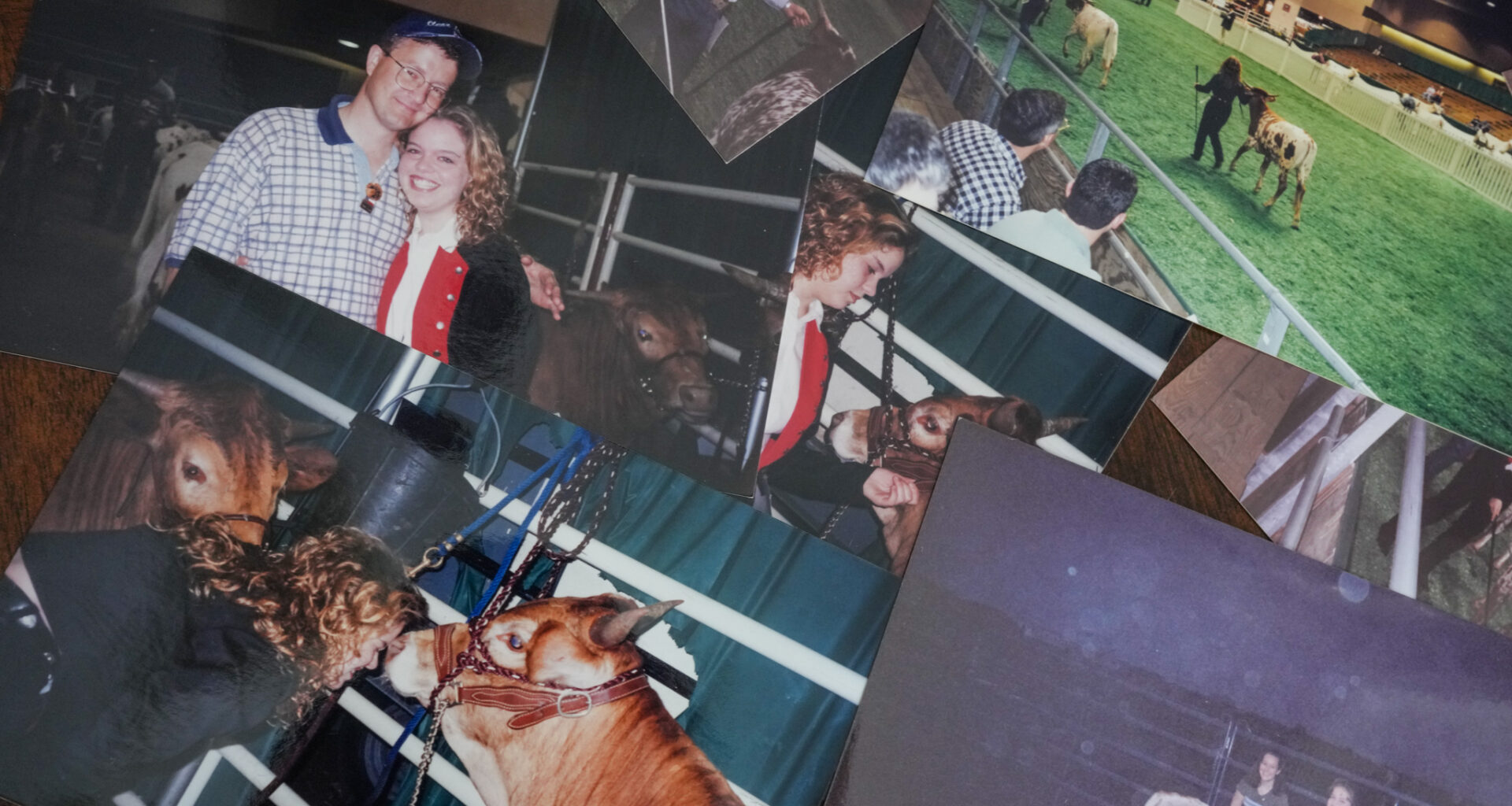
Mary Zwieg Dean looks through photos of herself when she was enrolled in The Longhorn Project in League City, Friday, Aug. 14, 2026. The Longhorn Project used NASA’s Johnson Space Center to raise longhorn cattle. Students took care of the animals and would take them to shows. Now, after 30 years, that project is ending.
Jacob Lujan/Houston Chronicle
Mary Zwieg Dean remembers pulling Copper’s Honey Bell into a competition arena in 1999. The longhorn, a stubborn white heifer with brown spots, had two speeds: immobile or running.
They did not win the contest.
“I tied her up, and I just leaned on her like, ‘Oh my gosh,’” said Dean, who was a Clear Creek High School student at the time. “First time showing her at the rodeo, and she’s running around like a spaz.”
Article continues below this ad
LONGHORNS: NASA’s Longhorn Project ends next week after three decades of student programs
Mary Zwieg Dean poses for a portrait in her home with photos of herself when she was enrolled in The Longhorn Project in League City, Friday, Aug. 14, 2026. The Longhorn Project used NASA’s Johnson Space Center to raise longhorn cattle. Students took care of the animals and would take them to shows. Now, after 30 years, that project is ending.
Jacob Lujan/Houston Chronicle
Mary Zwieg Dean is seen in a printed photo from when she was enrolled in The Longhorn Project in League City, Friday, Aug. 14, 2026. The Longhorn Project used NASA’s Johnson Space Center to raise longhorn cattle. Students took care of the animals and would take them to shows. Now, after 30 years, that project is ending.
Jacob Lujan/Houston Chronicle
Mary Zwieg Dean poses for a portrait in her home with photos of herself when she was enrolled in The Longhorn Project in League City, Friday, Aug. 14, 2026. The Longhorn Project used NASA’s Johnson Space Center to raise longhorn cattle. Students took care of the animals and would take them to shows. Now, after 30 years, that project is ending.
Jacob Lujan/Houston Chronicle
Mary Zwieg Dean looks through photos of herself when she was enrolled in The Longhorn Project in League City, Friday, Aug. 14, 2026. The Longhorn Project used NASA’s Johnson Space Center to raise longhorn cattle. Students took care of the animals and would take them to shows. Now, after 30 years, that project is ending.
Jacob Lujan/Houston Chronicle
Mary Zwieg Dean looks through photos of herself when she was enrolled in The Longhorn Project in League City, Friday, Aug. 14, 2026. The Longhorn Project used NASA’s Johnson Space Center to raise longhorn cattle. Students took care of the animals and would take them to shows. Now, after 30 years, that project is ending.
Jacob Lujan/Houston Chronicle
It was still a pivotal moment. Dean, now 45, was the first student to show one of NASA’s beloved longhorns.
The iconic cattle lived at the Johnson Space Center for three decades. Locals admired them while driving past NASA in southeast Houston. Tourists snapped pictures – what could be more Texas? – during tram tours. And more than 100,000 students visited the cattle during field trips or other programs, according to the Longhorn Project, which coordinated the cattle and other educational programming.
Article continues below this ad
But the longhorns are no longer at NASA. The project – much like the Saturn V moon rocket and space shuttle replica that surround its fields – is being put out to pasture.
The Longhorn Project announced last week that it would close due to “significant financial challenges and capital improvement needs that exceed its limited resources.” Its cattle have been rehomed with event venues, ranch owners and breeders, according to a letter the Longhorn Project posted to Facebook.
NASA confirmed the Longhorn Project is not renewing its agreement. Its “tenancy” expires on Wednesday, the agency said.
“We are proud of the generations of students we have inspired and the legacy created through this unique blend of agriculture, longhorns, science, engineering and space exploration,” the Longhorn Project said in its letter.
The cattle were the brainchild of George W.S. Abbey, an influential NASA leader and former director of the Johnson Space Center. Abbey, who died in 2024, was inspired to start the Longhorn Project by a faded photo in his office that showed cattle on the land before it became the Johnson Space Center, according to the Longhorn Project’s website.
Article continues below this ad
“Mr. Abbey loved the longhorns. I think we all did,” Estella Hernández Gillette, who spent 40 years at NASA and later became president of the local chapter of the NASA Alumni League, said in an email. “We were just a cow pasture, once upon a time, then we went to the moon! And we kept going.”
The Longhorn Project launched in 1996 as a collaboration with NASA’s Johnson Space Center and Clear Creek Independent School District. The Houston Livestock and Rodeo and the Texas Longhorn Breeders Association of America provided support.
The early years were managed by Ray Pieniazek, who taught agricultural science at Clear Lake High School from 1989 to 2000.
Pieniazek helped students care for the longhorns and prepare for shows. He recalled their joy, particularly one student who he described as glowing after she won a competition buckle.
He also remembered a few calls from NASA when a longhorn escaped its enclosure.
Article continues below this ad
“If any of them would get out,” he said, “I would get the calls at 1 in the morning.”
Sabrina Wilson, then Sabrina Dell’Osso, was among his early students and described the group as a little family. She said the Longhorn Project provided hands-on experience she couldn’t get in her urban neighborhood.
“It just gave me the opportunity to be with those animals that I really love,” said Wilson, who is now 45.
Wilson was sad to learn the program was ending. She hadn’t thought about it in years, though she recently began raising cattle at her home outside of Houston in Bellville. She cares for about 50 cattle with her husband, and they sell the meat.
The Longhorn Project later added aquaculture ponds and a seven-acre garden area so students could learn how food is grown. Joel Walker, who was the director of center operations at the Johnson Space Center for 25 years, tended a plot of onions and radishes for a while. “I was not one of the better gardeners,” he said.
Article continues below this ad
WILDLIFE: Meet the biologist who protects deer, snakes and space missions at NASA’s Johnson Space Center
At one point, a longhorn was named after him: JSC Joel Walker.
He enjoyed seeing the program connect agriculture with science and space exploration. Students used the longhorns for genetics lessons. They also learned about animal husbandry, fruit and vegetable cultivation, soil research and recycling. This knowledge was then connected to the future of human spaceflight, according to the Longhorn Project.
The Longhorn Project’s leaders worked tirelessly, Walker said, but he felt that it would struggle without an influx of money or support.
“Even in the best of times, it was never flush,” Walker said. “It’s similar to a lot of 501(c)(3)s, right? You kind of live on the edge.”
Dean, who showed the stubborn longhorn nearly three decades ago, lives in League City and routinely drives past NASA, pointing out the longhorns while taking her daughter to dance class. She’s sad to see the the program ending and changes at NASA, where her father worked as a pilot.
“It’s just one more thing that’s changing,” Dean said, “with the space program and the area.”