
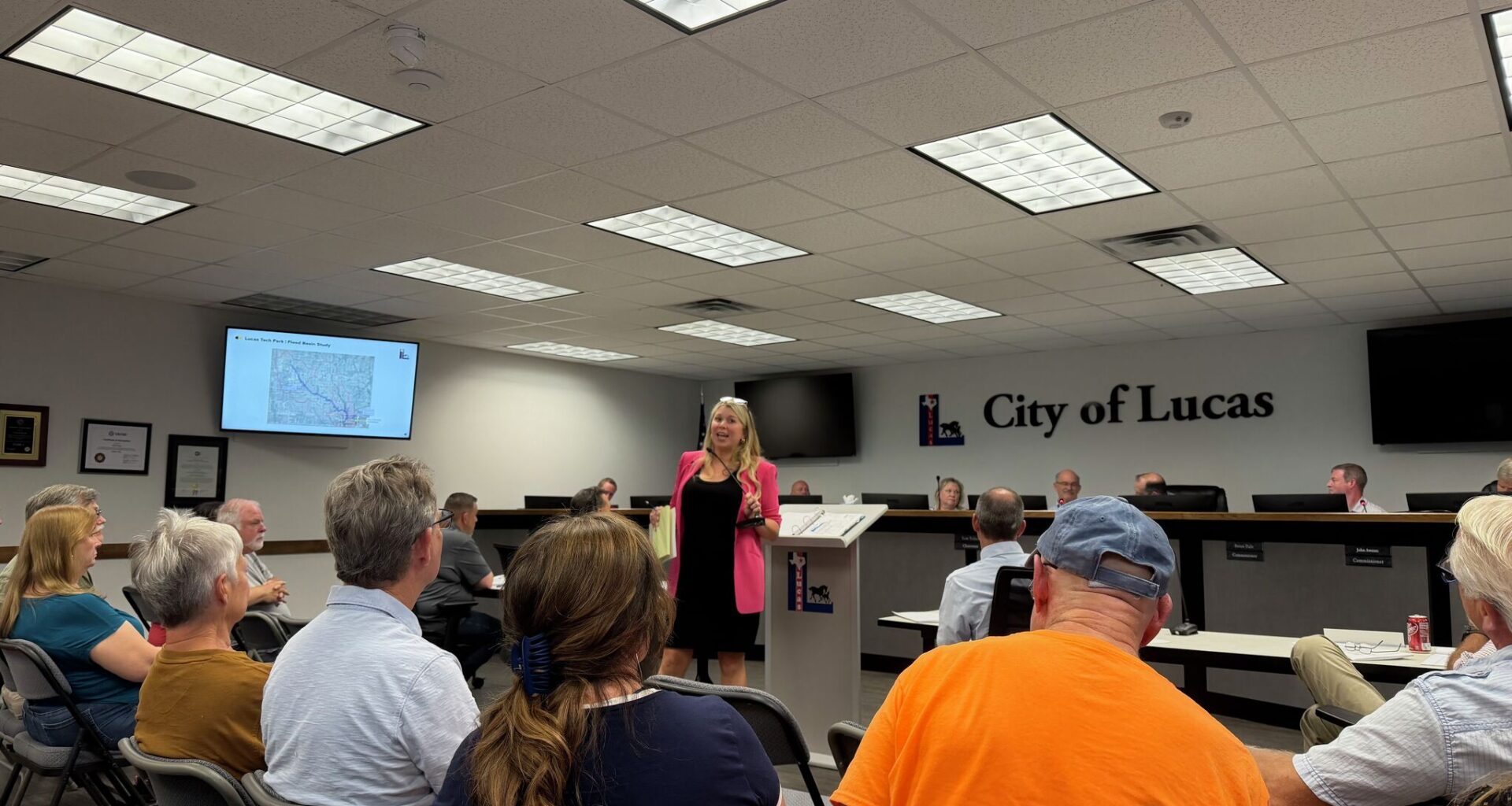
Kate Valent speaks in opposition to a potential data center at a planning and zoning commission meeting in Lucas, Texas on August 13, 2026.
Angela Mathew
LUCAS — If you searched the agenda packet for Thursday’s planning and zoning meeting in Lucas, a semi-rural town about 30 miles northeast of Dallas, you wouldn’t find the phrase “data center” anywhere.

But residents’ eyes widened when they spotted the phrase “technology storage facility” listed as one of 29 potential uses a commercial developer wanted to authorize for a piece of land at the edge of the city.
They feared an ugly facility guzzling their energy and water and a low hum all hours of the day and night polluting the country lifestyle they have worked to protect, even as neighboring suburbs Allen and McKinney embraced commercial growth.
Article continues below this ad
About two dozen residents of the Collin County town came to the meeting Thursday night, and planning and zoning commissioners mused that they’d never seen their small city hall so packed.
Related: Dallas ranks No. 1 primary data center market globally, surpassing Atlanta, Virginia
As demand for artificial intelligence ramps up, data center construction has boomed. Dallas-Fort Worth was recently named the top data center market in the country, but proposed facilities have faced local opposition in Red Oak, Westlake and Keller. This week, Fort Worth’s City Council took initial steps towards a data center moratorium and Prosper postponed a meeting considering a data center after public outcry.
The developer, St. John Properties, never said they intended to build a data center at the site. The project titled “Lucas Tech Park” was described in city documents as a commercial space spread across seven buildings. Raphael Alterman, a representative for St. John Properties, said the project could have tenants ranging from daycare centers to automobile repair shops to corporate offices.
Alterman said that two potential tenants use physical storage space, which is why the phrase “technology storage facility” was included in their application.
Article continues below this ad
“I understand it opens the door for it,” he said of data centers.
Resident Kate Valent said the way the technology storage use was included in the developer’s application was an “undermining of the public trust.”
She said her family specifically picked Lucas, where most residents live on two-acre lots with various pets and farm animals, for its peaceful rural atmosphere. A large commercial project, especially one that could someday include a data center, would threaten that, she said.
“I spent a lot of money to buy my old farmhouse here in Lucas when I could have gotten a brand new build in Frisco or Plano,” Valent said.
Article continues below this ad
Joe Williams, vice chair of Lucas’ planning and zoning commission, said the only other time a meeting was as crowded in his more than 12-year tenure was when the city voted on the application for the Walmart Supercenter that opened in 2013. Williams, an investment banker who lives on five acres with his family and miniature cows, said the city received 20 letters about the project, a rare occurrence for a single agenda item.
“All 20 of them are opposed, and all 20 are related to the one item about the data center. I’m sorry, ‘technology storage facility,’” Williams said, the audience giggling at the ambiguous phrase that had drawn them to the meeting.
Ultimately, the commission unanimously decided to remove “technology storage facility” as a land use for the project, but postponed the approval on the commercial project to their next meeting.
Resident Jennie Tissing was glad the commission did not authorize the land to be used for a data center, but she and others are still concerned about what they see as the encroachment of developers on their country oasis.
Article continues below this ad
“The people that come in for the different developments … they don’t live here,” Tissing said. “Once you give them the approval to build these buildings, it’s entirely up to them who they want to lease to … I don’t trust other people to run my community.”