
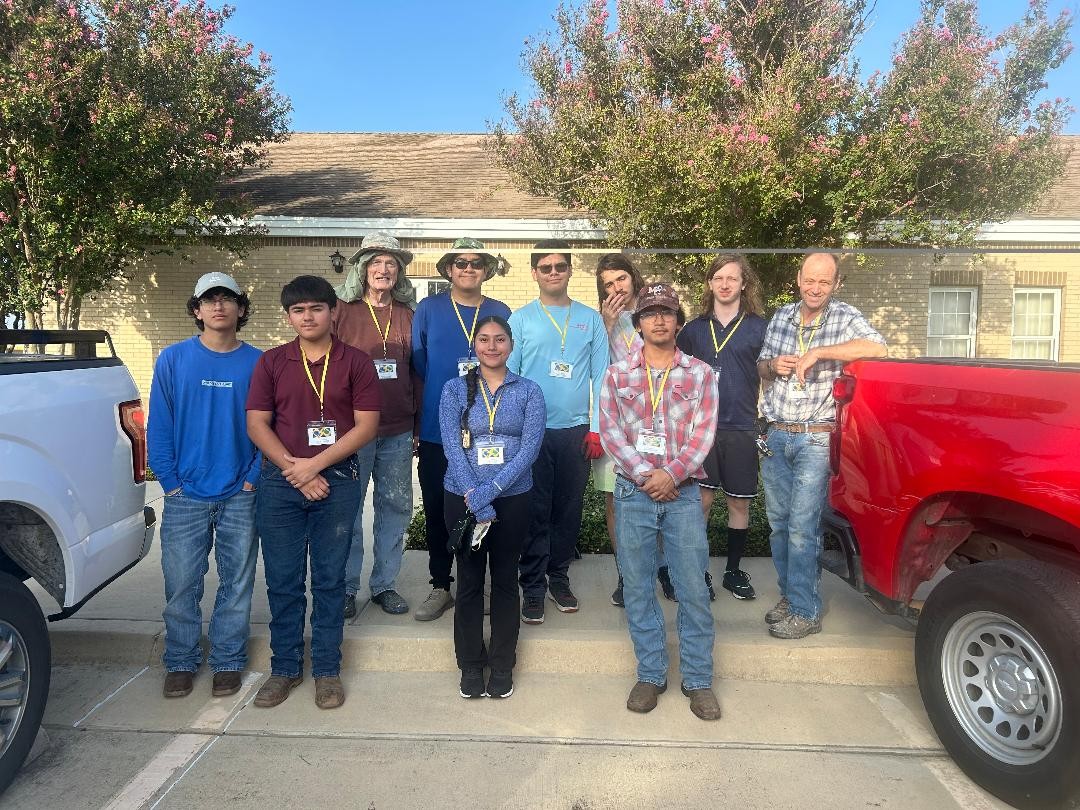
Members of The Church of Jesus Christ of Latter-day Saints from the Laredo area traveled to communities in the Texas Hill Country to assist families recovering from the July 2026 floods. Laredo volunteers joined teams from across South and Central Texas in removing flood-damaged materials, clearing debris and helping homeowners begin the recovery process.
Courtesy/Church of Jesus Christ of Latter-day Saints, Laredo Stake
When devastating floods struck communities across the Texas Hill Country in July, the call for help reached Laredo.

Members of The Church of Jesus Christ of Latter-day Saints in the Laredo area responded by sending volunteer teams into some of the hardest-hit communities, joining hundreds of other Texans in the difficult work of helping families begin putting their lives back together.
Article continues below this ad
For members of the Church’s Laredo Stake, which includes five local congregations, the response was personal.
Two 12-person teams were organized from the Laredo congregations to participate in the recovery effort, working alongside volunteers from throughout South and Central Texas in communities including Uvalde, Crystal City and Batesville.
Their assignment was not complicated: show up, work hard and help wherever they were needed.
That meant cleaning flood-damaged homes, removing debris and damaged materials, hauling refuse and helping homeowners begin the long process of recovering from the flooding.
Article continues below this ad
From Laredo to Uvalde
The Laredo volunteers were part of a much larger effort organized by local Church leaders in cooperation with emergency management officials.
Beginning shortly after the flooding, volunteers began arriving in Uvalde and surrounding communities. A local Church meetinghouse became a staging and coordination center where teams received assignments each morning before heading into affected neighborhoods.
The response eventually grew to hundreds of volunteers on peak days.
Article continues below this ad
Rather than simply arriving and looking for places to help, Church leaders worked with the Texas Division of Emergency Management and local officials to identify homes and other locations where assistance was needed.
That allowed volunteers to concentrate their efforts where they could make the greatest difference.
For homeowners, the help often came at a difficult moment.
Flood recovery can be overwhelming. Before rebuilding can begin, someone has to remove the mud, ruined furniture, damaged flooring, wet drywall and mountains of debris left behind by the water.
Article continues below this ad
That is where the volunteers came in.
More than swinging a shovel
The Laredo volunteers were part of an effort that extended beyond cleanup.
In the Uvalde area, Church volunteers helped distribute food and water to families affected by the disaster. More than 600 meals were distributed, and a large shipment of shelf-stable food was provided to a local food pantry.
Article continues below this ad
When Carrizo Springs experienced a disruption to its water supply, two truckloads of water were delivered to the community.
Church members also worked with a local Methodist congregation to establish and supply a clothing closet for people who had lost belongings in the flooding.
Other volunteers provided blankets, cleaning supplies and other necessities.
A larger South Texas response
The Laredo volunteers were joined by Church members from the San Antonio area, Corpus Christi and other communities, as well as missionaries serving in South Texas.
Article continues below this ad
Together, volunteers contributed thousands of hours of labor.
In the Uvalde and Zavala areas, the overall Church response accounted for more than 10,500 volunteer hours and included assistance at approximately 248 locations. In Kerr and Kendall counties, another 10,400 volunteer hours were recorded at approximately 275 locations.
But for those who traveled from Laredo, the numbers were less important than the individual families they encountered.
The work provided an opportunity for Laredo residents to do something tangible for fellow Texans who were facing a crisis.
Article continues below this ad
Why Laredo responded
The response illustrates something that can be easy to overlook during a disaster: Communities don’t have to be directly affected to be part of the recovery.
The Laredo volunteers were not responding to flooding in their own neighborhoods. They were responding because other Texans needed help.
That spirit of service is familiar in Laredo, where churches, civic organizations and community groups regularly mobilize to help neighbors facing difficult circumstances.
Article continues below this ad
For the members of the Laredo Stake, the flood response was simply another opportunity to put that principle into practice.
They came from their homes, businesses and families in Laredo, traveled north and went to work alongside people they had never met.
They brought tools and supplies.
They brought tired muscles.
Article continues below this ad
And, perhaps most importantly, they brought the message that the families affected by the floods had not been forgotten.
The recovery continues
The immediate emergency may have passed, but the recovery is far from over. Damaged homes must still be rebuilt, possessions replaced and communities restored.
The Laredo volunteers’ contribution was one small part of a much larger response involving government agencies, churches, nonprofit organizations and individual citizens.
Article continues below this ad
But disasters are ultimately overcome one home, one family and one helping hand at a time.
For the Laredo volunteers who made the trip to the flood zone, the experience offered a simple lesson: Sometimes helping your neighbor means driving a few hours to find them.