
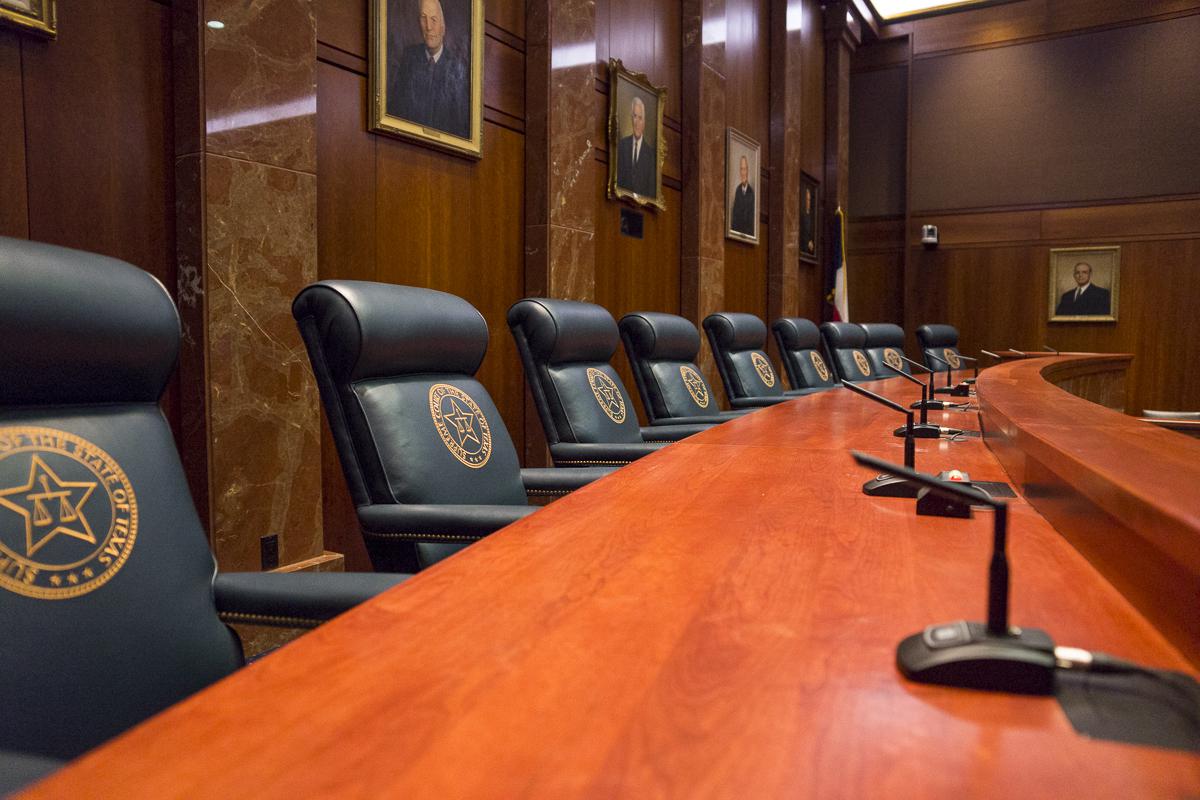
The Texas Supreme Court bench on July 30, 2020.
Courtesy of Texas Office of Court Administration
Two Galveston residents and a constable are asking the Texas Supreme Court to stop the county from using a newly redistricted map in the November general election,
They argued in an emergency petition that that because a different map was used in the primary election, the county’s actions violate equal protection and the election code — and set a bad precedent for the rest of the state.
FLOCK CAMERAS: Flock camera surveillance is spreading across the Houston region. So is the backlash
Article continues below this ad
Lawyers for Precinct 3 Constable Derreck Rose and county residents Wilma Green and Diane Merchant filed the emergency petition for writ of mandamus, which is a type of legal remedy that asks a higher court to order a public official to correct an abuse of discretion. The Justice Department has called this type of petition an “extraordinary remedy, which should only be used in exceptional circumstances of peculiar emergency or public importance.”
“If this is not stopped, the precedent set will be horribly damaging to democracy,” the petition states. “It will make Texas’s primary elections an empty exercise. The voters’ choices just cast aside on the whim of the government—the 4 very governmental officials on the ballot in the ongoing election. If polling against their general election opponent is looking bad, they can just change the map—up to the very eve of the election—to evade the voters’ judgment.”
Galveston County commissioners unanimously passed a motion in June to redraw boundaries for commissioner, justice of the peace and constable precincts. Galveston County Judge Mark Henry told the Chronicle in June the redrawing was done to align precincts for the “most efficient and beneficial setup,” helping keep the county Republican.
But because a different map — one that sparked a federal lawsuit over claims of racial discrimination — was used in the primary elections earlier this year, the emergency petition argues the change violates various parts of state election code. The petitioners argue that while the constitution allows commissioners to redistrict from time to time, they have to redistrict in accordance with state law.
Article continues below this ad
The post-primary redistricting also means a chunk of voters didn’t get to vote, or run as a candidate, in the primary for the new precinct the recent map has left them in, the emergency petition claims. Galveston County has staggered elections, and as a result, residents who voted in the primary but have now been moved to a precinct that isn’t having an election this year will not be able to vote until 2028. The petitioners argue that consequence violates equal protection.
In a response to the petition, lawyers for Galveston County argued the petitioners misinterpreted the state constitution and election code. The county’s lawyers argued mid-cycle redistricting doesn’t violate state election code, and that those filing the emergency petition don’t have a valid reason to ask the state supreme court to intervene because redistricting isn’t illegal.
“Texas Constitution expressly authorizes precinct redivision ‘from time to time,’ which necessarily includes periods between elections unless otherwise limited,” lawyers for the county wrote in their response. “No statute restricts the authority to redistrict commissioner, justice of the peace or constable precinct boundaries to a particular time period.”
The new 2026 maps have effectively switched the precincts of the Precinct three Justice of Peace and the Precinct 4 Justice of Peace. Galveston County’s lawyers stated in their response that the plan is to have the Precinct 4 Justice of the Peace, Republican Kathleen McCumber, who is not up for reelection in November, finish the last two years of her term in Precinct 3. The Precinct 3 Justice of the Peace, Billy Williams, who ran unopposed in the Democratic Primary, will now run in the general election for Precinct 4, Galveston County’s response says.
The county’s lawyers called petitioners’ interpretation of election code inflexible and gave hypothetical examples: For example, if a natural disaster occurred between the primary and general election, and as a result the population changes, the county would have to redraw precinct boundaries ahead of the general election, the county argued.
Article continues below this ad
Intentional discrimination claims still to be ruled on
The new 2026 map came after commissioners created a controversial map in 2021 that broke up Precinct 3, a majority-minority district of Black and Hispanic voters. The 2021 map led to a federal lawsuit, in which plaintiffs including the NAACP and LULAC, argued the map violated the Voting Rights Act. In 2023, U.S District Judge Jeffrey Brown ruled against the county, deciding the map violated the Voting Rights Act. But the county appealed that ruling to the Fifth Circuit. The appeals court sided with the county and reversed the lower court ruling. Republicans then swept the 2024 election.
In June, Galveston residents argued the commissioners’ new map would further dilute minority voting power. The new map enlarged Precinct 3, but residents argued it also aligned justices of the peace and constable precincts with the controversial commissioner precincts created in 2021.
Because a Supreme Court ruling in April significantly reinterpreted claims under the Voting Rights Act, the federal case against commissioners over the 2021 map was set to go back to Brown’s court in July to hear new arguments.
In Louisiana v. Callais, the U.S. Supreme Court ruled that Louisiana couldn’t create a second Black-majority congressional district, arguing that it was racial gerrymandering. The court ruled that claims of violating Section 2 of the Voting Rights Act are only legitimate if plaintiffs can prove legislators intentionally discriminated against minority voters.
Article continues below this ad
Previously, plaintiffs in cases that dealt with the Voting Rights Act had to prove that map changes led to discriminatory effects, regardless of legislators’ intent. So, the plaintiffs in the federal case against commissioners were set in July to argue the 2021 map intentionally discriminated against minority voters.
But after commissioners adopted a new map in June, they filed a motion in the federal case suggesting the whole case should be rendered “moot.” In the filing, lawyers for Galveston County did not dispute allegations of intentional discrimination; they argued that since the disputed map 2021 no longer exists, the case shouldn’t either.
On July 28, Judge Brown struck down the county’s suggestion that the case is moot and ruled it should proceed, leaving the intentional discrimination claims against the county still up in the air.